Blog

7 Fatal Differences Between Proforma vs Commercial Invoice That Often Hinder Business Payments in 2026
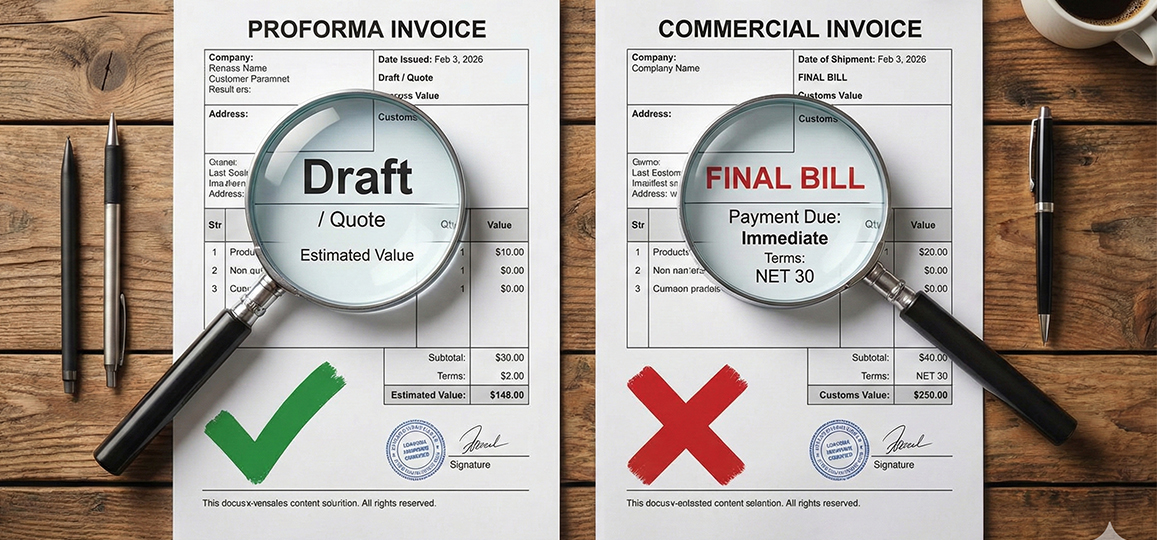
Have you ever experienced a logistics nightmare where goods were held up at customs or payments were rejected by a client simply due to documentation issues? These situations often occur due to fatal errors in distinguishing between a Proforma and a Commercial Invoice—two documents that look similar at a glance but possess contradictory legal powers. Many professionals still consider them interchangeable, even though if we use an analogy, a Proforma Invoice is merely an "engagement proposal" showing initial intent, whereas a Commercial Invoice is the "marriage certificate" that is legally and financially valid.
In 2026, global financial audit and customs systems are increasingly strict in detecting data discrepancies. Consequently, small errors in the use of these documents are no longer just administrative issues, but serious cash flow risks. This article will dissect the fundamental differences between these two invoices so you can avoid costly shipping delays and ensure your business payment processes run smoothly without obstacles.
1. Definition & Legal Power: Initial Commitment vs Legal Demand
Many fall into the trap of thinking that a Proforma Invoice is just an "unfinished Commercial Invoice." This is a misconception. The main difference lies in their legal weight and the purpose of their creation.
A Proforma Invoice is essentially an indicative document. It functions as an estimate or official offer stating: "If you buy X, then the price is Y." No debts or receivables are legally recorded in the accounting books when this document is issued.
Conversely, a Commercial Invoice is a final, binding document. When you issue this, you are stating to the client and the law: "The goods have been sent/are ready, now you have a legal obligation to pay X amount." This is the document recognized by tax offices and customs as proof of a real transaction.
To make scanning easier, observe the comparison table below:
| Feature | Proforma Invoice | Commercial Invoice |
| Nature of Document | Temporary (Draft/Estimate) | Permanent (Final/Legal) |
| Accounting Record | Not recorded as Accounts Receivable (AR) | Mandatory to record as Accounts Receivable (AR) |
| Primary Function | Negotiation & Order Confirmation | Billing & Customs |
| Data Changes | Can still be negotiated/changed | Forbidden to change (Except via official revision) |
Key Point: Never use a Proforma Invoice to collect final payment (settlement), except for down payments.
2. Timing is Money: When to Play the Right Card?
Timing errors in sending documents are often the main cause of bottlenecks in the supply chain. Sending a Commercial Invoice too early can mess up bookkeeping if there are order changes, while sending a Proforma when goods are already at the port will give your customs broker a headache.
The key lies in chronological order. Imagine this like the order of dining at a restaurant: The Proforma is the Menu you agreed to, while the Commercial Invoice is the Bill/Receipt after you have finished eating.
Here is the correct timeline guide for each document:
When to Use a Proforma Invoice?
-
Negotiation Phase: When the buyer wants to know the total cost (including estimated shipping and taxes) before the deal.
-
Arranging Import Permits: Buyers often need this document to apply for a Letter of Credit (L/C) at the bank or import permits from the local government.
-
Down Payment (DP) Request: As a legal basis for the buyer to transfer a deposit before production begins.
When to Use a Commercial Invoice?
-
Goods Ready to Ship: When production is finished and packing details (packing list) are final.
-
Customs Clearance: Mandatory inclusion when goods cross borders for the calculation of import duties and taxes.
-
Billing Settlement: Sent to the buyer's Finance team to disburse the remaining payment.
3. Document Content Details: What Changes?
Many administrative staff are lazy about retyping and simply change the title "Proforma" to "Commercial." Be careful; this blind copy-paste practice is dangerous.
Although the formats look identical, there are several crucial columns that must contain different information. If the Proforma is the "plan map," then the Commercial Invoice is the actual "travel log."
Here are specific details you must pay attention to:
-
Reference Number:
-
Proforma: Uses a quotation number (e.g., PF-2026-001).
-
Commercial: Uses an official invoice billing number (e.g., INV-2026-999). Do not let these numbers be the same, or your accounting system will reject the double input.
-
-
Validity Period:
-
Proforma: Must include an expiration date (e.g., "Valid until: 28 Feb 2026"). This protects you from raw material price fluctuations or currency exchange rates.
-
Commercial: There is no offer expiration date; instead, there is a Payment Due Date.
-
-
"Actual" vs "Estimated" Details:
-
In a Proforma, the Gross Weight or package dimensions might still be estimates.
-
In a Commercial Invoice, these figures must be 100% accurate according to the physical goods loaded into the container. A difference of just 1 kg can trigger a fine ("Red Line") at customs.
-
4. Accounting Traps: Beware of "Ghost Revenue"
This is the difference that most often causes headaches for finance managers. Treating a Proforma Invoice as an official bill in bookkeeping is a cardinal sin of accounting.
Why? Because a Proforma Invoice does not trigger tax obligations or the recording of Accounts Receivable.
If your finance staff accidentally inputs a Proforma Invoice as a sale, you create what I call "Ghost Revenue."
-
On paper, the company looks profitable and has receivables.
-
In reality, the goods may not necessarily be purchased, money hasn't come in, but you are already indebted for VAT (Value Added Tax) to the state for a transaction that hasn't happened yet.
Guiding Principles for the Finance Team:
-
Received a Proforma? Do not journal it as debt/receivable. Just keep it as a reference for creating a Purchase Order (PO) or DP payment approval.
-
Received a Commercial Invoice? Immediately record it as Accounts Payable and prepare fund allocation. This is the valid document used for claiming input tax restitution.
5. Customs Currency: Who Determines the Tax?
This is where many novice entrepreneurs stumble. Customs Officers work with black-and-white rules, not assumptions.
-
Proforma Invoice: Generally REJECTED by customs as a basis for calculating Import Duties and Import Taxes. Why? Because values in a Proforma can still change. Customs does not want to calculate taxes from uncertain figures.
-
Commercial Invoice: This is a mandatory document. The figures listed here are the final figures that will be multiplied by the import duty percentage rates.
Rough Analogy: Trying to handle customs clearance using only a Proforma Invoice is like trying to board a plane with only a booking confirmation email, not a Boarding Pass. You will definitely be stopped at the gate.
6. Bank Treatment & Payment Methods (L/C vs T/T)
The role of these two documents changes drastically depending on how you pay. In 2026, where cross-border transactions are increasingly strictly monitored to prevent money laundering, banks have become very fastidious.
-
For Letter of Credit (L/C):
-
Proforma is used at the start to open the L/C application at the importer's bank.
-
Commercial Invoice is the document that must be submitted to the exporter's bank to cash out funds. Remember, if there is a single letter difference between the Commercial Invoice and the L/C terms (discrepancy), payment can be rejected!
-
-
For Telegraphic Transfer (T/T) / Wire:
-
Proforma is often sufficient to make an Advance Payment (DP) transfer.
-
However, for the balance payment, the majority of central banks in destination countries require the attachment of a Commercial Invoice as proof of the underlying transaction so that foreign exchange can be released.
-
7. Flexibility & Revision Levels
How easy is it to change the document content if a mistake occurs? This is a mentality difference that your admin team must have.
-
Proforma Invoice (Fluid/Flexible):
-
You can revise it multiple times. Client asks for an additional discount? Revise Proforma v1 to v2. Change item specs? Create v3. This is a discussion document. There are no heavy legal consequences as long as no money has been transferred.
-
-
Commercial Invoice (Solid/Rigid):
-
Once issued and sent, this document is forbidden to be changed arbitrarily. If there is an error (e.g., wrong price), you cannot simply cross it out. You must issue an official accompanying document like a Debit Note (for underpayment) or Credit Note (for overpayment/returns). Secretly changing a Commercial Invoice after tax reporting is an illegal act (tax evasion).
-
Don't Let a Piece of Paper Block Your Cash Flow
Understanding the fundamental differences between Proforma and Commercial Invoices is a crucial strategy for maintaining smooth business cash flow, especially in this era of digital integration in 2026. Even the smallest administrative error now has a very thin tolerance because customs and banking systems run automatically. Remember the main principle: Proforma is the initial plan for negotiation, while Commercial Invoice is the final reality for billing; interchanging the two can be fatal to the payment process.
Want an administration and finance system that is perfectly integrated with zero loopholes for error? Consult your ERP implementation and business automation needs with Soltius right now.
Other News