Blog

Comparative Study: SAP Analytics Cloud vs. Traditional BI Tools
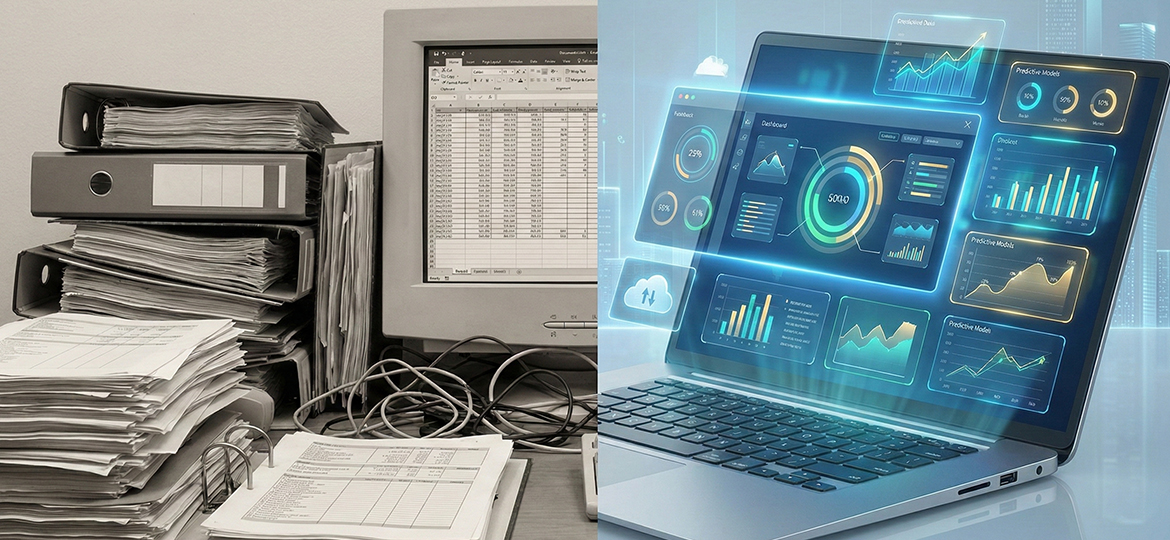
Traditional Business Intelligence (BI) tools, such as legacy systems or heavy Excel-based reports, have indeed been the corporate backbone for decades. These systems are stable, and we are very accustomed to using them. However, in the context of rapid decision-making, sticking with these old methods is like driving a car on a highway while only looking at the rearview mirror. You know exactly the history of the journey behind you, but you are blind to the sharp turns ahead.
This is where SAP Analytics Cloud enters, offering a different perspective. It is not merely a software upgrade, but a fundamental shift from a culture of "reporting the past" to "predicting the future."
What is Traditional BI vs. Modern Analytics?
Before diving into the technicalities, let’s straighten out the perception. Traditional BI is not actually "bad"; its function is simply very different from the needs of modern, fast-paced business.
Simply put, Traditional BI (like SAP BusinessObjects or massive spreadsheet-based reports) focuses on reporting. It is reactive and looks backward. This system answers the question: "What happened last month?"
Conversely, Modern Analytics like SAP Analytics Cloud is data-driven and predictive. It does not just present data, but also answers: "Why did it happen, and what will happen next?"
4 Fundamental Differences: SAC vs. Legacy BI
Many professionals think switching to SAP Analytics Cloud (SAC) is just a matter of moving data from an office server to the cloud. In reality, the difference is much more radical than that. It is like comparing an electric typewriter to a laptop; both can type, but their capabilities are worlds apart.
Here are four areas where SAC draws a firm line with its predecessors:
1. Architecture: SaaS vs. On-Premise
Traditional BI is usually infrastructure-heavy. Your IT team must buy servers, install them, and routinely perform manual patching. It takes weeks or even months just for the initial setup.
SAC is pure Software as a Service (SaaS). There is no hardware installation. You only need a browser.
-
Advantage: Agility. Business teams can work immediately without waiting for long IT ticket queues.
-
Impact: Operational expenses (OpEx) are more predictable compared to large capital expenditures (CapEx) for physical servers.
2. Augmented Analytics: Letting AI Do the Work
In Traditional BI, you need to know exactly what you are looking for. You have to filter, pivot, and dig through data manually to find anomalies.
SAC changes this game with the Smart Discovery feature. Using Machine Learning, SAC automatically:
-
Detects hidden patterns that might be missed by the human eye.
-
Explains the key influencers behind a number.
-
Example: Instead of you searching for "Why did sales drop?", SAC will proactively tell you: "Sales dropped 15% primarily caused by shipping delays in the West Java region."
3. The Killer Feature: Integrated Planning
This is the point that often makes CFOs fall in love. In the old world, BI (historical data analysis) and Planning (budgeting) were two separate worlds.
-
You analyze past sales in the BI system.
-
Then you open a separate Excel file to create next year's budget.
-
The result? Messy file versions (Budget_Final_V3_Revision.xlsx) and unsynchronized data.
SAP Analytics Cloud is the only solution on the market that unifies BI, Planning, and Predictive in a single engine. You can view last year's performance, make predictions for next year, and directly input new budget figures on the same screen.
4. Data Connectivity: Goodbye "Silos"
A classic problem with Traditional BI is that data must be extracted or copied from the source to a data warehouse (ETL). Consequently, the data you see is often data from yesterday, not data from this very second.
SAC offers a Live Connection feature (especially to SAP systems like S/4HANA or BW). Data does not need to be moved or duplicated. Your SAC dashboard becomes a direct "window" to operational data. As soon as a transaction enters the ERP system, the charts on your SAC dashboard move at that very moment.
Comparison Table: Traditional BI and SAP Cloud
To make it easier to compare technical capabilities, see the summary table below. Note how SAC attempts to fill the void that has long existed in old tools.
| Key Feature | Traditional BI (Ex: SAP BOBJ, Excel) | SAP Analytics Cloud (SAC) |
| Primary Focus | Historical Reporting | Analytics & Prediction (Modern BI) |
| Data Access | Often Extraction/Duplication (ETL) | Live Connection (Real-time) |
| Planning (Budgeting) | Separate (usually via manual Excel) | Integrated (BI + Planning + Predictive) |
| Artificial Intelligence | Limited / Non-Existent | Augmented Analytics (Smart Discovery) |
| Infrastructure | On-Premise (Requires Physical Servers) | Cloud SaaS (Vendor Managed) |
| Maintenance | Heavy (Manual patching by IT) | Automatic (Periodic updates via Cloud) |
| Mobile Access | Limited / Less responsive | Native Mobile App (Responsive) |
When Should You Stick with Traditional BI?
As an objective discussion partner, I will not lie by saying that Cloud is the solution for everything. There are specific moments where Traditional BI or "Legacy Systems" actually work better than SAC.
Do not rush to shut down your old servers if your main needs are:
-
"Pixel-Perfect" Reports for Regulation
If you need formative reports that are rigid, precise down to the millimeter for government audit purposes or legal reports (like those usually done by Crystal Reports), Traditional BI is still king. SAC is excellent for dynamic dashboard visualization but is not yet as precise as old tools for formal document print layouts.
-
Mass Static Report Distribution
If your routine is to send static PDFs to 5,000 employees every Monday morning via email (bursting), the existing on-premise infrastructure usually handles this "rough" workload more efficiently and cheaply.
-
Connectivity to Non-Standard Legacy Databases
Sometimes, companies still use niche databases from the 90s. Old on-premise tools usually have custom drivers that have been matured over decades to talk to these ancient systems, something that might be difficult for modern cloud solutions to do.
Conclusion & Recommendation
The choice between SAP Analytics Cloud and Traditional BI is not just about choosing software, but choosing how your company thinks.
If your organization feels it is enough to simply monitor what has already happened, Traditional BI can still be relied upon. However, if you want to shape the future, react to market changes in real-time, and cut planning time from weekly to daily, migrating to SAP Analytics Cloud is no longer an option, but a necessity.
Our Recommendation:
Do not do a "Big Bang" (replacing everything at once). Start with a Hybrid approach. Use SAC for management levels and strategic analysis, while letting the old system handle static operational reports until you are ready to switch completely.
Ready to turn data into decisions?
Discuss your data architecture with our team to see how SAP Analytics Cloud can be implemented without disrupting your current operations.
Other News