Blog

Comparison of Migration to Cloud RISE vs SAP On-Premise
The deadline for the end of SAP ECC support in 2027 is already breathing down our necks, yet many companies are still frozen in hesitation. In fact, Gartner research confirms that 61% of SAP ECC customers worldwide have not yet migrated to S/4HANA, largely because they are trapped in system complexity and the fear of cost overruns.
Deciding the future of your IT infrastructure is like choosing between renting a fully serviced luxury penthouse apartment or building your own house from the ground up. Both have their respective advantages, but a miscalculation at this stage can lead to massive budget waste and hindered operations.
This article is here to provide a sharp and tactical decision-making framework, not just sales brochure theory. We will dismantle the Total Cost of Ownership (TCO) calculations, data privacy controls, and match them with the real regulatory context in Indonesia. You will get a head-to-head comparison table, evaluation checklists, and a roadmap that will save your company from the risk of "making the wrong turn" in investing.
What is RISE with SAP? (More than Just "Moving to the Cloud")
Dissecting the Brief Definition of RISE with SAP
Many think RISE is just SAP's strategy to move its customers from local servers to the internet. However, its essence goes much deeper than just hosting an ERP system.
Let's use a simple analogy: RISE with SAP is like renting a fully serviced luxury apartment. You arrive bringing only a suitcase of clothes (your business data). Building security, electricity bills, fixing a broken AC, and environment cleanliness are all the responsibility of the apartment management.
In technical terms, RISE is a subscription model in the form of Business Transformation-as-a-Service (BTaaS). You simply sign a single contract (Single SLA) with SAP, and you instantly get a comprehensive bundled package comprising:
-
S/4HANA Cloud License: The operational heart of your business.
-
World-Class Infrastructure: Freedom to choose a hosting home from giant hyperscalers (AWS, Google Cloud, or Microsoft Azure).
-
Technical Management (Managed Services): An SAP team that will handle system upgrades, security patching, and database maintenance.
-
Access to Innovation: Instantly connected to the latest AI and analytics technologies through the SAP Business Technology Platform (BTP).
What is SAP On-Premise? Why is it Still Relevant in 2025?
Brief Definition of SAP On-Premise (The Guardian of Tradition)
If RISE is a serviced apartment, then SAP On-Premise is a private house that you design and build yourself from scratch. You hold the permanent ownership certificate, but you are also the one who must pay the security guards, call a handyman when the roof leaks, and pay the property taxes.
In the On-Premise model, a company purchases a perpetual software license. This system is then installed and run on the company's own server infrastructure, or in a local data center facility (Colocation) managed independently by your internal IT team.
In this cloud-centric era, this "old-fashioned" option is still retained by many large companies due to three main reasons:
-
Absolute Control (Data Sovereignty): The physical servers are under your own supervision. No confidential data crosses submarine cables to other countries.
-
Limitless Customization: Like your own house, you are free to knock down walls or add rooms. You can modify the ERP system as deeply as you want without being hindered by standard vendor rules.
-
Lifecycle Independence: You hold full control over when the system must be upgraded or experience downtime, without having to follow forced schedules from external parties.
Head-to-Head Comparison: RISE with SAP vs SAP On-Premise
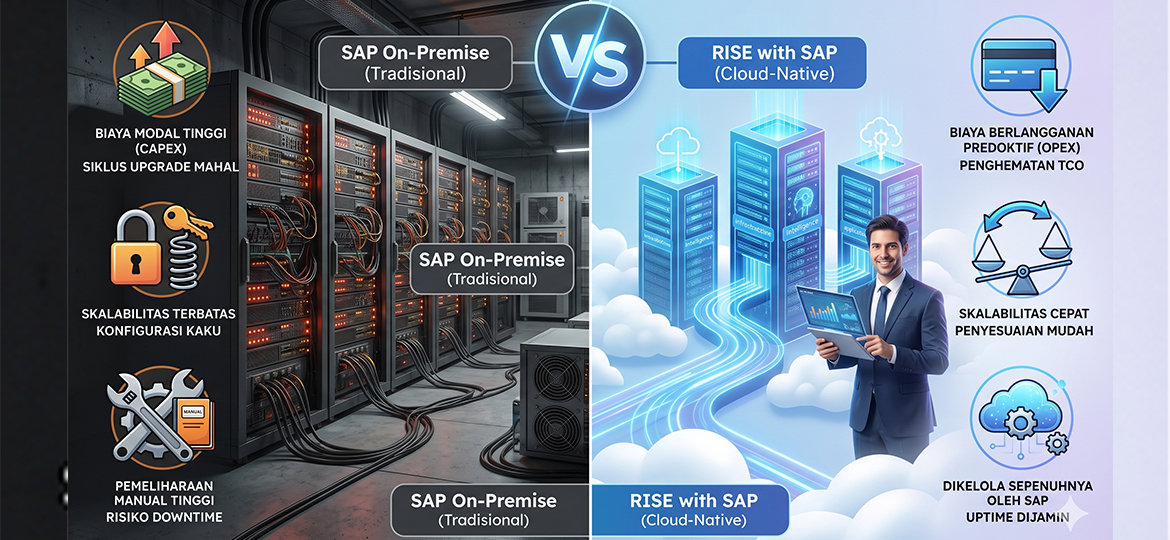
Comparing RISE and On-Premise isn't just about cheap vs. expensive, but about matching technological DNA with your business operational style. Here are 8 critical dimensions you must weigh:
| Critical Dimension | RISE with SAP (Cloud-Based) | SAP On-Premise (Local Server) |
| Cost (TCO) | OpEx (Operational Expenditure): Pay a routine subscription. Initial capital is relatively light. | CapEx (Capital Expenditure): Massive upfront investment to buy servers, licenses, and space. |
| System Control | Managed by SAP & Hyperscalers. You are hands-off from "under the hood" engine matters. | 100% in your hands. You are the absolute king in your own data center. |
| Data Security | Global cybersecurity standards. SAP is responsible for fending off hackers. | Highly dependent on the sophistication of firewalls and the resilience of your internal IT team. |
| Customization | Limited (Clean Core): Directed to use industry standards, minimizing code modification. | Limitless: Free to overhaul down to the system roots (Z-programs) according to company ego. |
| Implementation | Faster. Cloud infrastructure is ready-to-use when the contract is signed. | Slow. Hindered by hardware procurement and physical installation processes taking months. |
| AI Capabilities | Directly connected to the SAP AI ecosystem (like Joule) and the latest innovations. | Isolated. Extremely expensive and complex if you want to marry local systems with modern AI. |
| Scalability | Elastic like a rubber band: Add or reduce server capacity in just hours. | Rigid: Full capacity? You must process purchase permits and install new physical servers. |
| Compliance | Compliant with global standards, but requires extra carefulness regarding local data placement rules. | Highly ideal for SOEs/Government bodies mandated to keep confidential data domestically. |
Using RISE for AI capabilities is like having a personal assistant whose brain is automatically upgraded from the headquarters every night. By morning, they are already smart on new technology. Conversely, in an On-Premise system, you have genius staff, but you have the hassle of finding teachers and sending them to school yourself every time there is a new technology trend.
5-Year TCO Analysis: Which is More Cost-Effective for Indonesian Companies?
Speaking of IT budgets, the nominal figure stated in a vendor contract draft is often just the tip of the iceberg. The true numbers only become clear when we draw a timeline up to five years ahead.
RISE Cost Model (Subscription/OpEx Approach)
RISE with SAP uses an operational expenditure (OpEx) model. Like subscribing to a premium streaming service, your cash flow will be much easier to predict. With a single bill, you have paid off the S/4HANA Cloud license, infrastructure rent from hyperscalers, and expert fees for daily maintenance.
On-Premise Cost Model (Capital Expenditure/CapEx Approach)
The On-Premise route demands a massive capital expenditure (CapEx) commitment on day one. Your expense burden is spread across physical procurement (purchasing servers, storage, generators), upfront perpetual licenses, data center electricity bills, and the salary costs of an internal IT team on standby 24/7.
The Often-Forgotten "Hidden Costs" Trap
Comparing the license price of RISE with On-Premise rawly is a fatal mistake. There are hidden costs that you must include in your TCO proposal:
-
Dual-Run Costs: While the migration is underway, you pay for the operations of two systems (the old ECC and the new S/4HANA) simultaneously for months.
-
Surge in Consultant Rates: As the 2027 deadline gets closer, SAP talent becomes scarcer. Consultant rates (man-days) are projected to skyrocket due to panic buying.
-
Code Cleansing Costs: If your ECC system is filled with modifications (Z-code), cleaning it requires considerable developer labor costs.
Critical Factors for Indonesian Companies: Aligning Ambition and Reality
Adopting global technology must be able to "coexist" with the infrastructure and legal conditions in Indonesia. There are three local factors that often trip up migration projects:
1. Data Residency Regulations & the Shadow of PDN (National Data Center)
For SOEs (BUMN) and the banking sector, customer data cannot carelessly cross national borders. This is like storing family heirloom jewelry; you certainly want the safe embedded inside your own house.
-
On-Premise: Provides absolute peace of mind. Physical data is 100% in Indonesia, safe from reprimands under the Personal Data Protection Law (UU PDP).
-
RISE: Ensure the contract explicitly states that data is hosted in the Jakarta region (e.g., Google Cloud Jakarta) to comply with localization rules.
2. The Bitter Reality: Internet Connectivity Challenges
RISE with SAP is a digital entity that "lives" and breathes from the oxygen called an internet connection. If your operations are in remote areas like mining sites or plantations, losing signal means the factory stops operating. For this scenario, On-Premise remains a safe "anchor" so business isn't paralyzed when internet providers have issues.
3. The ERP "Pilot" Crisis: The SAP Consultant Talent Gap
Buying the most sophisticated system without the experts to control it is like buying a fighter jet but having no pilot. It is estimated that there is a shortage gap of around 2,000 to 3,000 S/4HANA-certified SAP consultants in Indonesia approaching 2027.
RISE with SAP alleviates this burden because SAP takes over basic technical tasks, freeing you from the war of fighting over scarce infrastructure technicians.
Decision Framework: When to Choose RISE? When to Stay On-Premise?
Choosing between the two isn't about which is "more sophisticated," but which fits your company's shoe size best.
10-Question Determinant Checklist
Discuss these 10 questions in your board of directors meeting:
-
Do we have a large upfront budget (CapEx) or prefer monthly costs (OpEx)?
-
Is our internal IT team strong enough to manage servers 24/7?
-
How unique are our business processes? (Heavy modification vs. Industry Standards).
-
Do industry regulations mandate physical data to be in our own building?
-
Do our operational locations have highly stable internet?
-
Do we plan to use AI and Machine Learning within the next 2 years?
-
How fast do we need to expand system capacity?
-
Do we already have data center infrastructure that is still viable?
-
How big is the risk of loss if the system goes down for 1 hour?
-
Are we ready to follow the rhythm of technology updates from headquarters (SAP) periodically?
Company Profile Recommendation Table
| Company Profile | Recommendation | Main Reason |
| Startup / Growing Company | RISE with SAP | Needs speed, saves upfront capital, and high scalability. |
| SOEs (BUMN) / Government Agencies | On-Premise | Compliance with data residency regulations and information sovereignty. |
| Manufacturing (Remote Area) | On-Premise | Operational stability without internet dependency. |
| Multinational Corporations | RISE with SAP | Global process standardization and quick access to AI innovation. |
Conclusion
Choosing between Migration to Cloud RISE vs SAP On-Premise is not an overnight decision. RISE offers speed and future innovation, while On-Premise provides unparalleled traditional control and security.
The first step you can take today:
Conduct an inventory audit of your current SAP ECC system. How many custom modifications (Z-programs) do you have? The more modifications, the greater your consideration should be to stay On-Premise or conduct a massive cleanup before moving to RISE.
Other News