Blog
E-Invoicing: Survival Strategy Amidst the Storm of Coretax 2026 Digitalization
Imagine a morning in your office. Instead of being greeted by the soothing aroma of coffee, your eyes are drawn to a mountain of folders in the corner of the room. Tucked inside are hundreds of physical invoices waiting to be validated, stamped, and sent via courier. Have you ever calculated how much of your team's productive time is wasted just to ensure a single digit on a tax invoice doesn't miss the mark? Or worse, has your heart ever raced because a crucial billing document was misplaced somewhere when the due date was only hours away?
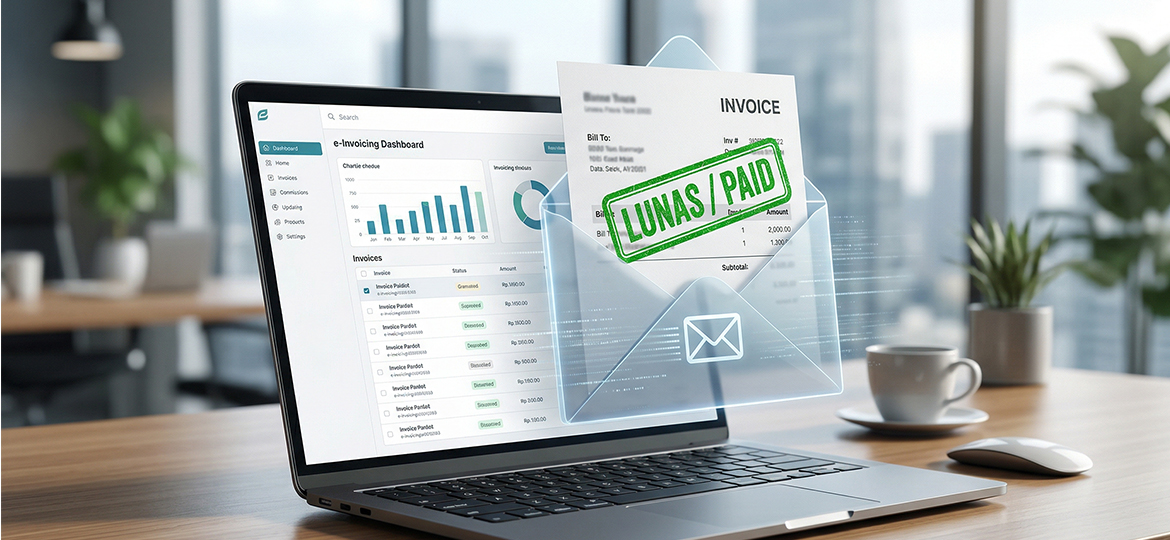
In this lightning-fast era, maintaining manual processes in financial management is no longer merely an issue of being "outdated". It is a real business risk. Digital transformation is no longer a choice for those who want to look modern, but a lifeline to keep the business from drowning in exhausting bureaucracy. Welcome to the era of e-invoicing or electronic invoices—a revolution that not only turns paper into PDFs, but transforms the way businesses interact financially.
Understanding the True Essence of E-Invoicing
Misconceptions often occur in the field. Many business owners feel they are already doing e-invoicing just because they send photos of invoices via text message or scan documents as email attachments. Technically, that cannot yet be called a valid electronic invoice. Genuine e-invoicing is the exchange of structured data between buyers and sellers in standard formats such as XML or EDI (Electronic Data Interchange).
Its purpose is highly specific: so that accounting systems on both sides can "communicate" with each other without human intervention. Without the need for manual input, the risk of typographical errors (human error) vanishes. In Indonesia, the challenge is slightly more unique because we must balance two interests: commercial invoices for the smooth flow of internal cash, and e-Faktur for tax compliance through the Coretax system owned by the Directorate General of Taxes (DJP).
Why Make the Digital Migration Now?
Adapting to new technology indeed requires energy and the willingness to relearn. However, sticking to the old system is like trying to win a Formula 1 race driving a horse-drawn carriage. There are three fundamental reasons why this transition cannot be delayed:
-
Drastic Cost Efficiency. Try grabbing your calculator. Calculate the costs of paper, ink, envelopes, couriers, up to warehouse rental fees to store archives for the next ten years. Various global research shows that invoice digitalization can reduce administrative costs by up to 80%. The funds usually wasted on these trivial matters can be allocated for business expansion or more strategic market research.
-
Healthier Cash Flow. A classic hurdle in business is the excuse "invoice not yet received" or "currently being processed by finance". With e-invoicing, bills land on the buyer's dashboard in seconds. Automatic validation ensures there are no excuses for payment delays due to typographical errors or an incorrect NPWP (Taxpayer Identification Number). The result? Faster payment approvals and the company's lifeblood (cash flow) is maintained.
-
Security and Legal Compliance. Humans can be tired and negligent, but an integrated system will remain consistent. E-invoicing is equipped with high-level encryption and certified electronic signatures. This minimizes the risk of document manipulation by irresponsible parties. Furthermore, automatic synchronization will protect you from painful tax penalties resulting from administrative errors.
Read Also: The Complete Cloud ERP Migration Checklist: A Guide to Transitioning from On-Premise to SaaS
Facing Coretax 2025: The New Rules of the Game
The Indonesian government, through PMK (Minister of Finance Regulation) Number 81 of 2024, has confirmed that the taxation system will migrate to the Coretax System in 2025. This is the "brain" of modern taxation that demands total transparency. The crucial points include real-time integration via API, the use of a 16-digit NIK (National Identity Number) as a single identity, and the validation of transactions occurring instantaneously. There is no longer any room for fictitious invoices or backdating. Your business must have an internal system capable of "shaking hands" with the DJP servers seamlessly.
Strategies for Choosing a Technology Partner
Choosing e-invoicing software is almost akin to choosing a business partner; a wrong choice can have long-lasting impacts on your reputation and finances. Ensure your vendor has ISO 27001 certification for data security. In addition, choose a system that is flexible enough to be integrated with existing ERPs, such as SAP or Oracle. Local team support is also highly crucial considering tax regulations in Indonesia are highly dynamic and frequently change on short notice.
Conclusion: A Logical Investment for the Future
E-invoicing is no longer merely a technology trend that can be ignored. It is the foundation for every company wanting to remain competitive. With tangible efficiency, solid data security, and absolute compliance with the Coretax 2025 rules, switching to a digital system is the most logical step you can take today. Do not let your business operations be choked by paper bureaucracy. Start transitioning now, and let technology work hard for the growth of your enterprise.
Is Your Business Ready to Face Coretax 2025 Without Administrative Drama?
Sales CTA (Soltius): Do not let manual systems become a bottleneck to your business growth amidst strict new tax regulations. As the number one official SAP partner in Indonesia, Soltius is here to provide seamless, secure, and fully Coretax 2025-compliant e-invoicing integration solutions. We help you transform complexity into efficiency within just a single integrated dashboard.
Secure the operational future of your company now. Get a Free Consultation with Soltius Experts Here.
Other News