Blog

End-to-End Visibility: Integrating SAP EWM, SAP TM, and SAP YL for a Seamless Supply Chain
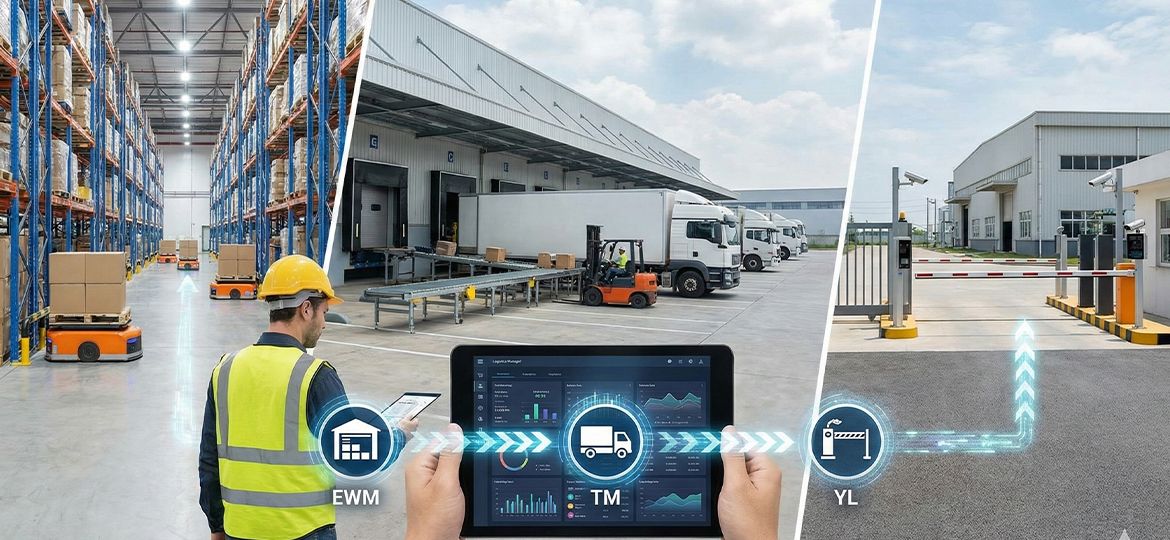
In the last decade, I have witnessed a fundamental shift in the logistics industry: speed is no longer the sole king; visibility is the queen in control. We all agree that managing a supply chain with siloed systems where the transportation team is unaware of warehouse activities and the warehouse team is blind to gate queues is a recipe for high costs and disappointed customers.
If your company is still struggling to synchronize shipping planning with physical execution, the integration of the SAP S/4HANA ecosystem is the solution. I will guide you through a deep dive into integrating the three main pillars: SAP EWM (Extended Warehouse Management), SAP TM (Transportation Management), and SAP YL (Yard Logistics). We will explore the latest technical architecture, specifically Advanced Shipping and Receiving (ASR), and configuration strategies to achieve unprecedented operational efficiency.
The Trinity of Logistics Execution: Understanding Roles and Symbiosis
Before diving into the technicalities of integration, it is crucial to align our understanding of the specific roles these three modules play within the SAP Supply Chain Execution (SCE) landscape. Project failures often stem from misunderstandings regarding the functional boundaries of each system.
-
SAP Transportation Management (TM): SAP TM is the "brain" of external logistics operations. Its focus is the movement of goods between geographical locations. The system handles route planning, carrier selection, charge calculation, and tender management. In an integrated context, TM acts as the trigger that informs the warehouse and the yard about what is coming and when to be ready.
-
SAP Extended Warehouse Management (EWM): SAP EWM manages everything that happens inside the warehouse. Unlike the classic WM module, EWM offers granular control down to the bin level, slotting optimization, and complex wave management. Its primary task is ensuring the right goods are picked, packed, and staged in the shipping area on time.
-
SAP Yard Logistics (YL): Often referred to as "the missing link," SAP YL manages assets in the area between the facility gate and the dock door. Without YL, this area often becomes a "black hole" where trucks queue without clarity. YL synchronizes dock appointments with warehouse capacity and transportation schedules.
Architectural Evolution: Why Advanced Shipping and Receiving (ASR) Changes Everything
For solution architects, this is the most critical part. The way we integrate SAP TM and EWM has changed drastically since the release of SAP S/4HANA 2020.
-
The Old Era: Transportation Unit (TU) Based Integration Traditionally, integration was performed by replicating data. A Freight Order (FO) in TM would trigger the creation of a Transportation Unit (TU) object in EWM via LDAP messages or IDocs. While functional, this model had a major flaw: data redundancy. Any sudden changes to truck schedules in TM often led to synchronization issues with the TU in EWM, resulting in inconsistent data.
-
The New Era: Advanced Shipping and Receiving (ASR) SAP introduced ASR to eliminate this redundancy. In the ASR model:
-
Single Object of Truth: No more duplication. The Freight Order (FO) object in TM is used directly by EWM.
-
Elimination of TUs: EWM no longer requires TU or Vehicle objects. Warehouse operators load goods directly against the FO reference.
-
Multi-Warehouse Support: A single truck (one FO) can now load goods from several different warehouses at the same location without interface complexity.
-
When to use ASR? If you are performing a greenfield implementation on SAP S/4HANA (Embedded), ASR is the mandatory future standard. However, if you are still using decentralized EWM (Side-by-Side) on older versions, the TU-based model may still be required.
Integrated Process Flow: The "Life of a Truck" Scenario
Let’s visualize how the integration of SAP EWM, TM, and YL works in an outbound shipping scenario using the ASR model.
Phase 1: Planning (SAP TM) The process begins when a Sales Order is created. SAP TM automatically creates Freight Units and plans them into a Freight Order (FO). With ASR, instead of sending complex XML messages to the warehouse, TM simply flags the FO as "warehouse-relevant."
Phase 2: Scheduling and Preparation (SAP YL & EWM)
-
The FO information flows to SAP Yard Logistics to create a Yard Request.
-
In the Yard: Vendors or operators book time slots through the Dock Appointment Scheduling feature in YL.
-
In the Warehouse: EWM sees the FO and begins planning picking waves. Because it is integrated, if a truck is delayed (updated in TM), EWM can delay the wave release to prioritize trucks already on-site.
Phase 3: Physical Execution (Real-Time Integration)
-
Check-In: The truck arrives at the gate. Security performs Check-In in SAP YL. The status in TM automatically updates to "Arrived."
-
Docking: YL directs the truck to a specific dock door.
-
Loading: The warehouse operator scans goods using an RF Gun. The system verifies the goods directly against the TM Freight Order. There is no data lag.
-
Goods Issue: Once loading is complete, the Goods Issue is posted. Inventory decreases in EWM, and the "Loaded" status is updated in TM instantly.
Technical Guidance & Key Configurations
For your IT team, the success of this integration depends on configuration details. Here are the crucial points to note:
-
EWM Integration Profile: In SAP TM, ensure you define the correct EWM Integration Profile. This governs when Transfer Orders are created and how data changes are handled.
-
Location Mapping: Ensure Business Partners and Location Master Data in TM are precisely mapped to Warehouse Numbers in EWM. The
WM_LOGSYSandWM_WH_NUMBERfields are vital links. -
YL-TM Integration: You need to map Freight Order Types from TM to Yard Request Types in YL. Without this, the system will not know how to translate a transportation order into yard activities.
Technical Tip: When configuring ASR, ensure you use Consignment Orders if you are handling Groupage or LTL (Less than Truckload) scenarios. This allows you to group multiple FOs into one master document for easier cost settlement.
Conclusion
Integrating SAP EWM, SAP TM, and SAP YL is the ultimate key to digital logistics evolution. This integration removes the boundaries between transportation, warehouse, and yard management providing you with both efficiency and business resilience amidst supply chain uncertainty. End-to-end visibility is now a foundation, no longer an option.
The first step toward this transformation begins with the right understanding. Is your infrastructure ready for Advanced Shipping and Receiving? Let SOLTIUS help you map out the answer. Contact us for an initial consultation session and let’s design your future logistics strategy.
Other News