Blog

Enterprise SAP SuccessFactors Implementation Guide: Strategies, Phases, and Keys to a Successful Go-Live
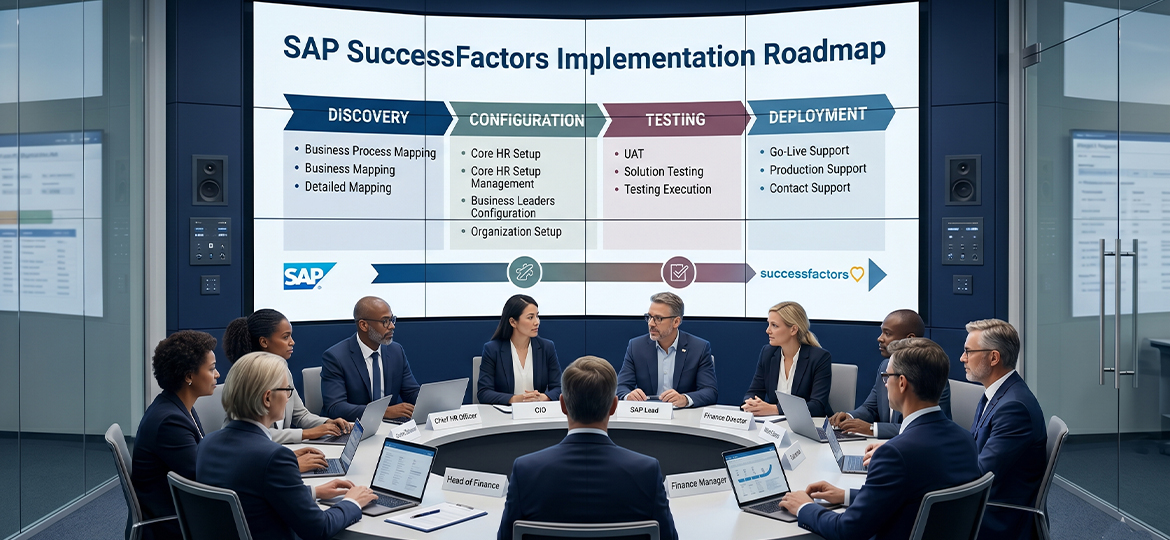
Managing HR operations at an enterprise scale is often hindered by fragmented legacy systems. When compensation, performance management, and recruitment data are trapped in their respective application silos, HR teams are forced to perform manual data reconciliation, which is time-consuming and prone to human error. This condition not only creates administrative bottlenecks but also deprives executive-level management of real-time data visibility crucial for strategic HR-related decision-making.
Overcoming these HR architectural inefficiencies requires a planned transition to a centralized cloud-based Human Capital Management (HCM) system. This guide will dissect the step-by-step implementation of SAP SuccessFactors in a structured manner, starting from the fit-gap analysis in the discovery phase, the execution of the SAP Activate methodology, the data migration process, to risk mitigation strategies so that your company's go-live phase runs stably and successfully without operational disruption.
1. What is SAP SuccessFactors and Why Do Enterprises Choose It?
SAP SuccessFactors is a leading cloud-based Human Capital Management (HCM) solution designed to manage the entire employee lifecycle. Ranging from basic recruitment processes, onboarding, and performance management, to succession planning and complex HR analytics.
For large-scale organizations, integrating this platform into an ERP ecosystem (such as SAP S/4HANA) ensures that operational HR data can respond in real-time to the financial pulse of the business, automating multi-layered approvals, and minimizing manual intervention.
2. Step-by-Step Guide to SAP SuccessFactors Implementation (Phase by Phase)
Enterprise-scale implementation projects demand a structured methodology to control scope creep. This is where the SAP Activate methodology takes on the role of a standard framework that guarantees implementations run quickly, predictably, and with minimal risk.
Here is a technical breakdown of the six crucial phases in the methodology:
Phase 1 — Discover: Business Case & Fit-Gap Analysis
This phase focuses on aligning business strategies with the system's technical capabilities. The solution architect team maps the current system condition (As-Is) to the future architecture (To-Be).
-
Objective: Evaluate module implementation priorities (e.g., Employee Central as the main backbone, followed by talent modules).
-
Output: Business Case document, ROI estimation, and a fit-gap analysis between standard SAP processes and specific needs.
Phase 2 — Prepare: Project Governance, Team, & Kick-off
Project governance is established here. Failed implementations often stem from fragile project management, not software failure.
-
Team Structure: Formation of a Steering Committee, Project Manager, Functional Consultants, and internal HR Subject Matter Experts (SMEs).
-
Project Infrastructure: Preparation of the initial SAP SuccessFactors tenant (Provisioning) for familiarization and sandbox purposes.
Phase 3 — Explore: Fit-to-Standard Workshop & Initial Configuration
Modern cloud systems like SAP SuccessFactors strongly emphasize a Fit-to-Standard approach, where companies are encouraged to adopt the system's built-in global best practices.
-
Workshop: Consultants demonstrate the standard system, and HR SMEs provide configuration feedback.
-
Architecture Decisions: Minimizing customizations (custom code) that can complicate future cloud release updates.
Phase 4 — Realize: Build, Configuration, UAT, & Data Migration
The construction phase where design documents are transformed into a functional configuration tenant. This phase demands maximum precision in data integration.
-
Iterative Configuration: Building and testing modules incrementally (sprints).
-
User Acceptance Testing (UAT): Comprehensive system testing scenarios by end-users to validate business workflows.
-
Data Migration: The process of extracting, cleansing, transforming, and loading (ETL) employee data from legacy systems to SuccessFactors.
Phase 5 — Deploy: Go-Live Preparation & Cutover
The system prepares to transition to the Production environment. Precise cutover planning is highly crucial at this stage.
-
Cutover Strategy: The sequential transfer of final configurations and active data to avoid downtime.
-
Change Management: Intensive user training and organizational transition communication.
-
Go-Live: The official activation of system access in the real production environment.
Phase 6 — Run: Hypercare, Stabilization & Continuous Improvement
Go-live is just the starting line for continuous improvement.
-
Hypercare Support: Intense support from the implementation team during the first few weeks to handle technical hurdles and user errors.
-
Stabilization: Ensuring data synchronization between systems (such as SAP to attendance machines or third-party payroll vendors) is stable.
-
Continuous Improvement: Scheduling evaluations of new features (release updates) automatically rolled out by SAP on a regular basis.
3. Latest SAP SuccessFactors Features: Leveraging AI & Joule
The HR ecosystem continues to evolve, and the integration of Artificial Intelligence (AI) is now the driver of automation and analytical insights within SAP SuccessFactors. In the 2025 and 2026 releases, SAP further deepens the functionality of its intelligent assistant.
Joule: Integrative HR AI Assistant in SAP
Joule is SAP's built-in generative AI assistant that works seamlessly to facilitate daily transactions.
-
Natural Language Queries: Employees can ask questions like, "What is my remaining annual leave balance?" or request an employee profile summary, and Joule will navigate the information without the need for complex menu clicks.
-
Expanded Use Cases: In the latest updates, Joule's capabilities are expanded directly to various corrective actions and workflows, from time management to performance feedback.
AI for Employee Intelligence
AI algorithms in SAP SuccessFactors read historical patterns to support more tactical HR analytics. AI can help map learning course recommendations, analyze worker profiles, and compose specific career development narratives for each talent.
AI's Impact on New Enterprise Implementations
AI integration in SuccessFactors requires the implementation team to allocate time to ensure data governance. AI can only recommend targeted insights if it is supplied with clean, structured, and valid employee data right from the Data Migration phase.
4. Choosing the Right Implementation Partner
Purchasing an SAP SuccessFactors license without a reliable implementation partner will increase the risk of budget overruns. The partner acts as a translator of SAP's technical architecture into your business's operational language.
Criteria for Choosing an SAP SuccessFactors Partner
Evaluate your vendors critically. Here is a crucial comparison:
| Evaluation Criteria | Standard Vendor | Certified Partner (Ideal) |
| Team Certification | General HRIS understanding | Specific module certification (SAP Certified Application Associate) |
| Methodology | Conventional / disjointed implementation | Adopts SAP Activate & Fit-to-Standard methodology |
| Experience | SME / small domestic scale | Implementation portfolio at the Multinational Enterprise level |
| Go-Live Support | Ends on launch day | Extended Hypercare services and application support (Managed Services) |
The Role of an SAP Certified Partner in Indonesia
For organizations in Indonesia, technical capabilities must be combined with an understanding of regulatory localization. Implementers must be proficient in aligning the Employee Central structure and derivative modules with the latest PPh 21 tax deduction policies, BPJS contribution calculations, as well as accurate local employment reporting (Omnibus Law / UU Cipta Kerja).
Checklist: 10 Questions to Evaluate an Implementation Partner
-
How many enterprise implementations have you completed using SAP Activate?
-
Does the Lead Consultant have active SAP certification in our target modules?
-
What is your strategy for mitigating risks when migrating high-volume data?
-
Can you provide an example of previous Fit-Gap Analysis documentation?
-
What is your specific approach to the localization of payroll and tax regulations in Indonesia?
-
To what extent do you enforce the Fit-to-Standard approach over building custom code?
-
What is your specific Change Management strategy to ensure high user adoption?
-
How do you handle SuccessFactors integration with our non-SAP ERP systems?
-
What is the standard duration of Hypercare you include post-go-live?
-
Is it possible for us to contact 2-3 of your enterprise-scale clients for a reference check?
CONCLUSION
The success of an enterprise-scale SAP SuccessFactors implementation rests on mature preparation, not just speed of execution. By strictly following the SAP Activate phases, adhering to a standard-based architecture, and appointing a certified partner, organizations can eliminate the risk of project failure. Supported by AI assistant functionalities like SAP Joule, your enterprise HR can now break free from piles of manual administration towards a proactive analytical role.
It is time to audit the quality of HR data in your company and schedule a Business Case discussion session with a certified consultant to take the first step in a distortion-free operational transformation.
Other News