Blog

ESG Reporting: How SAP Solutions Simplify the Process?
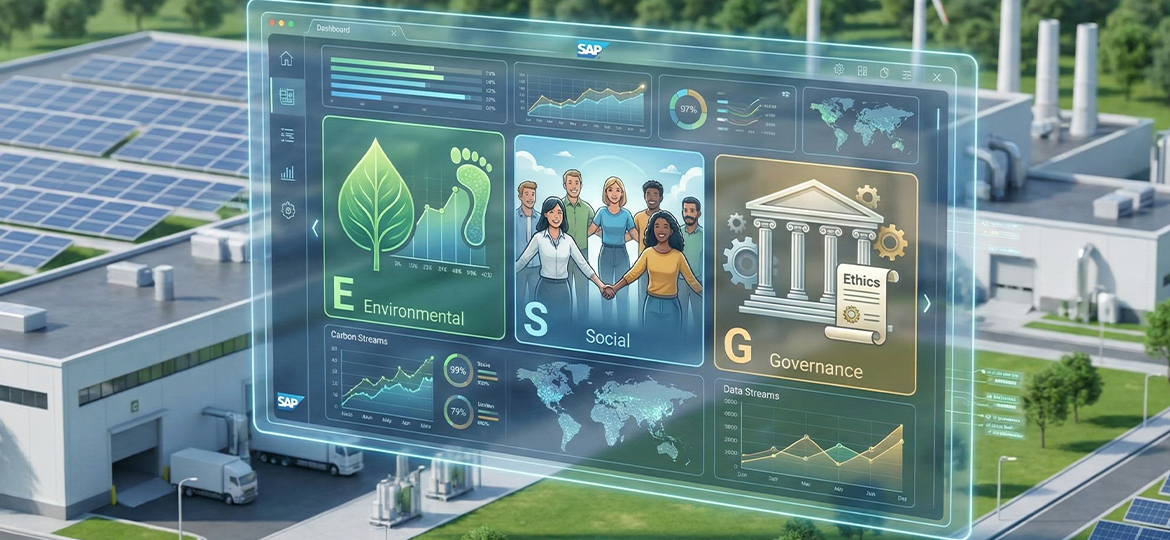
Is your company still collecting sustainability data manually using dozens of separate spreadsheets across divisions? If so, don't worry you're not alone. However, as your discussion partner today, I must remind you: you are in a rather risky position.
In the modern business landscape, Sustainability Reports are no longer just a "sweetener" for company image or a standard CSR program. For many companies especially listed issuers in Indonesia this has become a "License to Operate" or a ticket for the business to keep running. Unfortunately, the biggest challenge is not your good intention to report, but the quality and integrity of the data you present. SAP Sustainability Control Tower transforms the complexity of "data silos" into accurate, fast, and audit-ready reports.
Foundational Understanding: What is ESG?
Before we dive into SAP's technical solutions, let's get on the same page. What exactly is ESG?
Often this term is used interchangeably with "Sustainability," even though ESG has much more specific metrics, especially in the eyes of investors. ESG (Environmental, Social, and Governance) is a set of operational standards used by investors to screen potential investments. In short, it is a measurement tool for them to assess the future risks and viability of your company.
What is Typically Included in ESG Reporting?
ESG reporting demands transparency in both quantitative and qualitative data. Based on global standards like GRI (Global Reporting Initiative), here are the main components:
Environmental:
-
Greenhouse Gas (GHG) Emissions: Includes Scope 1 (direct), Scope 2 (purchased electricity), and Scope 3 (supply chain).
-
Waste and water management.
-
Energy efficiency and renewable energy use.
Social:
-
Occupational Health and Safety (HSE).
-
Diversity, Equity, and Inclusion (DEI) in the workforce.
-
Human rights and community relations.
Governance:
-
Business ethics and anti-corruption.
-
Executive pay transparency.
-
Board composition and independence.
ESG Reporting Challenges in Indonesia
In Indonesia, the pressure to present valid ESG data is strengthening due to government regulations.
Regulatory Obligations (POJK 51) The Financial Services Authority (OJK) has issued POJK No. 51/POJK.03/2017 concerning the Implementation of Sustainable Finance. This regulation requires Financial Service Institutions, Issuers, and Public Companies to prepare Sustainability Reports that are separate from or integrated with the Annual Report.
Failure to comply with this regulation results not only in administrative sanctions but also affects reputation in the eyes of global investors who now use ESG scores as a determining factor for funding.
The Solution: SAP Sustainability Control Tower (SCT)
The big question now: how do you turn those scattered piles of data into a neat, audit-ready report? This is where modern Enterprise Resource Planning (ERP) technology plays a crucial role.
Introduce SAP Sustainability Control Tower. This solution comes with a primary mission: to make the data transparency of ESG Reporting equivalent to the rigor of your company's financial data standards. No more rough estimates; everything is based on real data. SAP uses a systematic approach called Holistic Steering. SAP applies the same "smart" logic to your company's sustainability through these three steps:
1. Record (Automated Recording)
Instead of wasting time on manual input prone to human error, SAP solutions integrate data automatically directly from core ERP systems (such as SAP S/4HANA) and other non-SAP sources.
2. Report (Reporting According to Standards)
One of the most powerful features is the ability to align reports with various global framework standards. SAP has the capability to tailor your ESG Reporting to various complex global frameworks. SAP provides templates combined with GRI, TCFD, EU Taxonomy standards, and even local regulations.
3. Act (Strategic Follow-up)
Sustainability data should not stop as just a reporting document; it must become the basis for improvement. SAP dashboards provide easy-to-understand visualizations of sustainability performance.
Benefits of Using SAP for ESG
Why are companies turning to SAP for their sustainability reporting?
-
Accuracy and Auditability: Every figure in the report can be viewed and analyzed back to its source transaction (traceability). This increases the trust of investors and auditors.
-
Multinational Compliance: For Indonesian companies exporting products to Europe, this solution helps comply with strict standards like CBAM (Carbon Border Adjustment Mechanism).
-
Operational Efficiency: Reduces the workload of teams that previously spent all their time manually compiling data.
FAQ: Questions Regarding ESG Reporting and SAP
In consultation sessions with clients, critical questions often arise before they decide to switch to a digital system. Here is a summary of questions you might also be thinking about:
Q: Is ESG reporting mandatory for all companies in Indonesia? A: Currently, the primary obligation applies to Financial Service Institutions, Issuers, and Public Companies according to POJK No. 51/2017. However, private companies that are part of global supply chains are also increasingly encouraged to have ESG reports.
Q: Can I use the SAP ESG solution if my ERP is not SAP? A: Ideally, the best integration occurs if you use SAP S/4HANA. However, SAP Sustainability Control Tower is designed as an open system. We can install data connectors to pull information from third-party systems, although it does require some initial configuration to ensure the data flows smoothly.
Q: Why is Excel not enough for long-term ESG reporting? A: Excel lacks robust audit trail features, is prone to formula errors, and is difficult for departments to collaborate on in real-time. For large-scale companies, Excel is no longer compliant with modern audit demands.
Conclusion
With the ever-growing complexity of sustainability data, sticking to manual processes is a very risky strategy. You are gambling with data accuracy in front of investors and regulators. Solutions like SAP Sustainability Control Tower are indeed the key, but technology this sophisticated requires precise implementation. This is why I always suggest not walking alone. Partnering with an experienced partner like SOLTIUS can be the bridge connecting SAP's technical complexities with your business needs.
Other News