Blog

Network Performance Analysis and Capacity Planning Using SAP IBP
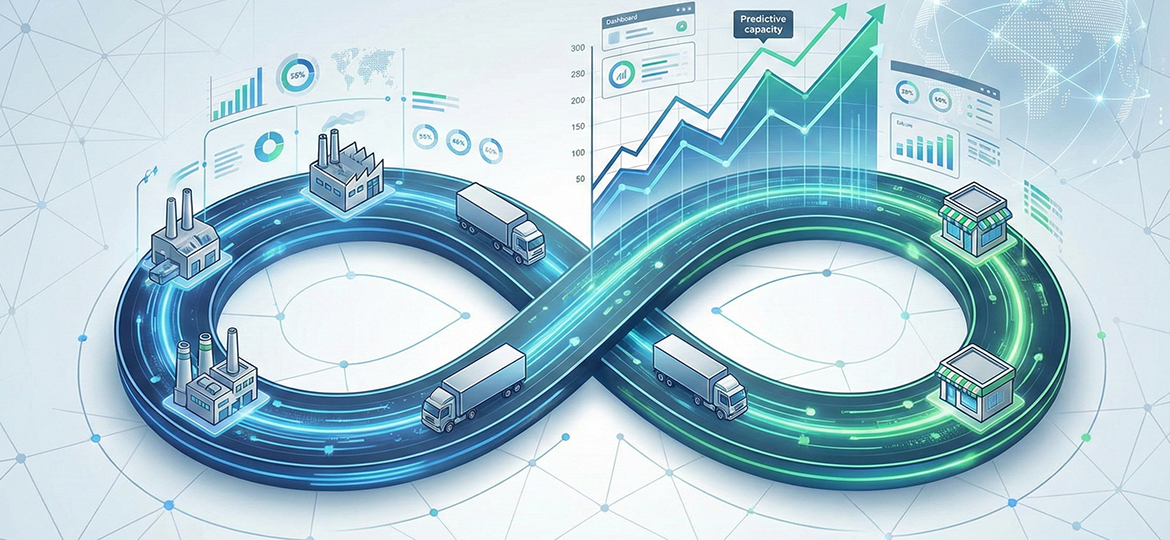
The complexity of modern supply chains has far exceeded the capabilities of static rows and columns. Today's logistics network is no longer a straight line, but an intricate spiderweb pulling in various directions. One small issue in a distribution warehouse can create a domino effect (Bullwhip Effect) that disrupts production schedules at the main factory.
This is where SAP IBP (Integrated Business Planning) steps in, not just as a sophisticated calculator, but as a "watchtower" providing total visibility. In this guide, we will dissect how this solution helps you measure network performance precisely, balance workloads through intelligent features, and perform capacity planning that is far more accurate than conventional methods.
Why Does SAP IBP Excel in Supply Chain Network Analysis?
Many companies feel they are "digital" just because they moved data from paper to Excel. However, the real challenge is integration. SAP IBP offers something difficult for legacy systems to achieve: a single source of truth.
When sales, marketing, and operations departments see the same numbers in real-time, internal debates over "whose data is correct" disappear, replaced by strategic discussions about solutions.
Understanding Supply Chain Control Tower (Not Just a Dashboard)
There is often a misconception equating a Control Tower with a regular Dashboard.
This feature allows you to view network performance end-to-end (E2E). You not only monitor your own factory but also gain visibility down to distributor stock or delays from tier-2 suppliers.
Detecting Network Anomalies in Real-Time with Intelligent Visibility
The main strength of SAP IBP lies in its ability to filter data "noise" to find signals that truly matter. With Intelligent Visibility, the system proactively scans for anomalies such as sudden demand spikes in a region or unexpected machine downtime—and instantly presents them to planners.
Key benefits include:
-
Early Detection: Knowing potential stockouts before goods actually run out.
-
Root Cause Analysis: Ability to drill down into data to see specific causes of network congestion.
-
Rapid Response: Reducing decision latency from days to hours.
According to industry research, implementing an integrated planning system like this can have a significant impact on operational speed.
Capacity Planning Strategy: Infinite vs Finite Planning
One of the classic debates in supply chain management is choosing between planning speed or constraint accuracy. This is where SAP IBP demonstrates its intelligence by providing two different yet complementary algorithmic approaches: Infinite Planning (Heuristic) and Finite Planning (Optimizer).
Understanding when to use the right "mode" is key so that your production plan not only looks good on a computer screen but can also be executed on the factory floor.
Using Time-Series Heuristic for Rough Overview (Infinite)
Imagine you are compiling a monthly shopping list without looking at your bank account balance first. You list all family needs to ensure they are 100% met. This is how the Time-Series Heuristic works in Infinite Planning mode.
This algorithm works backward from customer demand (backward scheduling) without caring whether your factory machines have enough capacity or not.
-
Main Goal: Identify gaps or resource shortages.
-
How It Works: The system will stack all production requests in the desired period. If machine capacity is only 100 hours but demand requires 150 hours, the system will still schedule 150 hours.
-
Result: You get a visualization of "overload." This is very useful for long-term planning (Tactical/Strategic Planning) to decide if the company needs to buy new machines, add overtime shifts, or subcontract.
Using Supply Optimizer for Constraint Accuracy (Finite Capacity)
If the Heuristic is your "wish list," then the Supply Optimizer is your "wallet reality." This algorithm works with strict limits (Finite Capacity). It will not allow production schedules to exceed available capacity.
Here lies the sophistication of SAP IBP: The Optimizer doesn't just cut orders, but seeks the most profitable solution based on business rules you establish.
-
Smart Decision Making: If capacity is lacking, the algorithm will choose to produce products with the highest profit margins first, or prioritize VIP customers.
-
Complex Scenarios: The Optimizer is capable of calculating cost trade-offs. For example: "Is it cheaper to produce at Factory A and ship via air, or produce at Factory B with overtime costs but ship via land?"
When to Use Heuristic vs Optimizer?
To make it easier to determine which strategy to use, consider the following comparison:
| Criteria | Time-Series Heuristic (Infinite) | Supply Optimizer (Finite) |
| Main Focus | 100% demand fulfillment (Supply & Demand Balancing). | Profitability and compliance with physical constraints. |
| Capacity Treatment | Ignores constraints (Over-capacity can occur). | Respects constraints (Must not exceed capacity). |
| Process Speed | Very Fast (Suitable for flash simulations). | Slower (Due to complex mathematical calculations). |
| Output Result | Shows what is needed (Required Capacity). | Shows what can be done (Feasible Plan). |
| Usage Time | Initial S&OP stage (Rough Cut Capacity Planning). | Supply plan maturation stage (Constrained Supply Planning). |
Technical Steps to Measure Network Performance in SAP IBP
Having a sophisticated tool like SAP IBP without proper configuration is like buying a sports car but only driving it in first gear. For the system to truly work for you, not the other way around, technical settings focused on supervision efficiency are required.
The key is "Management by Exception." You don't need to monitor thousands of SKUs (Stock Keeping Units) every day. Let the system do the hard work of sorting data, and only call you when something is wrong.
Configuring Alerts and Exception Management
The first step in performance management is defining the problem. In SAP IBP, use Custom Alerts as your business warnings where the system monitors silently and only notifies when an anomaly is detected.
Here are 4 crucial alert configurations that must be installed for supply chain health:
-
Critical Capacity Warning (Resource Overload): Set notifications if machine utilization is projected to exceed 90-100% in the next 3 months. This gives you crucial time for mitigation.
-
Stock-out Risk: Get early detection when inventory projections drop below Safety Stock levels.
-
Dead Stock: Identify goods piling up without movement to avoid wasted warehouse costs (carrying cost).
-
Forecast Variance: Automatic alert if actual orders deviate significantly (e.g., >20%) from predicted figures (forecast accuracy).
End Result: Your planning team can start the day executing the highest priorities, without spending time searching for data manually.
What-If Analysis Scenarios for Anticipating Demand Surges
In the uncertain world of supply chains, the ability to "predict" the future is the most expensive asset. SAP IBP provides the What-If Analysis feature or scenario simulation that allows you to experiment without risk.
Think of this as a digital "sandbox." You can make a copy of the current work plan, then scramble the data to see the impact, without damaging the original operational data.
Contoh penerapan teknisnya:
-
Create New Scenario: Copy Base Version to Simulation Version.
-
Manipulate Variables: For example, "What happens if demand for product X rises 30% next month due to a viral trend?" or "What if Factory A closes for 2 weeks for maintenance?"
-
Run Simulation: Let the system recalculate the impact on stock, capacity, and profitability.
-
Compare: Compare simulation results with the initial plan. Can your network handle it? What additional costs arise?
If the simulation result shows a profitable solution, you can promote that scenario to the active plan with just one click.
Case Study & Implementation Best Practice
Theory without proof is just discourse. To understand the real power of SAP IBP, let's look at a common scenario often faced by manufacturing companies, especially when facing Peak Season (such as Eid or Year-End).
Problem: The "Bottleneck" Nightmare in Peak Season
A Consumer Goods (FMCG) company often experiences a recurring crisis pattern. Market demand surges 200% in December. However, their factory capacity is limited and cannot be increased instantly.
-
Consequence: Order backlogs occur, employee overtime costs skyrocket uncontrollably, and deliveries to distributors are delayed. Service quality drops, competitors take over the market.
Solution: Balancing Load with Capacity Leveling
By implementing SAP IBP, the company no longer responds reactively, but proactively. The Capacity Leveling feature plays a key role here.
How does SAP IBP solve it?
-
Early Identification: Three months prior, the algorithm detects that December demand will exceed machine capacity (red).
-
Pre-Build Strategy: The system suggests advancing the production schedule (pull-forward). Goods for December needs start being produced in October and November when factory utilization is still low.
-
Warehouse Optimization: The system also calculates whether the warehouse is sufficient to accommodate the stock built earlier (inventory build-up).
The Result? The production curve becomes flat (smooth). No more deadly overtime work in December, machines work stably, and most importantly: customer orders are fulfilled 100% on time.
Conclusion
Switching to SAP IBP is not just replacing software, but a mindset transformation. It's time to leave the era of "recording the past" and start "planning the future."
In network performance analysis and capacity planning, SAP IBP offers 3 Indisputable Strategic Advantages:
-
Total Visibility: Erases barriers between departments and creates an accurate single source of truth.
-
Algorithmic Intelligence: Full flexibility to choose Infinite mode (for rough overviews) or Finite (for real execution).
-
Agility: Business becomes resilient to market shocks thanks to What-If simulation features.
Ready to Optimize Your Supply Chain?
Implementing advanced technology like SAP IBP requires a partner who not only understands the technicalities but also deeply understands your business flow. Don't let system complexity hinder your company's digital transformation.
Soltius is here as an experienced trusted partner to help you navigate SAP IBP implementation. From technical configuration to user adoption strategy, we are ready to ensure your technology investment yields real ROI.
Discuss your capacity planning challenges with our expert consultants today.
Other News