Blog

Optimizing Pit-to-Port Mining Operations with SAP S/4HANA
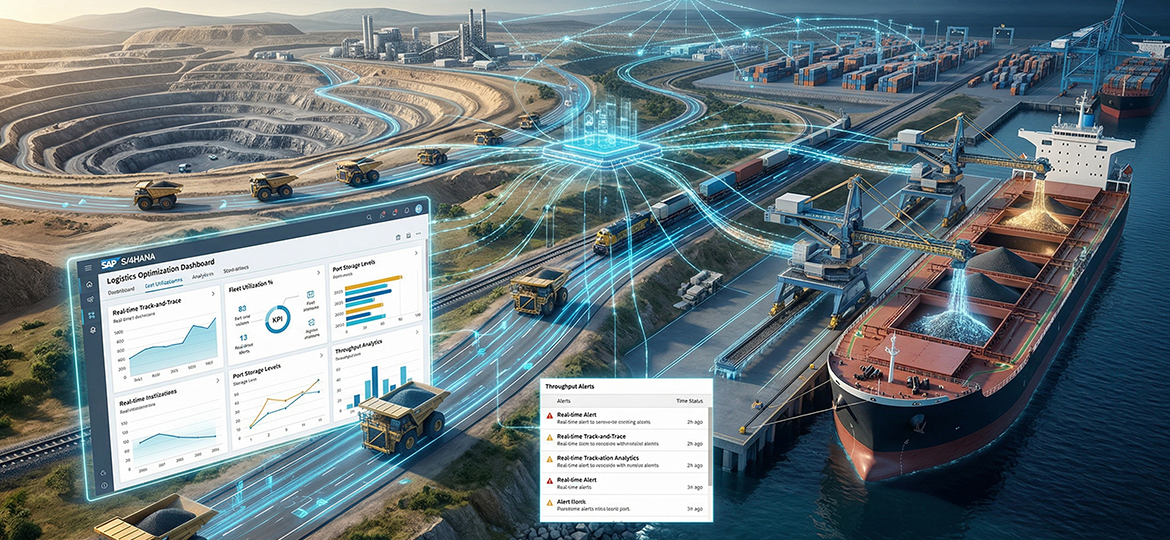
Modern mining operations face highly complex technical challenges, particularly in maintaining the precise synchronization of material flow from the pit area to the loading point (port). Unscheduled heavy equipment downtime, logistical bottlenecks that cause hauler unit queues, and data silos across operational sites often result in deviations between production plans and actual shipments. Amidst the volatility of global commodity prices and strict Environmental, Social, and Governance (ESG) reporting parameters, the lack of data visibility and slow response to operational anomalies can cumulatively erode profit margins.
To eliminate these inefficiencies, Optimizing Pit-to-Port Operations with SAP S/4HANA emerges as a digital architecture capable of integrating the entire mining value chain. This new-generation Enterprise Resource Planning (ERP) system processes operational data in real-time, automatically connecting asset maintenance, inventory control (stockpile), and logistics execution into a centralized database (single source of truth). Through functional data accuracy and predictive analytics capabilities, management can execute strategic decisions based on valid metrics to reduce Cost per Ton and ensure on-time delivery to customers.
Why Does the Mining Industry Need Next-Generation ERP Transformation?
Conventional ERP systems or legacy systems are often no longer capable of handling the dynamics of modern mining operations. Companies frequently get trapped in slow manual data reconciliation processes that are prone to human error. Delays in the flow of operational information trigger a series of field constraints that directly impact profitability margins.
To understand the urgency of this transformation, let's examine the three main pain points currently dominating the mining sector:
-
Data Silos Across Operational Sites: Remote mining areas often use databases or recording systems that are isolated from the port and head office. The absence of a single source of truth causes information asymmetry regarding stockpile volumes, triggers inefficiencies in barge allocation, and prolongs the cash-to-cash cycle.
-
High Unscheduled Heavy Equipment Downtime: Reactive maintenance of hauler units and excavators is highly detrimental to production continuity. According to a McKinsey & Company report on Mining Equipment Effectiveness, the average physical availability of heavy equipment in the global mining industry is only around 70-80%. This means the industry generally loses 20-30% of its production capacity due to the accumulation of planned and unplanned downtime. According to research from Telkom University Academic Journal (2023), utilizing the SAP S/4HANA-based Plant Maintenance module is crucial for executing preventive maintenance functions, allowing this capacity loss to be minimized by anticipating anomalies before fatal breakdowns occur.
-
Complexity of ESG (Environmental, Social, and Governance) Reporting: Demands from global investors and regulators require strict recording of carbon emissions, fuel consumption, and waste management. Collecting sustainability metrics from various departments without a centralized automation system is time-consuming and risks failing to meet compliance audit standards.
Without integrated technological infrastructure, controlling these three variables simultaneously is highly difficult. Transforming into an intelligent ERP is an absolute prerequisite for stabilizing operations and maintaining company competitiveness amidst commodity market fluctuations.
Read also: Improving Inventory Accuracy and Reducing Stock Loss with SAP EWM
Dissecting the "Pit-to-Port" Integration Concept in SAP S/4HANA
The Pit-to-Port concept in SAP S/4HANA orchestrates the flow of operational data end-to-end. This system eliminates information gaps between phases, enabling management to track the physical movement of commodities as well as their accumulated costs with precision.
Extraction & Production Stage (Pit)
The focus in the upstream area is the recording of daily production, which is directly integrated with the financial module. As tangible proof, IDX public disclosures note that PT Black Diamond Resources Tbk successfully implemented S/4HANA to automate pricing per pit and measurably improve fleet maintenance efficiency.
Stockpile & Blending Management (Processing)
In the processing phase, systemic accuracy replaces manual estimation. SAP S/4HANA automatically controls critical parameters in the stockpile area through:
-
Run of Mine (ROM) Visibility: Tracking material tonnage and quality degradation in real-time.
-
Blending Automation: Calculating the most efficient material mixing ratio to achieve buyer contract specifications.
-
Dynamic Inventory Valuation: Asset values in the financial system are updated automatically alongside the physical movement of materials.
Logistics & Shipping (Port)
The downstream phase synchronizes the land transportation (hauling) schedule with the availability of barges at the port. This synchronization prevents the buildup of unit queues and vessel delay penalties (demurrage). Furthermore, payload validation that is automatically integrated with sales contracts will accelerate the invoicing process and the company's cash conversion cycle.
Core SAP S/4HANA Module Architecture for the Mining Sector
The successful integration of pit-to-port operations relies heavily on the technical functionality within the SAP S/4HANA ecosystem. Each module is designed to exchange data in real-time, ensuring that every field decision is supported by accurate financial visibility.
The following is a mapping of the core modules that serve as the foundation of the digital architecture in the mining industry:
| SAP S/4HANA Module | Mining Operational Function | Business Impact |
| PM / EAM | Preventive & Predictive Maintenance for heavy equipment. | Reduces unscheduled downtime & extends asset lifespan. |
| MM & PP | Management of inventory (stockpiles), spare parts, & daily production plans. | Prevents material flow bottlenecks & spare part stockouts. |
| FI / CO | Allocation of actual operational costs (fuel, wages, logistics). | Real-time accuracy of Cost per Ton calculations. |
Enterprise Asset Management (EAM) & Plant Maintenance (PM)
The physical availability of heavy equipment units is the most critical variable in achieving production targets. The PM module facilitates the operational transition from mere reactive maintenance to systematized preventive maintenance. Referring to a technical study by Telkom University (2023), proper configuration of the SAP S/4HANA PM module enables automatic service scheduling based on utilization parameters (such as equipment hour meters), allowing anomalies to be detected before they trigger fatal component failures.
Material Management (MM) & Production Planning (PP)
The procurement cycle for spare parts (both fast-moving and slow-moving) is strictly controlled by the MM module to ensure heavy equipment repair schedules are not delayed due to parts shortages. In parallel, the PP module aligns the extraction rate in the upstream area with the hauling capacity to the port. The synchronization of these two modules effectively balances inventory levels at the stockpile, preventing the accumulation of dead stock while guaranteeing material availability when the shipping schedule arrives.
Controlling (CO) for Cost per Ton Visibility
Amidst the volatility of commodity selling prices, the accuracy of tracking operational costs becomes a determining factor for profitability. The CO module is responsible for recording and distributing every cost element, from fuel consumption per unit, heavy equipment depreciation, and blending costs, to logistics contractor rates. Through this integration, management gains highly precise real-time Cost per Ton metrics for every operating mining area.
The reliability of this modular architecture has been validated by various mining companies in Indonesia. Based on references from leading implementation partners (such as NTT Data and SNP Group), major energy groups like Jhonlin Group (through the RISE with SAP S/4HANA initiative) and ABM Investama (S/4HANA Cloud Transformation) have successfully automated their core business processes. This integration allows for the seamless consolidation of data from various remote sites into a single centralized analytics dashboard at the head office.
Challenges & Best Practices for SAP S/4HANA Implementation in the Mining Sector
Admittedly, adopting a massive-scale enterprise system in heavy industry is no simple matter. Transforming operational habits that have been in place for years requires a highly mature strategy so as not to disrupt the daily production rhythm.
Based on field experience, here are three main implementation challenges along with best practices to overcome them:
-
Connectivity Constraints in Remote Sites: Mining areas are generally located in isolated locations with minimal internet network stability.
-
Best Practice: Conduct a comprehensive network infrastructure assessment before the project begins. Consider a hybrid architecture or optimize offline synchronization capabilities so that data input from the pit area is not hindered when the connection is lost.
-
-
Change Management: Changing the mindset of mechanics, stockpile supervisors, and logistics operators to adapt with discipline to a new system often triggers resistance.
-
Best Practice: Position this implementation as a business transformation, not just an "IT project." Involve user representatives (key users) from the field right from the design phase. Provide intensive mentoring programs that focus on making their work easier, rather than just system theory.
-
-
System Migration Complexity: Transitioning from legacy systems to the S/4HANA ecosystem carries the risk of operational downtime if not executed carefully.
-
Best Practice: Leverage the RISE with SAP approach. Adapting strategies successfully executed by corporations like Jhonlin Group, this approach offers a more structured cloud migration roadmap. This bundled system accelerates the deployment process and drastically minimizes the risk of disruption to pit-to-port operations.
-
Conclusion: It is Time to Take Full Control of Your Operations
Managing today's mining supply chain can no longer rely on instinct or manual data reconciliation that is always late. Pit-to-Port optimization demands absolute visibility from the starting point of extraction to loading at the port.
SAP S/4HANA serves as the digital foundation that bridges all these information gaps. By automating asset maintenance, balancing stockpile inventory, and ensuring real-time Cost per Ton accuracy, your company not only secures profit margins but also builds a resilient supply chain immune to market volatility.
Now, the question is no longer whether the mining industry needs digital transformation, but rather how quickly you dare to begin.
Other News