Blog

SAP SPP vs. eSPP: Understanding the Differences and Their Respective Uses
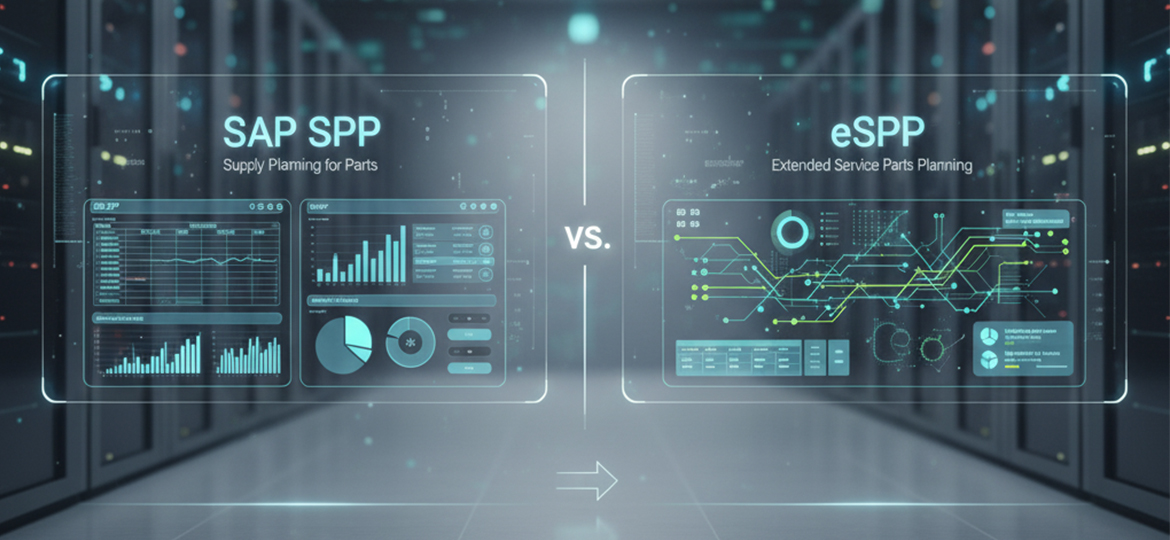
In the modern business world, supply chain management has become one of the most crucial aspects determining a company's efficiency and operational sustainability. As a world-class software solutions provider, SAP offers a variety of modules to manage the supply chain, including SAP Service Parts Planning (SPP) and enhanced Service Parts Planning (eSPP).
These two solutions are often compared because they both focus on service parts management, but they have fundamental differences in terms of function, flexibility, and scope of use. This article will provide a complete discussion of SAP SPP vs. eSPP, from their definitions and feature differences to their benefits and how companies can determine the right choice for their business needs.
What Is SAP SPP?
SAP SPP (Service Parts Planning) is a specialized solution designed to support parts planning in industries with a high degree of complexity, such as automotive, machinery manufacturing, or companies with a global supply chain.
Key features of SAP SPP include:
-
Demand Planning: Forecasting service parts requirements using predictive algorithms.
-
Inventory Optimization: Maintaining a balance between parts availability and storage costs.
-
Distribution Planning: Managing the distribution of stock to various warehouse locations or service centers.
SAP SPP delivers efficiency by reducing excess stock, preventing supply shortages, and accelerating the fulfillment of customer needs.
What Is SAP eSPP?
SAP eSPP (enhanced Service Parts Planning) is a further development of SPP, introduced as part of the latest SAP SCM. This solution integrates modern technology, a more user-friendly interface, and greater flexibility in managing supply chain data.
The main advantages of eSPP include:
-
Integration with SAP S/4HANA: Supports SAP's latest digital core ERP.
-
Advanced Analytics: Provides deeper insights with real-time data visualization.
-
Cloud Compatibility: Offers more flexibility for implementation in SAP Cloud ERP Private or hybrid environments.
-
Agility: Allows for quicker adjustments to market changes and customer demand.
In other words, eSPP elevates the capabilities of SPP to a more modern, efficient level that is suited to the challenges of the digital era.
Key Differences: SAP SPP vs. eSPP
To understand more clearly, here are some important distinctions:
System Architecture
-
SAP SPP: Based on SAP APO (Advanced Planning and Optimization).
-
SAP eSPP: Integrated with SAP S/4HANA and supports cloud technology.
Analytical Features
-
SAP SPP: Uses traditional forecasting methods.
-
SAP eSPP: Provides more sophisticated predictive analytics and data visualization.
Flexibility
-
SAP SPP: Relatively rigid, suitable for large companies with standard requirements.
-
SAP eSPP: More flexible and can be customized to the needs of dynamic industries.
User Experience
-
SAP SPP: The interface tends to be complex.
-
SAP eSPP: Features a modern UI that is easier to use, even for non-technical users.
Integration
-
SAP SPP: Limited to the SAP APO ecosystem.
-
SAP eSPP: Supports cross-module integration, including SAP TM, SAP EWM, and SAP IBP.
Respective Use Cases
-
SAP SPP: Suitable for companies with stable supply chains, predictable demand for service parts, and an IT infrastructure still based on SAP APO.
-
SAP eSPP: Ideal for companies that are undergoing or have completed a digital transformation, require higher agility, and want to optimize their supply chain through SAP Cloud ERP Private.
Benefits of Implementing SAP SPP and eSPP
Both SPP and eSPP bring significant benefits to a company, such as:
-
Operational efficiency through accurate planning of service parts needs.
-
Increased customer satisfaction with timely parts availability.
-
Cost optimization by reducing excess inventory.
-
Improved supply chain resilience against global disruptions.
However, eSPP offers the added value of real-time insights, cloud integration, and flexibility that is more adaptive to modern business dynamics.
How to Choose the Right Solution?
Choosing between SAP SPP vs. eSPP is not just a matter of technology but of business strategy. Companies need to consider the following factors:
-
Current IT Infrastructure. If you still rely on SAP APO, SPP could be a temporary option. However, if you are moving towards SAP S/4HANA, eSPP is more suitable.
-
Supply Chain Complexity. The more dynamic the supply chain, the more the flexibility of eSPP is needed.
-
Digital Transformation Vision. Companies with a digital transformation roadmap will benefit more from eSPP due to its compatibility with SAP Cloud ERP Private.
Conclusion
Both SAP SPP and SAP eSPP are powerful solutions for service parts management in industries with complex supply chains. SAP SPP is well-suited for companies with stable, SAP APO-based systems, while eSPP emerges as a modern solution that supports digital integration, advanced analytics, and cloud flexibility.
By understanding their respective differences and advantages, companies can choose the solution that best aligns with their long-term business strategy.
If your company wants to ensure a smooth transition and implementation of SAP SPP or eSPP, Soltius, as an official SAP partner in Indonesia, is ready to assist. With extensive experience across various industries, Soltius provides a holistic consulting approach, targeted implementation, and full support to ensure the operational efficiency of your supply chain.
Contact Soltius now and realize your company's supply chain transformation with the best SAP solution.
Other News