Blog

7 Key Benefits of Migration to Cloud RISE Every Business Leader Must Know
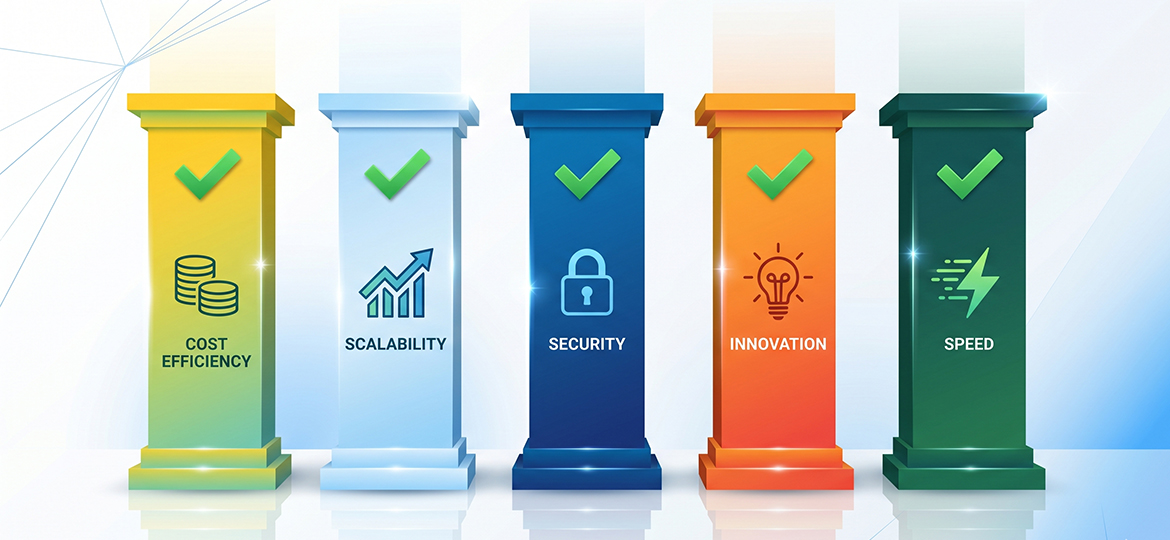
Many companies today face critical challenges as they are still stuck with on-premise SAP ECC infrastructure, where its official support period (end-of-maintenance) will absolutely end in 2027. Maintaining this legacy system not only triggers an inefficient surge in IT maintenance costs but also creates architectural bottlenecks that isolate company data. As a result, integration with modern technologies such as real-time analytics and Artificial Intelligence (AI) becomes very slow, forcing business and IT leaders to urgently find a way out before their infrastructure is left behind by market dynamics.
To overcome these bottlenecks, Migration to Cloud RISE is here not merely as a technical software update, but as a comprehensive Business Transformation-as-a-Service (BTaaS) framework. This approach allows companies to move their core systems to a managed cloud ecosystem (managed services), shift their cost structure from CAPEX to OPEX, and standardize business processes. In this article, we will thoroughly dissect the 7 strategic benefits of this migration, how the clean core architecture works within it, and compare the best migration strategies to secure your operations before the 2027 deadline arrives.
What Exactly is Migration to Cloud RISE? (Conceptual Fundamentals)
The Definition of RISE with SAP as Business Transformation-as-a-Service (BTaaS)
Migration to Cloud RISE is a strategic offering designed to guide companies in migrating their legacy systems (such as SAP ECC) to the cloud in a structured manner. SAP defines this approach as Business Transformation-as-a-Service (BTaaS).
This means SAP consolidates all the technical and software elements needed for digital transformation into a single integrated service (single offer). With this model, architectural complexity is simplified because you no longer need to manage multiple vendors separately. Under a single Service Level Agreement (SLA) contract, you will get:
-
SAP S/4HANA Cloud: The next-generation core ERP system with in-memory data processing capabilities for real-time analytics.
-
Hyperscaler Infrastructure (IaaS): The flexibility to choose a world-class cloud provider (such as AWS, Google Cloud, or Microsoft Azure) whose operations are managed directly by SAP.
-
Business Technology Platform (BTP): A platform-as-a-service ecosystem for building custom application extensions and third-party integrations without disrupting the stability of the clean core.
-
Business Process Intelligence: Built-in analytics tools to detect inefficiencies in your current operational business processes and provide data-driven improvement recommendations.
7 Key Benefits of Migration to Cloud RISE for Your Company
Deciding to transition from an on-premise architecture to the RISE cloud ecosystem brings a direct impact on cost structure, security, and operational agility. Here are 7 technical and strategic benefits that companies will gain:
1. Cost Efficiency — Transition from CAPEX to OPEX Model
Maintaining a physical data center forces companies to allocate a large upfront budget (Capital Expenditure / CAPEX) for hardware purchases (servers, storage). These devices also depreciate in value and require costs for cooling, electricity, and physical space.
Through Migration to Cloud RISE, the financing structure shifts to a subscription-based Operational Expenditure (OPEX). Companies only pay for the computing resources they actually use. This subscription model makes cash flow planning more transparent, predictable, and frees up capital to be invested in other business innovations.
2. One Contract, One SLA — Simplified Vendor Management
Traditionally, managing an SAP infrastructure requires many separate contracts: hardware vendors, software license providers, database providers, and maintenance consultants (AMS). This complexity often triggers the phenomenon of finger-pointing when a system disruption occurs.
RISE with SAP eliminates these obstacles through a single contract model. The benefits include:
-
A single Service Level Agreement (SLA) of 99.7% for overall application availability.
-
A Single Point of Contact for all operational incidents.
-
Consolidation of software licenses, hyperscaler infrastructure, and cloud management services.
3. Continuous Access to Innovation — AI and Analytics Ecosystem
Legacy systems require massive and expensive upgrade projects just to get new features. In contrast, the cloud-native architecture in RISE allows software updates (system updates) to be delivered automatically and periodically with minimal downtime.
This migration opens the door directly to SAP's intelligent innovation ecosystem. You gain access to:
-
SAP Joule: An integrated Generative AI assistant capable of processing natural language queries for business analytics.
-
Real-time Analytics: Direct in-memory data analysis (SAP HANA) without time-consuming data replication processes.
4. Infrastructure Scalability and Flexibility
On-premise server capacity is static. In the event of a transaction surge (peak season), the system is at risk of going down due to overload. Conversely, if transactions are quiet, these expensive servers become underutilized.
Hyperscaler infrastructure (such as AWS, Azure, GCP) within the RISE package offers auto-scaling. Database capacity and computing power can be scaled up or down instantly (on-demand) according to transaction volumes and the company's organic growth, ensuring system performance is always optimal without capacity waste.
5. Stronger Security Posture and Compliance
Building military-grade cybersecurity fortresses in internal data centers requires massive investments and scarce security experts. Even the smallest security flaw in an older system can trigger a fatal data breach.
Migration to Cloud RISE automatically shifts the burden of physical and network security mitigation to leading hyperscaler providers with global compliance certifications. The security benefits include:
-
End-to-end data encryption (in transit and at rest).
-
Disaster Recovery (DR) architecture and automated data backups to minimize the risk of data loss.
-
Security patching managed directly by SAP's expert team.
6. Clean Core Approach — Eliminating Customization Burden (Technical Debt)
In SAP ECC, companies often modify the program's core code (hard-coding) to fit specific business processes. This creates technical debt that makes the system rigid, error-prone, and nearly impossible to upgrade without breaking existing functions.
RISE with SAP implements the Clean Core principle. All customizations and additional applications (extensions) are built separately from the ERP core using the SAP Business Technology Platform (BTP). With this decoupled architecture, the core S/4HANA system remains clean and standard, so future upgrade processes can run smoothly without the risk of disruption.
7. Data-Driven Business Process Transformation
The biggest mistake in an ERP migration is merely moving poor operational processes to a new server. Migration to Cloud RISE prevents this by including Business Process Intelligence tools (such as SAP Signavio) in its standard package.
These tools act as an X-Ray machine for your operations. Before and during the migration, this technology will:
-
Map the actual running workflows.
-
Identify bottlenecks and inefficient manual processes.
-
Provide industry Best Practice recommendations to standardize business processes.
3 Migration to Cloud RISE Strategies: Choose the Right One for Your Business
Every company has different data complexities and legacy architectures. SAP provides three main migration paths within the RISE framework to ensure an optimal transition to S/4HANA.
1. Greenfield — New Implementation (Re-engineering)
This strategy involves building the SAP S/4HANA system from scratch. The company does not migrate old data or processes, but rather performs a total re-engineering based on SAP Best Practices.
This approach is most effective if your old system has too many modifications (customizations) that are no longer relevant. With Greenfield, you ensure the Clean Core principle is applied from day one, making the system lighter and easier to upgrade in the future.
2. Brownfield — System Conversion (Evolution)
Brownfield is a technical conversion method where the existing SAP ECC system is transformed into SAP S/4HANA. Its main focus is "Migration without Re-implementation."
The primary advantage of this strategy is the full retention of historical data. Existing business processes are maintained, thereby minimizing disruption to end-user operations. This path typically has a shorter project duration compared to Greenfield.
3. Bluefield — Selective Data Transition (Hybrid)
The Bluefield strategy, or Selective Data Transition, is a combination of Greenfield and Brownfield. You can choose specific modules or data to migrate to the new system (for example, only the last 5 years of data).
This method allows companies to leave behind inefficient business processes while still bringing over historical data that is important for audits or legal compliance. This is a solution for large companies with highly complex data structures.
Migration Strategies Comparison Table
| Feature | Greenfield | Brownfield | Bluefield (Hybrid) |
| Historical Data | Not carried over (Start from scratch) | Fully carried over | Selectively carried over |
| Business Processes | Total transformation | Maintained/Evolution | Selective optimization |
| Customization | Removed (Clean Core) | Retained (Converted) | Partially cleaned |
| Project Duration | Longer | Faster | Medium |
| Risk | Low (New System) | Medium (Compatibility) | High (Data Complexity) |
FAQ: Frequently Asked Questions About Migration to Cloud RISE
-
Is Migration to Cloud RISE only for large companies?
No. RISE is designed for companies of all scales, including SMEs that want to digitize their operations without having to manage complex IT infrastructures.
-
What is the fundamental difference between RISE and regular S/4HANA Cloud?
S/4HANA Cloud is the software, while RISE is the service package that includes the software, cloud infrastructure, and operational management services under a single contract.
-
How long is the average migration duration?
The duration highly depends on the chosen strategy. Brownfield usually takes 6-9 months, while Greenfield can reach 12-18 months depending on module complexity.
-
What about data security in third-party (Hyperscaler) infrastructure?
Your data remains entirely yours. SAP and hyperscaler partners (AWS/Azure/GCP) provide layered security that meets global certification standards (ISO, SOC 1/2), which are often stricter than internal data centers.
-
Can I use customizations (ABAP) in RISE?
Yes, but it is highly recommended to use SAP BTP to keep the core code standard (Clean Core) so as not to hinder future system update processes.
CONCLUSION
Migration to Cloud RISE is no longer just an option, but a strategic necessity considering the end of support for SAP ECC in 2027. By switching to a cloud-native model, companies not only secure long-term operations but also unlock access to OPEX cost efficiency, high scalability, and future AI technologies.
Secure the Future of Your Business Now.
Do not wait until 2027 when consultant resources become increasingly limited and the risk of downtime rises. Conduct an assessment of your system today to determine the most appropriate migration strategy.
Other News