Blog

A Complete Guide to IaaS Migration: Free Your Company from the Burden of Physical Servers
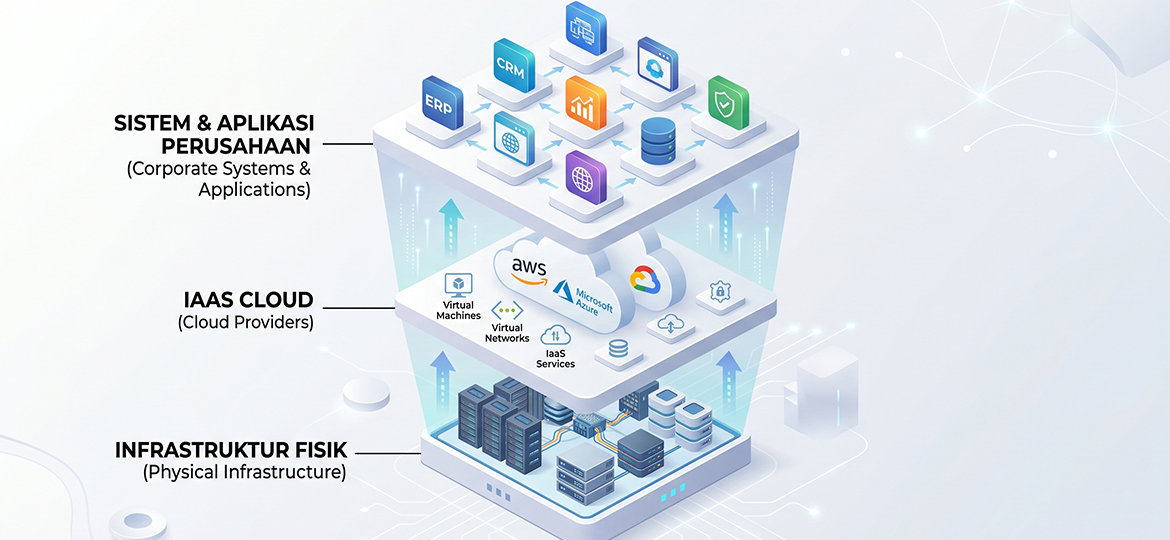
Many companies today are trapped by the constraints of on-premise IT infrastructure, which actually hinders business agility. Managing physical servers independently means companies must face large initial capital expenditures (CapEx), resource-draining hardware maintenance routines, and the risk of resource bottlenecks during sudden spikes in user traffic. This rigid system architecture often burdens operational teams with scalability issues and unpredictable downtime, ultimately slowing down the company's response to market demands.
As a strategic solution to this problem, moving workloads to Infrastructure as a Service (IaaS) allows companies to transform heavy physical infrastructure into an elastic (auto-scalable) and measurable cloud service. This article is designed as your comprehensive guide to the IaaS Migration process, from understanding its technical mechanisms and choosing the most appropriate migration approach using the 7Rs framework, to concrete steps in mitigating security risks so that the infrastructure transition runs without disrupting your business operations.
What is IaaS and Why is it Relevant to Your Company?
Understanding IaaS Through a Simple Analogy
Imagine IaaS like renting a modern office space equipped with electricity, water, and 24-hour security. You no longer need to worry about mixing cement, building a foundation, or installing wiring from scratch. You simply move in and bring your own "furniture," which in the IT world refers to your operating systems, business applications, and company data.
Technically, Infrastructure as a Service (IaaS) is a cloud computing service where a vendor rents out basic infrastructure such as virtual servers, networking, and storage. The business model is highly flexible as it uses a pay-as-you-go system. This means you only pay for the exact computing capacity you use, much like paying a monthly electricity bill.
Who Benefits the Most from Migrating to IaaS?
Although almost all industry sectors are starting to abandon physical servers, there are a few company profiles that will experience the most instant positive impacts from this migration:
Businesses with Fluctuating Traffic: Have an e-commerce platform or app where traffic explodes dramatically during year-end promotions? IaaS provides automatic elasticity. Servers won't crash when swarmed by thousands of visitors, and capacity can be scaled back down once the promotion ends. Startups & Aggressively Growing Companies: Forget spending billions of rupiah in capital expenditures (CapEx) just to guess hardware needs for the next three years. IaaS allows you to reinvest that capital into product innovation while still being able to increase server capacity (scale-up) in a matter of minutes. Organizations with a High Security Focus: Building an independent data center that is disaster-proof and hacker-resistant requires a fantastic amount of money. Utilizing IaaS means you piggyback on the trillion-dollar, military-grade security infrastructure owned by giant providers.
Three Leading IaaS Provider Giants in the Industry
When you are ready to perform an IaaS Migration, you won't be short of options. Currently, the global market is dominated by the "Big Three" providers, who already have a proven track record and local data centers in Indonesia:
Amazon Web Services (AWS) - Amazon EC2: The pioneer and current market leader. Its service ecosystem is the most massive and highly suitable for companies requiring advanced flexibility. Microsoft Azure - Azure Virtual Machines: A favorite choice for enterprise-level companies. If your operations already rely heavily on the Microsoft ecosystem (such as Windows Server or SQL Server), migrating to Azure will feel very natural. Google Cloud Platform (GCP) - Google Compute Engine: Highly respected among developers. GCP is the right choice if your company focuses on big data analytics, Machine Learning, and requires Google's super-fast global fiber-optic network.
Understanding the 7 IaaS Migration Strategies (The 7 Rs Framework)
Moving workloads to a cloud environment cannot use a one-size-fits-all approach. Every company application has different architectures, dependencies, and urgencies.
To design an efficient transition, cloud architects dissect workloads using the 7Rs framework. Here is a summary of the seven strategies:
Rehost (Lift & Shift): Moving applications directly from physical servers to IaaS virtual machines without modifying the underlying code. This is the fastest route if you are chasing a migration deadline. Replatform (Move & Improve): Retaining the application's core architecture while optimizing components (e.g., switching to a managed database) to make it more efficient and lighter to run. Refactor / Re-architect: Completely overhauling the application structure to become cloud-native (microservices-based). It is like disassembling a vehicle's chassis to make it modular; it requires a high initial cost but produces the most elastic system. Repurchase (Move to SaaS): Permanently abandoning legacy software and switching to a ready-to-use Software as a Service (SaaS) subscription license. Relocate: Transferring hypervisor-level infrastructure (such as VMware clusters) entirely from on-premise to cloud services without a conversion process. Retire: The cleanup phase of shutting down obsolete systems or "zombie applications" that consume computing power but are no longer used in operations. Retain: Temporarily keeping certain workloads on local servers, usually retained due to strict compliance regulations.
Main Risks of IaaS Migration and Foolproof Ways to Mitigate
Them Switching to IaaS is like moving from a traditional house to a smart home. Everything is highly advanced, but highly vulnerable to intrusion if you misconfigure the digital lock system. Here are four main risks and how to handle them:
-
Data Security & Misconfigurations: In the cloud, the vendor secures the physical server, but you manage data access (shared responsibility). Prevent leaks by applying Least Privilege (minimum access rights) and use Cloud Security Posture Management (CSPM) to automatically detect security vulnerabilities.
-
The Threat of Vendor Lock-in: Relying too heavily on a single vendor's exclusive ecosystem makes it difficult to switch services. Circumvent this by building a Container-based architecture (such as Docker/Kubernetes) to keep your applications neutral and portable.
-
Risk of Downtime During Execution: Moving data haphazardly can paralyze transactions. Use Blue-Green Deployment techniques; set up a new cloud environment covertly, ensure it's stable, and then divert traffic from the old server without dropping connections.
-
Internal IT Team Skill Gap: Managing the cloud requires a different mindset and competencies than maintaining hardware. Provide regular certification training, or hire a Managed Service Provider (MSP) to assist during the transition period.
Conclusion: Take Control of Your Infrastructure Now
Performing an IaaS Migration is an absolute necessity to free companies from the expensive and rigid burden of maintaining physical servers. By wisely applying the 7Rs framework and preparing mitigation strategies early on, your IT will transform from a mere "cost center" into an agile business driver. Don't wait for your servers to crash again; audit your infrastructure today and begin the transition to the cloud!
Other News