Blog

Best POS (Point of Sales) Software Recommendations: Understand Its Definition and Benefits for Business
Managing transactions, multi-branch inventory synchronization, and financial report consolidation using legacy cashier systems often triggers operational bottlenecks such as data discrepancies and workflow inefficiencies. Reliance on manual processes for stock visibility and sales recording not only slows down customer service level agreements (SLAs), but also increases the risk of revenue leakage due to human error during the end-of-day data reconciliation process.
To mitigate these complexities, this article will comprehensively dissect what POS Software is, the mandatory standard functional features, as well as crucial metrics in selecting an enterprise-scale system. Through a deep understanding of the transition from conventional infrastructure to a cloud-based ecosystem, you will find the answer to why the software integration capabilities from Soltius become the leading recommendation to support your business's scalability and data accuracy.
What is POS (Point of Sales) Software?
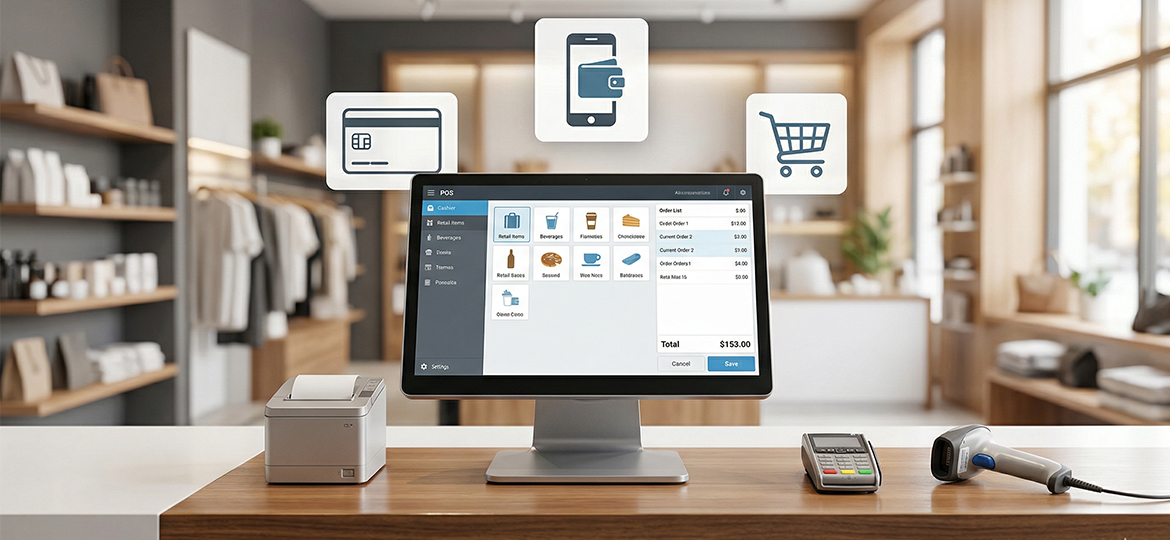
Operationally, POS Software, often referred to as a cashier application, is software designed to support the execution of direct transactions between sellers and consumers. This system functions as an endpoint (check-out counter) directly integrated with cash register functionality, the place where the sales cycle of a product officially ends and is recorded.
This enterprise-level POS application is developed specifically to accommodate operational complexities across various retail stores, especially for companies managing multiple branches. Its implementation ensures that every point of sale has a uniform data processing standard.
Definition and Differences from Conventional Cash Registers
The presence of POS applications is essentially a form of innovation and a crucial efficiency step to handle surges in consumer sales volumes. This is in stark contrast to past retail operational methods that were highly limited in functionality.
To understand the differences in its capabilities compared to legacy systems, here is the structural comparison:
| Operational Parameters | Conventional & Isolated Cashier Systems | Integrated POS Software Systems |
| Main Function | Manual calculator or standalone software without consolidation. | Central business management (all-in-one hub) connected to the main system. |
| Inventory Management | Manual physical checking (stock opname) prone to errors. | Automatic stock updates and reorder notifications (real-time). |
| Data Storage | Local storage, complicating inter-branch consolidation. | Automatic data synchronization with centralized digital backup. |
| Reporting & Analytics | Manual recapitulation at the end of operational shifts. | Automated analytics dashboard with business performance visualization. |
The Evolution of Cloud-Based POS in the Digital Era
To answer the challenge of exponentially growing retail stores, modern POS infrastructure now adopts a cloud-based architecture. The transition from unintegrated systems to a cloud ecosystem allows central management to manage and monitor the entire branch network without physical location constraints.
This architecture provides flexibility for companies to scale their operations. Product catalog updates, price modifications, and daily transaction audits can now be retrieved and synchronized in a matter of seconds across all retail operational points.
Why Your Business Must Switch to a Modern POS System?
The transition from conventional cashier infrastructure to a modern POS system is no longer merely an operational option, but a strategic necessity to maintain company competitiveness. Enterprise-level transaction management systems offer essential capabilities that directly impact cost reduction and workflow optimization.
Here are the technical foundations why companies must modernize their point-of-sale architecture:
-
Data Accuracy and Measurable Operational Efficiency: The implementation of a modern POS as part of systematic digital transformation drastically minimizes the risk of human error in data entry and manual reconciliation processes. Based on analyses by the World Economic Forum (WEF) and the Deloitte Global Industry 4.0 Readiness Survey, digital technology adoption has been proven to drive productivity increases of up to 15% - 20% and asset utilization by 15%, as well as record an average operational cost reduction of 20%. Referring to Strategic Roadmaps for Digital Transformation (ResearchGate), this real-time data automation and synchronization ensure every transaction is directly integrated with the company's general ledger.
-
Centralized Multi-Branch Inventory Visibility: For business entities with a broad operational scope, inter-branch stock management is a complex logistical challenge. POS software facilitates centralized inventory tracking, where the reduction of item quantities due to sales at one location will automatically update the main database, thereby mitigating the risk of stockouts or overstock.
-
Comprehensive Analytics for Data-Driven Decisions: A modern POS ecosystem does not only function as a transactional tool but also acts as a data aggregator engine. The system is equipped with an analytics dashboard capable of processing raw data into actionable insights, allowing management to evaluate the performance of each branch, analyze sales trends, and conduct demand forecasting precisely.
Crucial Features Your Chosen POS Software Must Have
In selecting POS infrastructure for enterprise scales, companies must evaluate system capabilities comprehensively. Ideal software must have integrated modules capable of accommodating all the operational complexities of a modern business.
Here are the functional feature specifications that your chosen POS ecosystem must possess:
-
Smart Inventory and Stock Management: The system must be equipped with real-time stock synchronization capabilities across the entire branch network and centralized storage warehouses. Automated low-stock alert features are highly crucial to mitigate supply chain disruptions and ensure optimal product availability levels at all times.
-
Customer Relationship Management (CRM) and Loyalty Programs: CRM module integration allows companies to aggregate consumer profile data and transaction histories centrally. This functionality facilitates the execution of personalized loyalty programs and promotions, which can directly increase retention rates and Customer Lifetime Value (CLV).
-
Digital Payment Integration and System Scalability: POS software must support omnichannel payment architecture, including debit/credit card processing, e-wallets, and QRIS integration with high security encryption standards. Furthermore, the system must have built-in scalability so that companies can expand to new sales points instantly without needing to overhaul their core IT infrastructure.
Best POS Software Recommendation: Soltius as a Smart Solution for Your Business
Accommodating digital transformation needs and enterprise-level operational complexities, Soltius is present as a leading POS software solution provider. Soltius designs point-of-sale infrastructures that not only process transactions but also function as a central ecosystem to eliminate data discrepancies and optimize your company's supply chain efficiency.
Advantages of Soltius POS Software
The selection of POS software must be based on technical capabilities that can answer specific industry challenges. Here are the advantages of the POS system architecture offered by Soltius:
-
Advanced Integration Capabilities (ERP/SAP): Soltius's POS systems are designed to integrate seamlessly with the company's backend infrastructure, including leading ERP systems like SAP. This two-way synchronization ensures that sales data, inventory movements, and financial journals are directly recorded in the general ledger without the need for manual entry.
-
Enterprise-Grade Data Security: Protecting the integrity of transaction data and customer profiles is a top priority. Soltius implements high-level security protocols, including end-to-end data encryption, Role-Based Access Control (RBAC), and compliance with commercial data protection regulatory standards.
-
Customization According to Workflow Complexity: Each industry sector has different operational metrics. This software offers interface customization flexibility and functional modules, enabling it to adapt precisely to specific workflows in the Retail, Food & Beverage (F&B), and large-scale Distribution sectors.
How Does Soltius Help Business Scalability?
Business network expansion demands agile and scalable IT infrastructure. Soltius facilitates operational scalability through a centralized management dashboard that allows executives to monitor the performance of dozens to hundreds of branches in real-time on a single screen.
More than just a software provider, Soltius ensures the success of technology adoption through comprehensive assistance services. Ranging from the consultation phase and architectural implementation by certified expert teams, to dedicated after-sales support to guarantee that your company's operational Service Level Agreement (SLA) remains optimal.
Conclusion
Modernizing point-of-sale infrastructure through the adoption of cloud-based POS Software is not merely an operational facility upgrade, but a long-term strategic investment. The system's ability to automate inventory synchronization, minimize human error, and present real-time data analytics directly contributes to cost efficiency and increased company profitability.
As a digital transformation partner, Soltius offers an enterprise-level POS ecosystem that is secure, integrated, and highly scalable to support your business growth.
Is your company ready to increase operational efficiency and eliminate revenue leakage? Thus, Soltius Indonesia is indeed always present to provide solutions for your company and business. Find out more details by clicking the following link: https://www.soltius.co.id/id/special-offer/read/pos-system-software
Other News