Blog

Bill of Materials (BOM): Definition, Types, and Examples
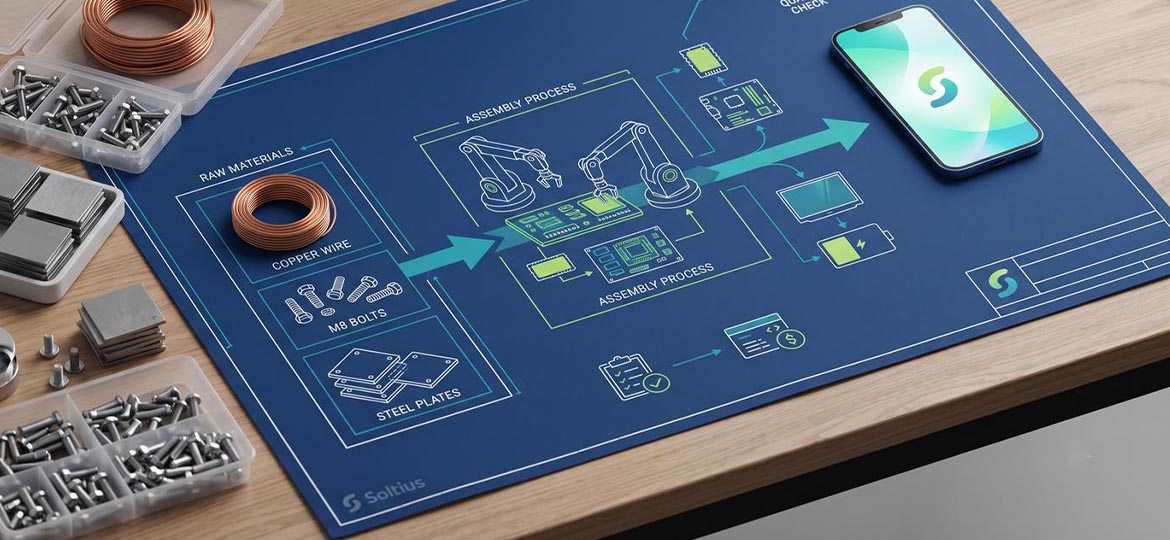
A single component line missing from the material requirements list can halt an entire assembly line; procurement does not order it, the warehouse does not stage it, and production waits. The Bill of Materials (BOM) is put together to prevent that scenario and serves as the data foundation for every digital manufacturing system. This article covers the types of BOM, an example of a multi-level structure you can adopt, and why BOM accuracy has such a strong bearing on material requirements planning results.
In short, a Bill of Materials (BOM) is a structured list covering all raw materials, components, and sub-assemblies, complete with item codes, quantities, and units of measure required to produce one unit of finished product. The BOM serves as a shared reference for the design, production, procurement, and finance teams, and is the primary input for calculating material requirements.
What Are the Types of Bill of Materials?
BOM types can be mapped along two main axes. The document function axis distinguishes the Engineering BOM (EBOM), the product as designed by the engineering team, from the Manufacturing BOM (MBOM), the product as built on the shop floor. The structural depth axis distinguishes the single-level BOM, which covers only one tier, from the multi-level BOM, which covers every intermediate assembly (sub-assembly).
|
Engineering BOM (EBOM) |
The product as designed: technical drawings and design specifications |
The engineering/R&D team during product design |
|
Manufacturing BOM (MBOM) |
The product as built: actual components, packaging materials, assembly sequence |
The production team; this is the day-to-day “production BOM” |
|
Single-level BOM |
One tier: the finished product and its direct components |
Simple assembled products with no sub-assemblies |
|
Multi-level (indented) BOM |
Tiered Level 0-1-2 and so on: finished product → sub-assembly → component/raw material |
The standard for complex products with sub-assemblies |
These four types are not an exhaustive list. The ASCM Dictionary (Association for Supply Chain Management), 18th edition, lists six display formats for the Bill of Materials; two of them are single-level and indented, while the rest are variants for specific needs such as the modular (planning) BOM and the costed BOM.
In practice, misalignment between the EBOM and the MBOM after a design revision is often uncovered when production master data is being cleaned up. Both are legitimate parallel documents for the same product.
Example of a Multi-Level BOM Structure
A multi-level BOM structure is read by level: Level 0 is the finished product, Level 1 is the sub-assembly, and Level 2 consists of components or raw materials. Each line lists the item code, description, quantity, and unit of measure against one base quantity (the base quantity of the finished product). The table below illustrates the BOM for an office chair with a base quantity of one unit.
|
0 |
FG-100 |
Office chair (finished product) |
1 |
unit |
|
1 |
SA-110 |
Seat assembly |
1 |
unit |
|
2 |
RM-111 |
Seat foam |
1 |
pcs |
|
2 |
RM-112 |
Upholstery fabric |
0.8 |
m² |
|
1 |
SA-120 |
Base assembly |
1 |
unit |
|
2 |
RM-121 |
Castor wheels |
5 |
pcs |
|
2 |
RM-122 |
Gas lift |
1 |
pcs |
|
2 |
RM-123 |
M8 bolts |
4 |
pcs |
Two notes from this table.
First, a component used in more than one sub-assembly appears repeatedly under each parent and is not consolidated into a single line. Second, the minimum elements on each line are the item code, description, quantity per base quantity, unit of measure, and level. Disciplined practice also adds a revision number.
This structure is what the material requirements planning system will work from.
Why the BOM Determines Production and MRP Accuracy
A quantity error on a single BOM line can lead to inaccurate purchase orders, stock imbalances, and incorrect cost calculations. According to official SAP Learning material, the BOM is used simultaneously by four core processes: material requirements planning, production, procurement, and product costing.
The link to MRP (Material Requirements Planning) happens through the explode mechanism, in which the system breaks down the BOM structure against the production schedule to calculate the identity and quantity of components at every level. For example, from an order of 100 chairs in the illustration above, MRP produces requirements for 500 castor wheels, 400 M8 bolts, and 80 m² of upholstery fabric.
Those requirement figures become the basis for raising purchase orders and staging stock in warehouse management.
A poorly managed BOM, with obsolete components left undeleted or design revisions never updated, can cause even the most sophisticated system to produce inaccurate plans.
That failure is not caused by the software, but by a lack of discipline in data management.
Once product structures become multi-level and design revisions grow more frequent, a BOM maintained in a spreadsheet quickly falls out of sync with stock and purchasing. This is why companies centralise the BOM as master data in an ERP (Enterprise Resource Planning) system. In SAP S/4HANA Manufacturing, the BOM consists of a BOM header holding the base quantity and BOM items; this single structure becomes the shared reference for the four processes mentioned above.
FAQ (Frequently Asked Questions)
What is a production BOM?
Production BOM is the everyday term for the Manufacturing BOM (MBOM): the list of materials as the product is actually built on the shop floor, including packaging and assembly sequence. The MBOM differs from the Engineering BOM (EBOM), which describes the product as designed; a single product commonly has both of these parallel documents.
What is the difference between a single-level and a multi-level BOM?
A single-level BOM shows only one tier, namely the finished product together with its direct components. A multi-level (indented) BOM shows the full tiered structure of Level 0-1-2 and beyond, following sub-assemblies down to the lowest raw material, as in the 8-line office chair example in the table above.
How is the BOM related to MRP?
The BOM is one of the main inputs for MRP (Material Requirements Planning). The MRP system explodes the BOM structure against the production schedule to calculate the requirement for each component per level; the order of 100 office chairs in the example above translates into requirements for 500 castor wheels and 400 M8 bolts.
Conclusion
Companies that treat the BOM as a static document often only realise its importance when the production line stops because one component was never ordered. The choice of BOM type should match the document's function and the depth of the structure, and its accuracy should be maintained with the same discipline applied to stock management. As an SAP Platinum Partner through its United VARs membership, Soltius implements and supports SAP S/4HANA Manufacturing across a range of industries, including automotive, consumer products, and mill products, along with the structuring of production master data such as the BOM.
For more information on structuring your BOM and your company's readiness for SAP S/4HANA Manufacturing, please visit soltius.co.id.
Other News