Blog

Building Seamless Business Intelligence: Why SAP Datasphere is the Future of Data
The corporate world today is facing a complex paradox. On one hand, we are swimming in an abundant ocean of data; but on the other hand, this data is often isolated in impenetrable silos. For IT leaders, managing data scattered across various cloud platforms and on-premise systems is no longer just a technical matter it is a bottleneck to the speed of strategic execution.
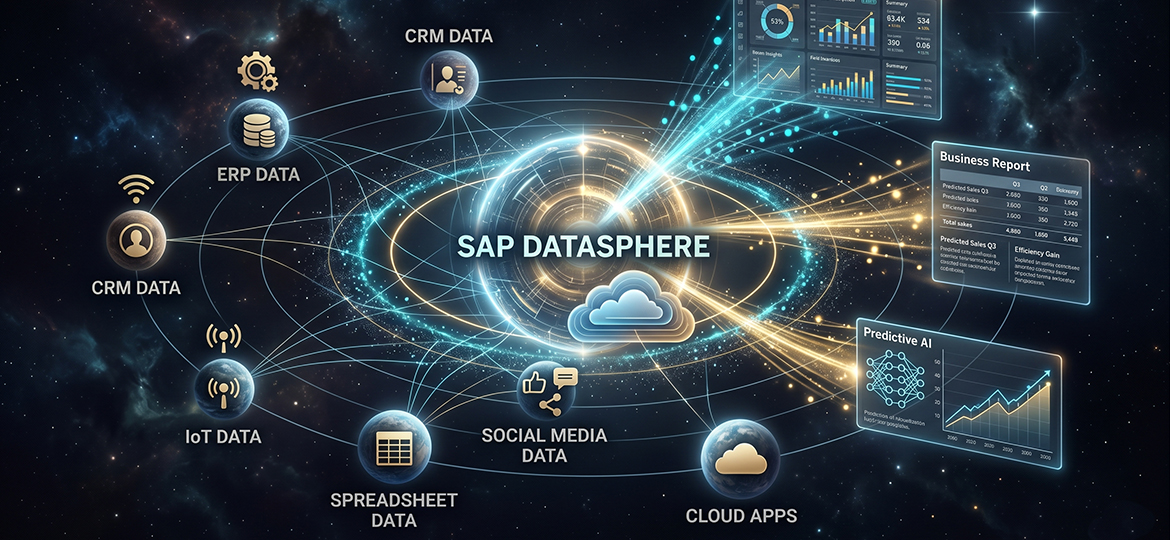
Many companies are beginning to realize that replicating all data into a single repository is an outdated, expensive, and exhausting strategy. This is where SAP Datasphere emerges as a differentiator. It is not merely an evolution of data warehousing, but rather a tangible manifestation of the Business Data Cloud concept.
Reviving Context in Data
Traditionally, conventional Data Lakes or Data Warehouses have had one fatal flaw: they often "kill" the business context. When data is extracted from an ERP system to a data lake, its business logic frequently evaporates. Column names that were previously meaningful in the source system turn into confusing technical codes for analysts.
The Business Data Cloud is here to fix that. The idea is simple yet powerful: data must be accessible anywhere without losing its original meaning. Without the need for convoluted ETL (Extract, Transform, Load) processes, data retains its identity and logic.
A Simple Analogy: Imagine a global retail company. They have sales data in S/4HANA, marketing data in Google BigQuery, and logistics in Azure. Without an integrated ecosystem, unifying these three to view real-time profitability is a technical nightmare. SAP Datasphere tears down those walls, making data speak in a uniform business language.
Why is SAP Datasphere Becoming the New Standard?
SAP Datasphere is not just a rebranding. It is a massive leap that introduces true data fabric capabilities through two main pillars:
-
Data Federation: Access Without Moving
One of the most radical breakthroughs is the federation capability. While we previously had to copy data from point A to point B—incurring storage costs and security risks—we can now access it virtually. Datasphere acts like a bridge connecting various data islands without having to relocate their inhabitants.
-
Business Semantic Layer: Keeping Logic Intact
This is SAP's primary strength. With the Semantic Layer, every piece of business logic, such as product hierarchies or organizational structures, remains intact. Analysts no longer need to guess what the MATNR column is, because the system will directly present it as Material Number, complete with its description.
Key Game-Changing Features
To support collaboration between IT teams and business users, Datasphere brings new weapons:
-
Intuitive Analytic Model: It is now much more visual. Business users can experiment with data dimensions and relationships independently without always having to wait for the IT department's assistance.
-
Data Catalog: Like a compass in the middle of an ocean of information. This feature helps companies document data assets, track their origins (lineage), and ensure compliance with regulations such as the PDP Law (Personal Data Protection) in Indonesia.
-
BW Bridge: A bridge for loyal SAP BW users. You don't need to throw away old investments; simply move your existing business logic to the cloud without rebuilding from scratch.
Strategic Comparison: Then vs Now
| Aspect | Traditional Architecture (Legacy) | SAP Datasphere (Business Data Cloud) |
| Integration | Manual ETL processes (days/weeks) | Real-time virtual federation |
| Cost | High due to data duplication | Efficient (data remains at the source) |
| Context | Often lost during migration | Kept intact via Semantic Layer |
| Security | Fragmented policies | Centralized & single-door governance |
Expert View: Start with Small Steps
In field implementations, I always advise companies not to rush into a total migration overnight. The best strategy is to look for "Small Wins."
Start with one department that is the most data-hungry, such as Finance. Once the ROI (return on investment) is clearly visible, support from the C-Level ranks will naturally flow in for expansion across the entire organization.
Conclusion
The future of business competition is no longer determined by who has the most data, but rather by who is the most agile in turning that data into action. SAP Datasphere is the foundation for companies that want to transform into an Intelligent Enterprise, turning piles of dead numbers into living, valuable strategic assets.
Other News