Blog

Data Lake vs Data Warehouse: The Differences and When to Use Each
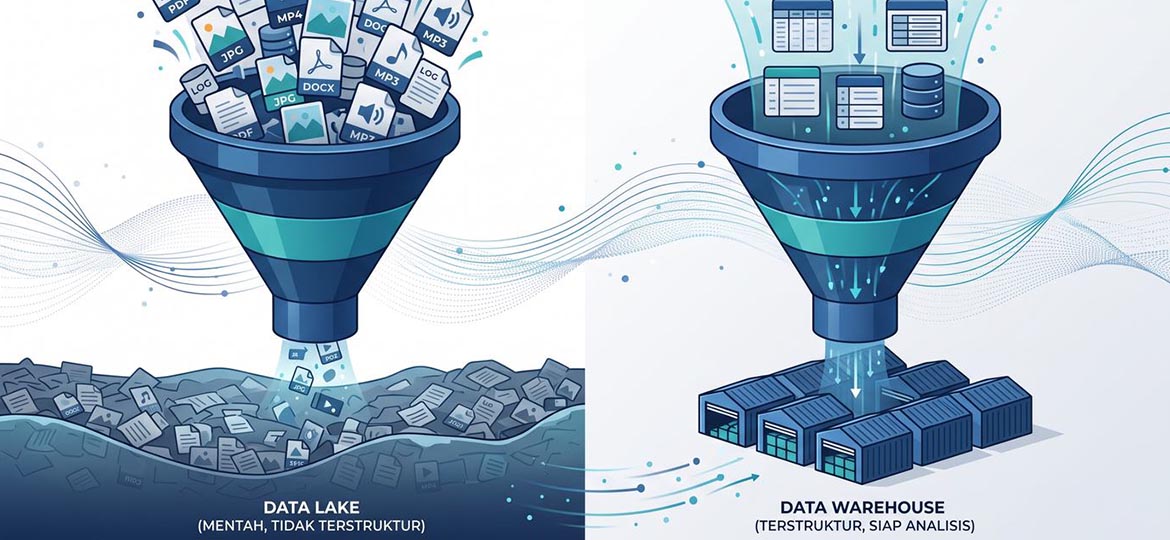
When a company starts getting serious about managing data, a question that often comes up is: “Is it better to use a data lake or a data warehouse?” The problem is that many guides out there only explain the definitions but don't discuss when to choose one or the other. This piece will help you understand the difference more practically, complete with a comparison table and a decision guide you can apply in your team right away.
In a nutshell: a data warehouse is a centralized repository that stores structured, already-processed data from various sources for business analytics and business intelligence. A data lake, by contrast, stores all kinds of data in its raw format with no fixed schema, serving as a flexible foundation for machine learning and exploratory analytics.
Through this article, we will dissect the two in order: what each is and who it's for, the difference across six concrete dimensions, when to use which, and then one piece of honesty vendors rarely write, namely that for the majority of Indonesian companies the answer is often not “pick one.”
Data Lake vs Data Warehouse: What's the Difference, Simply Put?
Picture a data warehouse as a goods warehouse that has been sorted, labeled, and neatly arranged on shelves, ready to be picked at any time. A data lake is a lake of raw water: everything comes in as is, and is only filtered when needed. The warehouse stores structured data for reporting; the lake stores raw, multi-format data for exploration.
The most fundamental difference is in when the data structure is determined. A data warehouse uses the schema-on-write approach: the schema is defined first, before data is stored, so data must be adapted to the predetermined structure. This approach maintains consistency and optimizes query speed, but is less flexible toward new data whose format is unexpected.
A data lake works the other way around with schema-on-read: data is stored in its original format, and a schema is applied only when the data is accessed or analyzed (Splunk). The consequence is that any data can enter the lake without needing to be adapted first. Flexible on the storage side, but it shifts the workload to the analysis stage.
This difference carries over to the data-loading process. The warehouse generally uses ETL (Extract, Transform, Load): data is cleaned and structured first, then loaded. The lake uses ELT (Extract, Load, Transform): data is loaded first, and transformation is done later when needed, as outlined in AWS's guide on the difference between a data warehouse, data lake, and data mart. And the context here is not an academic discussion.
What Is a Data Warehouse, and Who Is It For?
A data warehouse is a centralized repository for structured, already-processed data, designed so that business users can run queries directly without deep technical expertise. Its primary users are business analysts, executives, and operations or finance teams; its output is BI dashboards, KPI reports, and compliance reports, with a priority on consistency and readiness to use.
The core value of a warehouse is being a single source of truth, that is, one trusted data source used by all divisions. Rather than finance, sales, and operations each computing figures from their own spreadsheets, all of them refer to one repository that has already been tidied up. This is why a warehouse becomes the natural foundation for Analytics and Business Intelligence initiatives: a good dashboard needs clean and consistent data in the layer beneath it.
Because its data has already been processed through ETL, a warehouse excels at time-to-insight. A manager can open a sales dashboard and immediately trust the numbers, without having to reassemble data from various files. The consequence is that storage cost tends to be higher because the data has been purified and the infrastructure is optimized for SQL performance.
In the context of a company running an ERP, most of the data entering the warehouse comes from transaction systems such as SAP S/4HANA: highly structured customer, sales, and financial records. A classic SAP data warehouse for this kind of structured workload is SAP BW/4HANA, a data warehouse based on SAP HANA that can be deployed either on-premise or in the cloud. For those who want to dig into the technology options, the Data Management solutions page discusses it further.
What Is a Data Lake, and Who Is It For?
A data lake is a centralized repository that stores all kinds of data, structured, semi-structured, and unstructured, at any scale and in its original format. Its primary users are data scientists and data engineers, with the main use cases being machine learning (ML), predictive analytics, and large-scale data exploration. Flexibility is its strength; team maturity is its requirement.
The main advantage of a data lake lies in its flexibility; it can hold various kinds of data—from application logs and IoT sensors to documents, JSON files, CSV, even images and audio—without needing a rigid schema setup at the start. That is why a data lake is very well suited to AI projects, where machine-learning (ML) models require varied raw data, not merely summarized data.
On cost, a misunderstanding often arises. It is true that, because it uses object storage (such as AWS S3 or Azure ADLS), the per-GB storage cost of a data lake is far cheaper than a data warehouse. However, keep in mind that cheap storage does not mean the project's overall total cost is low. The compute cost of processing that raw data can balloon if it is not managed well.
The most real challenge is the human-resource requirement. Because data is only adapted when it is about to be used, you need competent data scientists or data engineers to turn that raw data into valuable insight. Without that expertise, a data lake that should be a strategic asset instead risks becoming a burden on the company—a risk we will examine more deeply in the next section.
The Difference Between a Data Lake and a Data Warehouse Across 6 Dimensions
The fastest way to compare the two is through a table. In short: the warehouse wins on consistency and readiness to use for business users; the lake wins on flexibility, scale, and storage cost for advanced exploration. The following six dimensions are the ones that most often determine the choice in the field.
|
|
|
|
|
|
|
|
|
|
|
|
|
|
|
|
|
|
|
|
|
|
|
|
One thing worth underlining: this table depicts two “pure” architectures. In practice, many modern platforms deliberately blur these boundaries, something we touch on in the last section. For now, treat this table as a map of two poles that serve as the reference points for your decision.
When Should You Use a Data Warehouse, and When a Data Lake?
Rather than agonizing over which is best, consider these four things to match your team's real needs:
-
Primary data type: If most of your data is structured (such as financial records or ERP transactions), a data warehouse is the primary choice. If you deal more with raw data such as logs or sensors, a data lake is a better fit.
-
Who the users are: Does the business team only need routine reports? Use a data warehouse. If your data-scientist team needs the latitude for deep data exploration, a data lake is far more flexible.
-
Team readiness: This is often the main determinant. Managing a data lake requires specialized expertise. If your team does not yet have a data engineer, a data lake can actually become an operational burden.
-
Priorities ahead: If your target this year is tidying up BI dashboards, start with a data warehouse. If there is already a solid plan for AI or machine-learning development, a data lake can enter your roadmap.
As a practical rule in meetings: if your team does not yet have a dedicated data engineer, you should prioritize the data warehouse first.
|
|
|
|
|
|
|
|
|
|
|
|
|
|
|
|
Do You Have to Choose One? (Often Not)
For most companies, the answer is not “pick one.” A data lake and a data warehouse are complementary, not mutually exclusive. The most realistic pattern for Indonesian companies is gradual: build a solid data warehouse first, then add lake capabilities once the team and the ML need are truly mature.
This part is rarely written by competitors, yet this is where most decisions go wrong. Most large organizations actually use a combination of data lake and data warehouse, rather than choosing one exclusively (AWS). The pattern is often layered: data enters the lake as a landing zone, then part of it is curated and loaded into the warehouse for ready-to-use operational analytics.
So when does a company NOT yet need a data lake? Hold off for now if your situation still looks like this:
-
The data team is still small and doesn't yet have a dedicated data engineer or data scientist.
-
Almost all your data is structured and comes from transaction systems such as ERP.
-
Your priorities for the year ahead are still around reporting and dashboards, not ML.
Forcing a lake under these conditions invites the classic risk: a data swamp, that is, a data lake that turns unmanaged and hard to navigate because data is poured in without governance, a catalog, or a steward (AWS). The illustration is sharp. Splunk's research in The State of Dark Data report found that around 55% of the data organizations hold is “dark”—never actually analyzed. Building a giant lake whose contents largely settle untouched is therefore real waste, not progress.
This is where modern platforms change the question. SAP Datasphere (formerly SAP Data Warehouse Cloud), launched on March 8, 2023, provides data federation and virtualization capabilities: data in source systems (including SAP S/4HANA, non-SAP sources, and cloud storage) can be queried without always being physically moved. Its model is “connect, not just move,” so the rigid “warehouse versus lake” boundary becomes more fluid. Note that Datasphere is a data-management platform with federation capabilities; it can access data in a lake, but it is not a data-lake platform itself.
There is also a third path, namely the data lakehouse architecture that seeks to combine the strengths of both in one paradigm. Its discussion is beyond the scope of this article, but it is worth exploring once you are comfortable with the two basic concepts above.
FAQ (Frequently Asked Questions)
What is the fundamental difference between a data lake and a data warehouse?
A data warehouse stores data that is already tidy and ready to use for business reports. A data lake, meanwhile, is like a storage warehouse for raw data (including the unstructured kind) for deep exploration needs such as machine learning.
What is a data warehouse?
It is a centralized storage place for processed, structured data. Its purpose is to let the business team obtain accurate and consistent reports or dashboards directly, without needing high technical expertise.
What is a data lake?
A data lake is a large container for storing various kinds of data in their original format. Data does not need to be transformed on the way in, so it is very flexible for experimentation or data-research needs by data scientists.
When should you choose a data lake?
Choose it if you manage a lot of raw data (such as logs or sensors), have a capable team of data engineers or scientists, and have a long-term target for AI or large-scale data analysis.
When should you choose a data warehouse?
Use it if your focus is stable business reports, KPI dashboards, and data consistency. It is highly recommended for companies whose data is already well structured (such as transactional data).
Can the two replace each other?
No. The two actually complement each other. Most large companies use both at the same time: the data lake to store raw data, and the data warehouse to present ready-to-use data for operational business needs.
What is a data swamp and how do you prevent it?
A data swamp is a condition in which a data lake becomes chaotic and unusable because it is not managed well. To prevent it, you must apply a data-catalog system, clear governance rules, and ensure there is a team responsible for keeping its data clean.
Conclusion
The question “data lake or data warehouse?” is best answered not by picking a side, but by understanding your situation: the dominant data type, the user profile, team maturity, and use-case priorities for the year ahead. For most Indonesian companies, the safest order is to build a tidy data warehouse first, then add lake capabilities once the need and the team are truly ready—not the other way around. An architecture decision like this determines whether data becomes an asset or a burden. This is where the role of an experienced implementation partner is felt: Soltius helps companies, especially those that have run an ERP for years and accumulated large volumes of data, design the right data architecture, from a data-warehouse foundation to integrating data-lake capabilities, tailored to the team's maturity and the system landscape already in place.
To assess your company's data-architecture readiness and move from plan to implementation, explore Soltius's Data Management solutions at soltius.co.id or start with a consultation session.
Other News