Blog

Differences Between SAP Signavio and SAP LeanIX: A Guide to Choosing the Right Transformation Tool
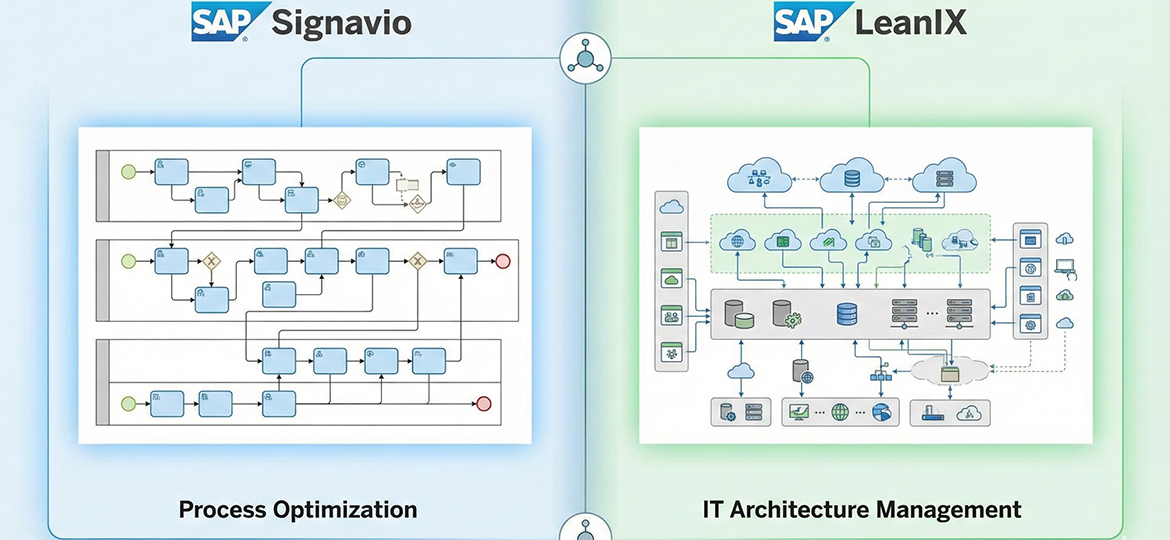
The digital transformation journey is now a necessity. However, modernization is often hindered by internal complexity, whether it be convoluted business processes or an IT landscape riddled with Technical Debt. The good news is that SAP has acquired two major systems: SAP Signavio and SAP LeanIX. Unsurprisingly, confusion has arisen: which one is best suited for my business?
As an analogy, imagine your digital transformation is the construction of a city. SAP Signavio acts as the Urban Planner, ensuring traffic flow (business processes) runs efficiently, while SAP LeanIX serves as the Civil Engineer, mapping and managing the infrastructure (applications and IT architecture) to ensure it is robust and integrated. We will review these fundamental differences not just as features, but as specific problem domains—so you can choose the right tool to accelerate your business goals.
Understanding the Differences Between SAP Signavio and SAP LeanIX: Process vs. Architecture
The most fundamental difference every IT decision-maker must understand lies in the primary focus of these two solution suites.
SAP Signavio: Focus on 'How' (Business Processes)
SAP Signavio is a leader in the realms of Business Process Management (BPM) and Process Mining. Its primary focus is understanding, analyzing, and optimizing business workflows (the how).
Signavio aims to provide total visibility into your end-to-end processes, from Order-to-Cash to Procure-to-Pay. By mining log data from execution systems (such as ERP or CRM), Signavio can:
-
Discover actual processes as they currently run (As-Is).
-
Model ideal target processes (To-Be).
-
Analyze process variants, bottlenecks, and the root causes of inefficiency.
Key Points:
-
Signavio Process Intelligence (Process Mining): Uses data to visualize actual process paths and measure KPIs like cycle time.
-
Signavio Process Manager: Collaboration for modeling processes, diagrams, and decision maps.
SAP LeanIX: Focus on 'What' (IT Assets/Applications)
SAP LeanIX, on the other hand, is an Enterprise Architecture Management (EAM) tool that focuses on IT assets and applications (the what) that support those business processes.
LeanIX is designed for IT Architects and Enterprise Architects to manage the complexity of the technology landscape. LeanIX helps answer questions such as:
-
Which applications are redundant and expensive (Technical Debt)?
-
Which applications are high-risk because they are obsolete or unsupported by vendors?
-
How do we map existing applications to Business Capabilities?
Key Points:
-
Application Portfolio Management (APM): Categorizing, assessing risk, and planning the decommissioning of applications.
-
Enterprise Architecture Management: Mapping relationships between applications, data integrations, and supported capabilities.
Consultant's Key Point: Signavio helps you discover where your process is broken (e.g., 40% of orders require manual intervention). LeanIX helps you decide which application to keep, modify, or discard to fix that process breakage.
A Clear Separation of Duties
To simplify understanding, here is a comparison of the tasks that separate the two platforms:
| Feature | SAP Signavio (BPM & Process Mining) | SAP LeanIX (Enterprise Architecture) |
| Problem Domain | Operational & Business Process Efficiency. | IT Landscape Complexity & Technical Debt. |
| Primary Question | How do we work? Where are the bottlenecks? | What are our IT assets? Are they still relevant and cost-efficient? |
| Key Metrics | Cycle Time, Process Variants, Conformance. | Total Cost of Ownership (TCO), Obsolescence Risk, Number of Redundant Apps. |
| Primary Users | Process Owners, Business Analysts, Compliance Officers. | Enterprise Architects, IT Architects, CIOs, IT Planners. |
| Project Targets | Process Transformation, Supplier Optimization, Financial Excellence. | Application Rationalization, Cloud Migration, ERP Transformation. |
When to Use SAP Signavio?
As a consultant, I advise clients to choose Signavio when their core issues lie in operational efficiency and process standards.
-
Operational Workflow Optimization: Signavio is vital if you face severe delays in vital processes like Order-to-Cash or Procure-to-Pay.
-
Process Compliance & Governance: In regulated industries, Signavio ensures full compliance of every transaction against Standard Operating Procedures (SOPs).
-
ERP & SAP S/4HANA Transformation: During migration projects, Signavio supports the process decision-making phase.
When to Use SAP LeanIX?
Choose LeanIX when the primary issues are IT visibility, cost management, and long-term architectural planning.
-
Application Rationalization: The primary solution for reducing licensing and maintenance costs (TCO) caused by redundant applications.
-
Obsolescence Risk Management: Prevents security crises and downtime caused by technology that is no longer supported (End-of-Life).
-
Cloud Migration Planning & Roadmapping: Functions as a navigation map during cloud migration or the transition to SAP S/4HANA.
Signavio and LeanIX Integration: Working Together
The collaboration between Signavio and LeanIX is a perfect synergy. While both have different focuses, their maximum potential is reached through integration. Both are essential elements of the SAP Business Transformation Suite.
Synergistic Data Integration:
-
Signavio Informs LeanIX: Data from Process Mining identifies inefficient processes. This information is then linked to the supporting applications in LeanIX. IT Architects can then prioritize the modernization of applications that support the most critical and problematic business processes.
-
LeanIX Informs Signavio: Architecture maps in LeanIX provide technological constraint contexts to Signavio Business Analysts. For example, it helps explain why a process cannot run faster (due to an underlying obsolete application).
This integration is crucial in SAP transformation methodologies like SAP Activate, where both tools play key roles, particularly in the Discover and Realize phases.
Conclusion & Final Recommendations
Signavio and LeanIX are two sides of the same coin in digital transformation: Process (Signavio) and Architecture (LeanIX). Neither is "better"; there is only the one that is more appropriate for your current challenges.
Choose SAP Signavio or SAP LeanIX?
Base your choice on the primary problem you face:
Choose SAP Signavio if:
-
Your Problem: Processes are too slow, expensive, or non-compliant.
-
Your Goal: Reducing P2P cycle times, increasing data accuracy.
-
Primary Users: Business Owners & Process Analysts.
Choose SAP LeanIX if:
-
Your Problem: The application landscape is too complex, expensive (high TCO), or lacks transparency.
-
Your Goal: Reducing technical debt, planning cloud migration, rationalizing applications.
-
Primary Users: IT Architects & Application Portfolio Managers.
Start with the tool that solves your company's most pressing problem. To ensure a smooth integration for end-to-end transformation, SOLTIUS is ready to be your discussion partner in building ideal business processes on a solid technological foundation.
Other News