Blog

ESG for Indonesian Companies: From a Reporting Obligation to an Auditable Data System
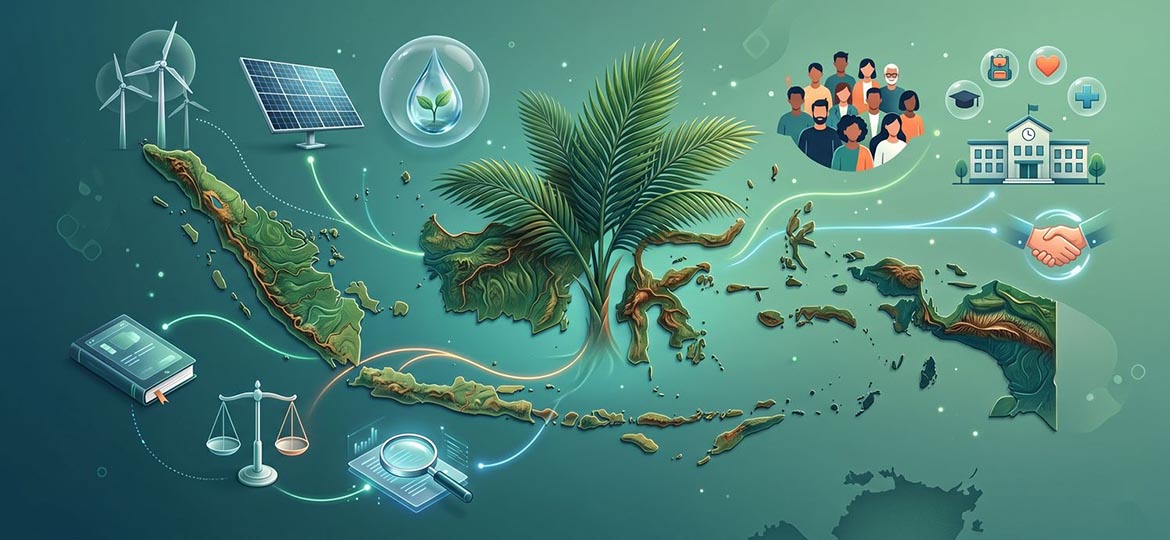
Every January, we know the scene all too well. Utter chaos. Take, for instance, a client's office in an industrial estate in the middle of last month: the sustainability team had to pull all-nighters just to scrape together emissions data from Excel documents scattered everywhere. Picture this, the factory's electricity consumption was still being tallied by hand in a notebook, yes, you read that right, while the POJK 51 reporting deadline from the Financial Services Authority was already squeezing their necks. And before the internal mess was even sorted, along came an email from an overseas buyer suddenly fussing for details of the carbon footprint of their first-quarter order. Stressful? Absolutely. But this is the raw reality of ESG in Indonesia today. Forget about posting a smiling photo of the directors planting mangroves on the front page of the Annual Report. ESG is now purely a matter of business survival and legal compliance that demands hard numbers, not mere window-dressing chatter.
So how do we turn this frustrating pile of administrative burden into a sound data system? We'll be blunt in dissecting what domestic regulations actually require, the brutal pressure from export markets, step by step how to build reporting that won't be laughed at by an independent auditor, and most crucially, when your company in fact does not yet need to throw hundreds of millions of rupiah at an ESG software subscription.
In brief: ESG is a framework for assessing a company's performance across three non-financial dimensions, namely environmental, social, and governance. Investors, regulators, and trading partners use this framework to judge a company's sustainability and risk beyond the profit-and-loss statement.
What is ESG and why is it increasingly urgent for Indonesian companies?
The ESG framework breaks sustainability performance into three measurable domains. The environmental domain concerns greenhouse-gas (GHG) emissions, energy and water consumption, and waste management. The social domain covers occupational health and safety (OHS), workers' rights, diversity, and impact on the surrounding community. The governance domain addresses board structure, anti-corruption, reporting transparency, and risk management.
What distinguishes Indonesia's situation from a mere global trend: the push here is now one of concrete regulation, not exhortation. OJK Regulation Number 51/POJK.03/2017 on Sustainable Finance requires financial services institutions, issuers, and public companies to prepare a Sustainability Report (sustainability report) every year.
The pressure does not stop at the regulator. Institutional investors increasingly use sustainability scores as a filter before deploying funds, and a number of banks are starting to tie loan interest rates to a borrower's environmental-social performance. For companies that want to grow through funding or stay in a large corporation's supply chain, ESG is shifting from a value-add to a prerequisite.
Is my company required to produce a sustainability report?
The short answer depends on your legal form. Not all companies in Indonesia are legally required, but the scope keeps widening.
|
|
|
|
|
|
|
|
|
A public company in this context is defined as a company with more than 300 shareholders and paid-up capital above Rp 3 billion. The report format refers to OJK Circular Letter Number 16/SEOJK.04/2021. Among businesses not yet required, many still prepare a report voluntarily to open access to sustainability-based funding and to qualify for tenders, including tenders by a number of state-owned enterprises (BUMN).
Why ESG Pressure Is No Longer Just About Regulators, but Buyers Too
This part is often overlooked, yet its impact is very real for exporters. Starting January 1, 2026, the European Union begins full enforcement of the Carbon Border Adjustment Mechanism (CBAM). Put simply, this is a carbon levy on imported products with high emissions such as iron, steel, aluminum, cement, fertilizer, and even electricity. After a transition phase that only required reporting from October 2023, importers there are now obliged to buy and surrender certificates based on the amount of emissions embedded in the product.
For Indonesia, this is a serious challenge. The value of our iron and steel exports to the European Union reaches around USD 1 billion, while aluminum contributes around USD 60 million (Pajakku, 2025). Some analyses even predict that CBAM could raise the cost of Indonesian steel exports to Europe by up to 20% (Bisnis, December 2025). Although this figure is still an estimate, the message is very clear: buyers now demand emissions data that is genuinely valid and verified. If a company cannot provide it, there is a large risk of being dropped from the list of preferred suppliers. In short, sustainability is no longer merely the CSR team's task but has become the key to staying in the international market.
Stages of building an auditable sustainability report
Collecting data once for a single report is one thing; building a system that produces consistent, audit-resistant numbers every year is another. The pattern often seen in the field falls into four phases. The durations below are typical ranges in the field, not a guarantee.
|
|
|
|
|
|
|
|
|
|
|
|
|
|
|
|
The phase most often underestimated is data consolidation. In many companies, the financial figures are already tidy in the ERP (Enterprise Resource Planning) system, but emissions, energy, and occupational-safety data still live in separate spreadsheets owned by each division. As long as sustainability data does not share the same source as operational data, the report will always be prone to discrepancies and hard to trace when audited.
This is precisely why the market is moving toward ESG software connected directly with the ERP. Several research firms estimate the global sustainability-reporting software market at around USD 1.2–1.3 billion in 2024–2025, projected to grow to around USD 4–7 billion in the early 2030s (a CAGR of roughly 16–21%, varying by firm). One practical driver: this kind of data integration is estimated to be able to cut manual entry by up to 80% (Roots Analysis, 2025), with a typical implementation duration of 4–12 weeks depending on data complexity.
This is where the role of an implementation partner becomes relevant. For example, a solution provider like Soltius implements the SAP Sustainability suite (including the Sustainability Control Tower and Product Footprint Management) that places sustainability data on the same ERP foundation as financial data, so that every reported figure can be traced down to its transaction.
When you DON'T yet need dedicated ESG software
Competitors rarely say this, but not every company needs to buy a platform right away. There are conditions in which a well-organized spreadsheet, plus consultant support, is already adequate for the first year. Consider delaying a dedicated software investment if:
-
Your company is not yet among those required by POJK 51, and there is not yet any request for sustainability data from buyers or lenders.
-
Operations are centralized at a single location with a small data volume, so manual consolidation is still manageable.
-
You are only just preparing your first report and don't yet know which framework (GRI or IFRS S1/S2) will settle in.
Preparing a first sustainability report via the consultant route is estimated to cost Rp 250–700 million, already including the materiality assessment and third-party assurance if taken (market estimate, Environment Indonesia, 2026). Buying a platform only to produce one report once a year is often not yet worth it. Software truly pays off when data must be collected repeatedly, from many locations, and must withstand an audit year after year.
FAQ (Frequently Asked Questions)
What is ESG?
ESG stands for Environmental, Social, and Governance, a framework for assessing a company's performance on the environmental, social, and governance aspects. The framework is used by investors and regulators to measure sustainability and risk beyond the financial statements.
Is a sustainability report mandatory in Indonesia?
It is mandatory for financial services institutions, issuers, and public companies under POJK 51/POJK.03/2017, with a submission deadline of April 30 each year. MSMEs and private companies are not yet required, although many prepare one voluntarily for funding access and tenders.
What is the difference between ESG and CSR?
CSR (Corporate Social Responsibility) focuses on social programs and a company's contributions to society. ESG is broader and more measurable: it assesses environmental, social, and governance performance with auditable data, making it more relevant to investors and regulators.
How much does it cost to prepare a sustainability report?
For a first report, the market estimate ranges from Rp 250–700 million, covering consultants, the materiality assessment, and third-party assurance if taken. This figure varies by company size and complexity, so treat it as a reference, not a fixed benchmark.
How long does ESG software implementation take?
The typical duration ranges from 4–12 weeks, depending on the number of reporting frameworks, data complexity, and the need for integration with an existing ERP or financial system. Projects with many locations tend to be at the upper end of this range.
What is CBAM and how does it relate to ESG?
CBAM (Carbon Border Adjustment Mechanism) is the European Union's carbon levy on imported products with high emissions, fully in effect since January 1, 2026. The connection: exporters now have to provide verified emissions data, which is the core of the environmental-dimension reporting within ESG.
Is ESG suitable for SMEs?
Yes, at an appropriate scale. SMEs that supply large corporations or export are often asked for basic sustainability data. For them, starting from simple measurement makes more sense than immediately buying a platform.
Conclusion
Sustainability pressure in Indonesia comes from two directions at once: regulators that mandate reporting and global buyers that demand verified emissions data. Both converge on the same need, namely data that is consistent, connected, and auditable. A company that treats ESG as an annual document project will keep racing against deadlines; one that treats it as a data system will turn it into an advantage when investors and trading partners ask.
As an SAP implementation partner in Indonesia, Soltius helps companies link sustainability data to the same ERP foundation as their operational data, so that reporting can be traced back to its source.
To discuss your company's ESG readiness and sustainability solution options, visit www.soltius.co.id.
Other News