Blog

Introduction to SAP EWM: What Is Extended Warehouse Management and How Does It Differ from Standard WM?
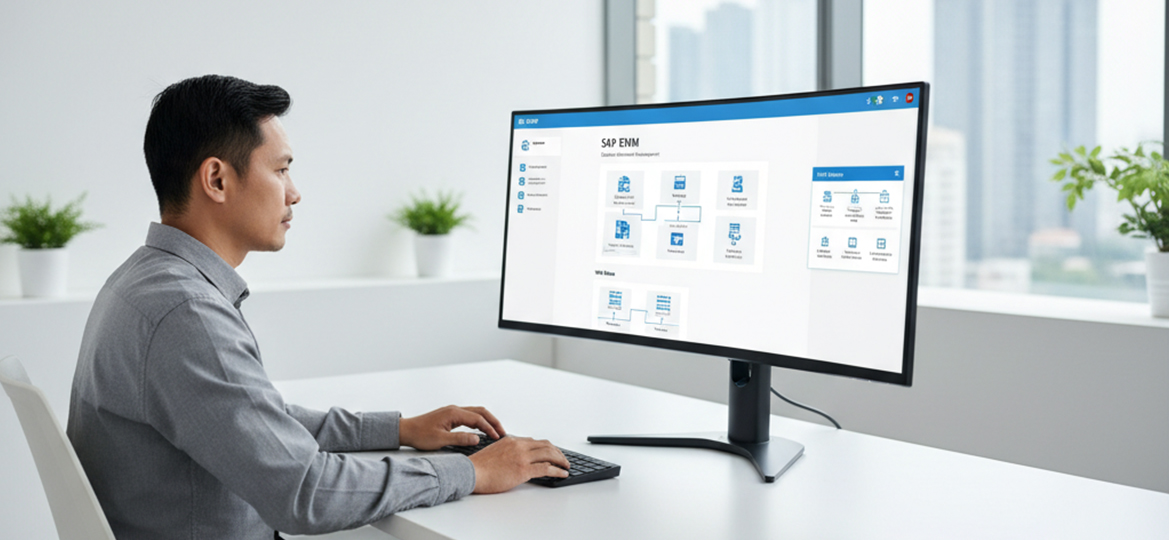
As modern logistics evolve, warehouses have transformed from mere storage spaces into central hubs that determine the smoothness of the supply chain. Inaccuracies in warehouse management can have wide-ranging impacts, such as stock discrepancies, shipping delays, and a decline in customer satisfaction. Therefore, warehouse management technology now plays a vital role in supporting business sustainability.
This is where SAP Extended Warehouse Management (EWM) comes in as the latest solution. For some business professionals, the name SAP WM (Warehouse Management) may be more familiar. So, what exactly is SAP EWM, and how does it differ from the standard WM that was used before it? Let's discuss it thoroughly here!
When Warehouse Management Becomes So Crucial
The boom in e-commerce and modern retail has turned the warehouse into a focal point of the supply chain that can no longer be overlooked. Coupled with rising customer expectations for a complete selection of products with secure stock levels and guaranteed fast delivery, warehouse management must be thoroughly optimized.
Furthermore, the number of SKUs in a warehouse can reach thousands, with increasingly complex variations. Relying solely on manual records or legacy systems significantly increases the risk of operational chaos.
At this point, many companies realize they need a more advanced warehouse management system—a system that not only records incoming and outgoing goods but also provides full control over every movement within the warehouse. In this context, SAP offers two solutions: WM and EWM. To understand EWM, let's first look at how WM works.
Understanding SAP WM
SAP WM (Warehouse Management) is the classic module within SAP ERP designed to manage basic warehouse activities. This module covers goods receipt, storage, picking, and shipping. With WM, companies can reduce manual recording errors and improve stock accuracy.
However, as the supply chain has evolved, company needs have become more complex. While WM is sufficient for standard requirements, it becomes limited when a company deals with thousands of SKUs, multiple warehouse locations, or the need for automation. This is where WM starts to feel inadequate, leading SAP to develop a more comprehensive solution: EWM.
SAP EWM: The Evolution of WM
Extended Warehouse Management (EWM) is the next-generation warehouse management system equipped with more comprehensive features than WM. EWM can run as part of SAP S/4HANA (embedded) or as a separate, standalone system. Its purpose is to give companies full control over their warehouse operations, from the simple to the highly complex.
With EWM, companies can handle advanced management processes such as integration with automated warehouses, yard management, cross-docking, and labor planning. While standard WM focuses on what is stored and where it is located, EWM's scope is broader, managing how goods move and who handles them with far greater detail and flexibility.
Key Differences Between WM and EWM
What are the main differences between SAP WM and EWM? Here they are:
-
Scope & Scalability WM is suitable for warehouses with standard needs, such as in small-scale factories, while EWM supports large-scale and complex operations, like those in large corporations and e-commerce.
-
Additional Features EWM introduces slotting & rearrangement (optimizing goods location), labor management, yard management, and integration with warehouse automation.
-
System Architecture WM is a module within SAP ERP, whereas EWM can run as an embedded component in SAP S/4HANA or as a standalone system.
-
Modern Integration EWM can connect with the latest automation technologies, from smart conveyors to Automated Guided Vehicles (AGVs).
-
Future of the System SAP has discontinued the development of WM. All future innovations and updates are focused on EWM. Thus, EWM is not just an "upgrade" of WM but a significant leap toward modern warehouse management that is better prepared for future challenges.
Why Is It Time to Switch to EWM?
Why should your company start considering a switch to SAP EWM? Here are a few reasons:
-
Operational Efficiency: Faster and more accurate picking and putaway processes with minimal errors.
-
Real-Time Visibility: Companies can track the position of goods down to the smallest unit.
-
Industry Flexibility: EWM can be adapted across various sectors, from manufacturing, retail, and e-commerce to FMCG.
-
Automation Support: Seamless integration with robotic systems, conveyors, and smart storage.
-
Improved Customer Service: Faster shipping, fewer errors, and increased satisfaction.
Soltius: The Right Partner for SAP EWM Implementation
However, implementing SAP EWM is about more than just installing software. In reality, its implementation requires a sound strategy and extensive experience to ensure it aligns and synergizes with business needs. This is where Soltius comes in as a trusted partner you can rely on.
As part of the Metrodata Group and an SAP Platinum Partner, Soltius has a long track record of helping various industries optimize their warehouse operations with SAP solutions.
Soltius is always ready to provide full support, from planning and implementation to post-go-live support.
If your business wants to take the next step in warehouse and supply chain efficiency, SAP EWM from Soltius could be the answer. It's time to optimize your warehouse with SAP EWM alongside Soltius. Contact us now for a further consultation!
Other News