Blog

Public vs Private vs Hybrid Cloud: The Differences and How to Choose
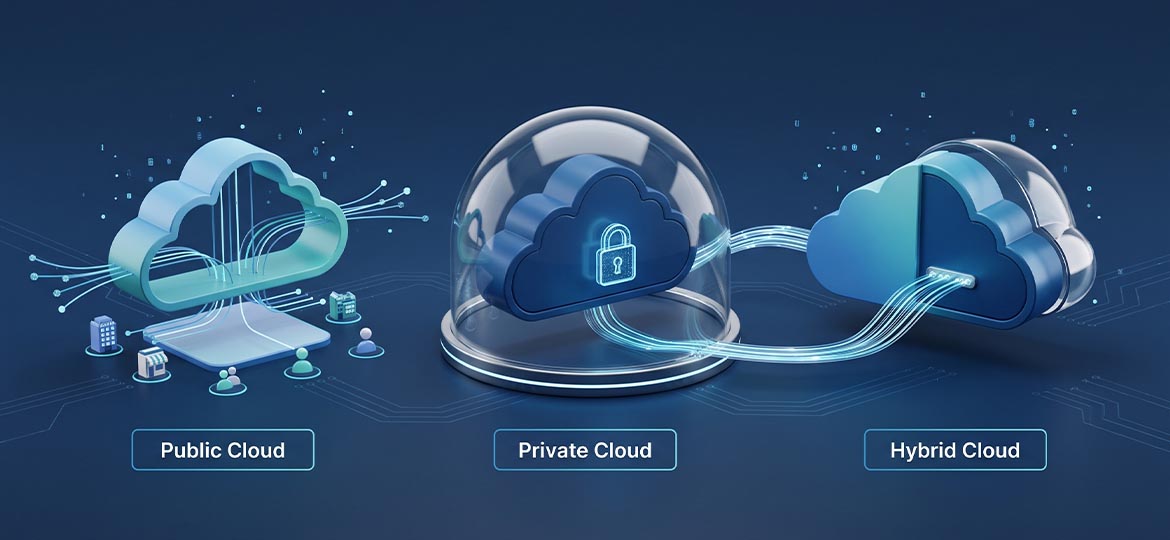
Vendors often throw around all three terms at once: public cloud, private cloud, and hybrid cloud. For an architecture team, choosing between public, private, or hybrid cloud is about more than terminology. It is a major decision that determines where sensitive data lives, the cost, and how flexibly capacity can scale. This article compares all three side by side. It also offers a selection framework as a deeper dive into the topic of cloud services.
In short, public cloud, private cloud, and hybrid cloud are three cloud deployment models under NIST SP 800-145. Public cloud uses the provider’s shared resources, so it is multi-tenant. Private cloud is for a single organization only, single-tenant. Hybrid cloud connects the two so that data and applications can move between environments.
Public vs Private vs Hybrid Cloud: A Head-to-Head Comparison
These three models differ in more than just shared versus private. The differences also cover tenancy, control and customization, data location and sovereignty, cost, latency, and scalability. For that reason, the effective way to compare them is to map your workload needs against each dimension, not just read the definition of each model.
|
Tenancy (NIST) |
Multi-tenant, shared by many organizations |
Single-tenant, dedicated to one organization |
A combination of both, interconnected |
|
Data location & sovereignty |
On the provider’s premises |
On-premise or off-premise, can be third-party |
Sensitive data kept on the private side |
|
Control & customization |
Lowest (provider standard) |
Highest (full control) |
Per workload |
|
Cost profile |
OpEx, pay as you go |
Larger upfront commitment/CapEx |
A mix |
|
Latency & location control |
Depends on the provider’s region |
Can be brought closer to users/plants |
Latency-sensitive workloads on private/edge |
|
Scalability |
Most elastic and fastest |
Limited to installed capacity |
Elastic on the public side (cloud bursting) |
|
Best suited when |
Fluctuating load, needs to be fast |
Strict regulation/control, stable load |
Some data controlled, the rest elastic |
Two things are often misunderstood. First, private cloud is not the same as a server in your own office. NIST SP 800-145, the reference standard published in September 2011 that lays out four deployment models and three service models, states that private cloud can be on-premise or off-premise and operated by a third party. What matters is that private cloud is dedicated to a single organization.
Second, NIST also names community cloud as a fourth model. This model is rarely used commercially in Indonesia.
How do you choose the right cloud model?
Choose the cloud model to fit the needs of each workload. Do not make a single decision for the whole company. Weigh five main factors: data sovereignty or compliance, cost, latency, control, and scalability. Two companies can have the same workload yet choose different models, because their priorities across those five factors are not always the same. Here is a practical guide.
- Choose public cloud if the workload changes often, needs fast provisioning, and has no data-location requirement.
- Choose private cloud if you need tight control and compliance. Also choose it if the workload is relatively stable. Use private cloud when sensitive data must be managed entirely in house.
- Choose hybrid cloud if some data must stay under control. Other workloads that need elasticity can also run in this pattern. This pattern is the most commonly used in large companies.
Personal data protection obligations, in particular Law No. 27 of 2022, often push toward private or hybrid cloud. This is especially true in the finance and healthcare sectors. Right now, the hybrid pattern has become dominant. According to Flexera 2026 State of the Cloud Report, 73% of organizations use hybrid cloud. That is up about three points from the previous year.
How Do Deployment Models Relate to RISE with SAP?
Once what you are moving is the core system, that is, the ERP that runs finance, inventory, and production, the deployment choice determines the room for customization, the compliance path, and the downtime plan. In the SAP landscape, the RISE with SAP program brings SAP S/4HANA Cloud in two editions that map directly onto this axis.
Private Edition is single-tenant with more room for customization. Control over the upgrade schedule stays with the customer. Public Edition is multi-tenant SaaS with automatic upgrades twice a year. For companies weighing this step, migrating the ERP to the cloud is the logical next step after the deployment decision.
Note that hybrid cloud does not always deliver the best of both models. Hybrid adds integration complexity, the burden of managing two environments, and management cost.
Hybrid is also different from multicloud. Hybrid mixes connected public and private. Multicloud uses several public clouds at once and can run with no private cloud at all. The two are often confused.
FAQ (Frequently Asked Questions)
What is the difference between hybrid cloud and multicloud?
Hybrid cloud combines connected public and private cloud so workloads can move between environments. Multicloud uses several public clouds from different providers and can run without private cloud. According to Flexera 2026, 73% of organizations use hybrid cloud. Only about 14% are truly multicloud. One company can use both at once.
Which cloud model is the most secure: public, private, or hybrid?
No cloud model is automatically the most secure. Security depends on the configuration, the division of responsibility, and compliance. Private or hybrid cloud is often chosen for sensitive data because a company can control where the data lives. This aligns with Law No. 27 of 2022 on Personal Data Protection. Data and identity remain the company’s responsibility across all models.
Is private cloud always in your own office?
No. According to NIST SP 800-145, private cloud can be on-premise or off-premise and can be run by a third party. What matters is that the service is for a single organization (single-tenant), not the physical location of its servers. A private cloud hosted in a provider’s data center still counts as private as long as it is used exclusively by one organization.
Conclusion
The main question is not just choosing between public, private, or hybrid cloud. What matters is determining the model that fits each workload best, weighing data sovereignty, cost, latency, control, and scalability. For core systems, this decision is critical. As a Best RISE & Best Cloud Partner (2021) with experience since 1998, Soltius supports migrating core systems to the cloud through RISE with SAP and Migration services. Soltius also maps each workload to the cloud model that fits best.
To discuss the deployment model that fits your workloads and core systems best, visit soltius.co.id.
Other News