Blog

RISE with SAP for Manufacturing: Benefits and Migration Considerations
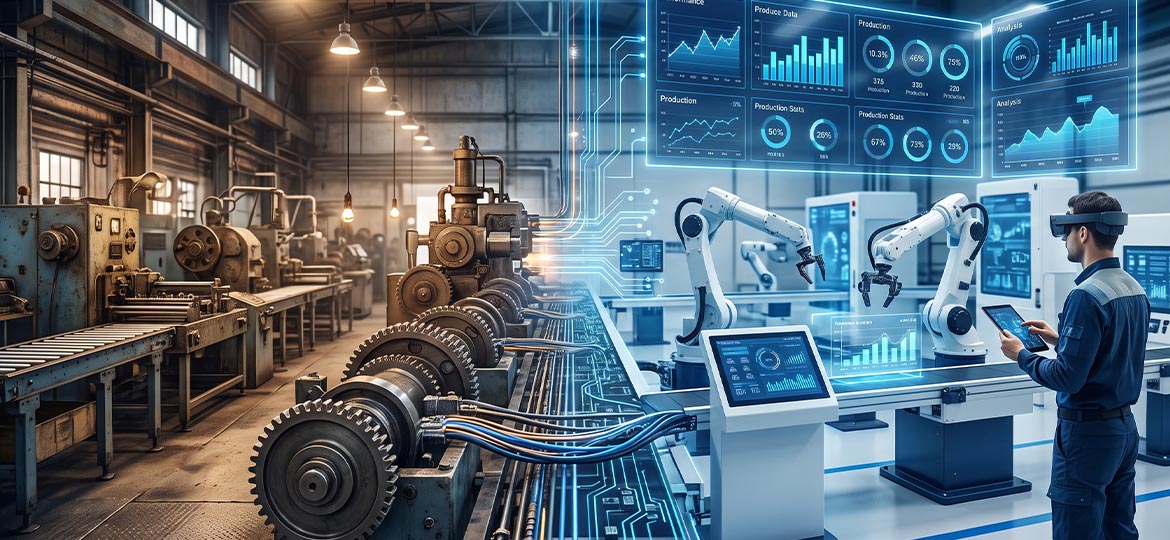
A Head of Manufacturing running SAP ECC understands a unique challenge: the production line cannot stop for days on end. A guide to migrating ERP to the cloud generally does not address this. This article separates the real benefits of RISE with SAP on the production floor from the migration considerations specific to the manufacturing industry.
In short, RISE with SAP for manufacturing is a subscription package, Business Transformation as a Service, that includes SAP S/4HANA Cloud Private Edition as the digital core of production, SAP Business Technology Platform, and SAP Business Network. SAP manages the cloud infrastructure. As a result, the factory IT team can focus on production processes rather than server maintenance.
What are the manufacturing-specific benefits of RISE with SAP?
The main benefits are felt directly on the production line, not just in the back office. Production Planning (PP) in SAP S/4HANA matches the schedule with material availability and machine capacity in real time. Detailed scheduling can be done down to the hour and minute (PP/DS). Production visibility improves because machine conditions can be monitored directly, not through manual recaps.
- Real-time production planning. PP reads machine capacity and material availability at the same time, then builds a schedule that can actually be run, not just a target on paper.
- Shop-floor-to-ERP connectivity. Machine data flows into the ERP through SAP Digital Manufacturing. This solution connects the shop floor with the core system.
- Embedded OEE analytics. OEE (Overall Equipment Effectiveness) is calculated from Availability, Performance, and Quality. This value is monitored through SAP Analytics Cloud, which is already connected to SAP Digital Manufacturing. You no longer need to export data manually to Excel.
- Managed infrastructure. SAP handles hosting, technical maintenance, and security monitoring 24 hours a day. The configuration, data, and business processes remain the property of the manufacturing plant.
Unlike back-office systems, a factory cannot stop for several days during cutover. Machines and non-SAP MES (Manufacturing Execution System) must stay connected. The PP, Quality Management (QM), and Plant Maintenance (PM) modules are usually the most heavily customized. Custom-code remediation is generally most complex on the production line.
SAP ensures that production planning and execution run in sync directly between the ERP and the MES (SAP). The following six factors are the main determinants:
|
Production continuity during cutover |
Line stops, orders late |
Schedule the cutover in a maintenance/shutdown window; prepare a rollback plan before go-live |
|
Machine & MES integration (non-SAP OT) |
Shop-floor data cut off after migration |
Map the interfaces (e.g., OPC UA / SAP Digital Manufacturing) from the Explore phase |
|
PP/QM/PM custom code |
Incompatible objects spill over into production operations |
Run SAP Custom Code Migration app; move extensions to BTP (clean core principle) |
|
Material & BOM master data |
Wrong component, wrong cost |
Clean and validate before migration (SAP Migration Cockpit) |
|
Batch management & quality (QM) |
Quality records and traceability broken |
Test the full production cycle during UAT, not just finance transactions |
|
Dual-run & parallel licensing |
Double infrastructure cost not budgeted for |
Model a parallel period of ±3–12 months (industry estimate, not an official SAP figure) |
An incorrect BOM (Bill of Materials) and material master are the most expensive source of error because they affect cost and schedule. Dual-run should be the practice benchmark on the ground. The common range is 3 to 12 months, not an SLA commitment from SAP.
When Is Your Factory Ready (and Not Ready) to Move to RISE?
A factory is ready if its production processes are already standardized. Material and BOM data are clean. A maintenance window for cutover is also available. A factory is not ready if the production floor is still manual. PP custom code has piled up with no owner. Production runs 24 hours a day, 7 days a week with no break at all.
Local context matters a lot. According to the Ministry of Industry, the seven priority sectors of Making Indonesia 4.0 contribute about 70% of manufacturing GDP. However, each factory’s digital readiness differs. The INDI 4.0 index measures it on a scale of 0 to 4. SAP ECC’s main maintenance deadline falls on December 31, 2027. This raises the urgency, but production-floor readiness remains the primary factor. RISE is not a quick fix for a factory with an immature MES. Shop-floor connectivity must be resolved first. The first concrete step is to run SAP Readiness Check and map the production-floor integration from the outset. All of that must be done before setting a cutover schedule.
FAQ (Frequently Asked Questions)
Does production have to stop during the migration to RISE with SAP?
Not throughout the project. Most of the work is done in parallel (dual-run), but the final cutover still requires a scheduled downtime window, ranging from a few hours to a few days depending on scope. The key is to schedule the downtime during a production maintenance window and to prepare a rollback plan before go-live.
Is SAP Digital Manufacturing included in the RISE with SAP package?
No. RISE consists of three pillars: SAP S/4HANA Cloud Private Edition, SAP Business Technology Platform, and SAP Business Network. Production Planning is indeed part of S/4HANA. However, SAP Digital Manufacturing is a separate MES solution with its own license that connects directly to S/4HANA.
What is the main benefit of RISE with SAP for the manufacturing industry?
Production Planning in SAP S/4HANA matches the schedule with material availability and machine capacity in real time. The system performs detailed scheduling down to the hour and minute (PP/DS). SAP manages the cloud infrastructure and monitors security around the clock. That way, the factory IT team can focus on production processes.
Conclusion
A factory’s main question during migration is not about the finance modules. The concern is how long the production line has to stop. RISE with SAP for manufacturing is only effective if the production benefits and the cutover considerations are assessed together from the start. Soltius, as an SAP Platinum Partner through United VARs, with experience since 1998, supports the migration process and the integration of the production floor with the ERP.
To assess the readiness for RISE with SAP Manufacturing and SAP Cloud ERP Private at your plant, visit soltius.co.id.
Other News