Blog

SAP Business One vs Odoo vs Oracle NetSuite: A Guide to Choosing the Best ERP for Growing Businesses in Indonesia (2026)
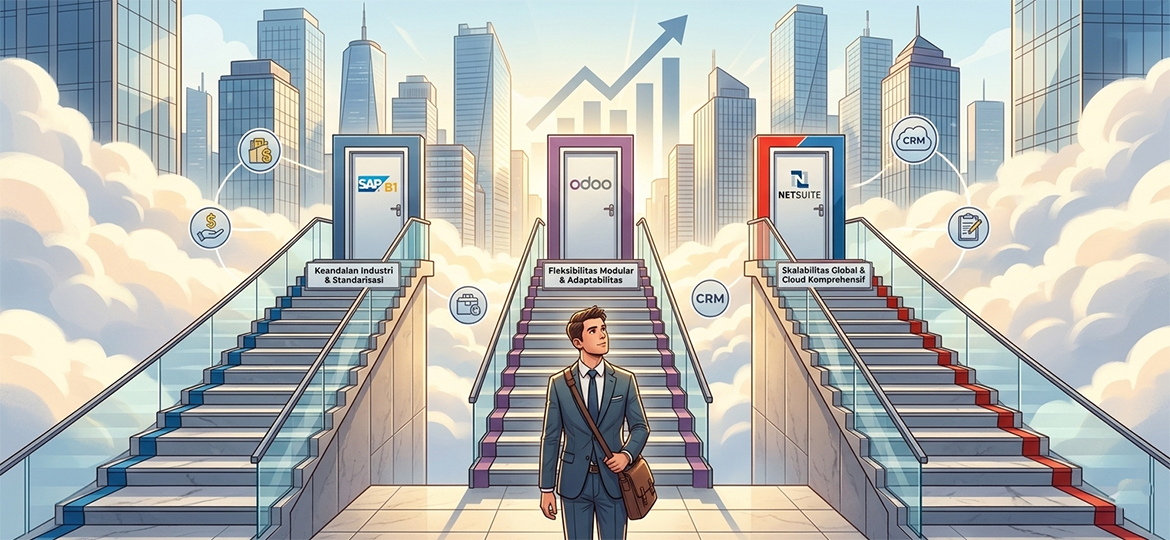
Choosing between SAP Business One, Odoo, or Oracle NetSuite for a growing business in Indonesia should be based on three key factors: operational scale (10–500+ users), depth of Indonesian tax localization (Coretax, e-Faktur, e-Bupot, PSAK), and total cost of ownership over the next five years. In brief: SAP Business One excels for SMB manufacturing and distribution, Odoo suits flexible businesses with a strong internal IT team, and Oracle NetSuite is ideal for multi-entity, cloud-first companies.
This article presents an honest comparison of three leading ERPs based on 2025–2026 data, including common real-world wrong-fit scenarios.
Why Choosing the Right ERP Is Critical
Selecting an ERP is a strategic decision with a 5–10 year impact — not merely an IT decision. Enterprise Resource Planning (ERP) unifies finance, inventory, sales, production, and HR into a single source of data. Choosing the wrong vendor results in re-migration costs that can multiply the initial investment.
Yet the risk of failure remains high. Gartner analysis indicates that approximately 70% of ERP implementations over the next three years will fail to meet their original objectives, with cost overruns averaging 189% across industries. Panorama Consulting reports a consistent range: 55%–75% of ERP projects fail to meet their initial goals.
Three key risks of choosing the wrong ERP:
- Costs spiral out of control. A low upfront license fee is often offset by customization and migration costs in years 2 through 5.
- Low adoption. An ERP that does not support Indonesian regulations (Coretax, e-Faktur, PSAK) forces teams to resort to double data entry in Excel.
- Stunted growth. A non-scalable ERP requires re-migration once users exceed 100+, or during regional branch expansion.
The Three Candidates at a Glance — 2026
SAP Business One — Enterprise DNA for SMBs
SAP Business One was designed by SAP SE specifically for SMBs since 2002, carrying the enterprise process DNA of SAP S/4HANA. As of 2025, more than 83,000 customers and 1.2 million users across more than 170 countries use SAP Business One, supported by a network of 850 global partners and more than 500 industry and country-specific extensions. SAP reaffirms its strategic commitment with the Version 11 roadmap for 2027.
Best for: Indonesian SMBs in manufacturing, distribution, and trading that need enterprise-standard process controls at SMB cost.
Odoo — Modular Open-Source with a Growing Ecosystem
Odoo is a modular open-source ERP from Belgium (since 2005), available in two editions: Community (free) and Enterprise (subscription). More than 12 million users worldwide use Odoo, with 60+ modules covering virtually every business process. Its main appeal is high customization flexibility — thanks to its Python architecture — and relatively affordable licensing.
Best for: Businesses with high customization needs, a strong internal IT team, and a tolerance for implementation complexity.
Oracle NetSuite — Cloud ERP Pioneer and Gartner 2025 Leader
Oracle NetSuite is a cloud-native, multi-tenant SaaS ERP since 1998 — not a product migrated from an on-premise solution. As of 2025, it has been named a Leader in the Gartner Magic Quadrant for Cloud ERP for both Service-Centric and Product-Centric Enterprises, serving more than 43,000 organizations across 220 countries. NetSuite moved from Challenger to Leader in the Product-Centric category in the 2025 report.
Best for: Multi-entity companies, multinational subsidiaries, or cloud-first subscription and professional services businesses.
Head-to-Head Comparison
The table below summarizes a comparison based on the criteria most frequently asked by ERP selection teams in Indonesia. Pricing figures are estimated market ranges for 2026; final pricing depends on negotiation, modules selected, and implementation complexity.
|
Criteria |
SAP Business One |
Odoo |
Oracle NetSuite |
|
License Model |
Perpetual / Subscription |
Community free / Enterprise subscription |
Pure SaaS Subscription |
|
Deployment |
On-premise / Cloud |
On-premise / Odoo.sh / Partner cloud |
Cloud-only |
|
License Price (per user/month)* |
USD 80–110 |
Enterprise USD 25–50 |
USD 99–150 + base USD 999/mo |
|
Implementation (25 users) |
IDR 400M – 1.5B |
IDR 200M – 800M |
IDR 600M – 2B |
|
Implementation Duration |
3–6 months |
2–6 months |
4–9 months |
|
Indonesia Localization |
Mature (PSAK, e-Faktur via add-on) |
Via partner custom module |
Limited (requires middleware) |
|
Customization |
Medium |
Very high |
Medium |
|
Scalability |
1–500 users |
1–1,000+ users |
10–10,000+ users |
|
Indonesia Partner Ecosystem |
Very mature |
Growing |
Limited |
|
Best Fit Industry |
Manufacturing, distribution, retail |
Retail, F&B, eCommerce, services |
Multi-entity, professional services |
*The figures above represent estimated market price ranges for 2026, with final values determined by negotiation outcomes and implementation complexity. Note that license costs do not cover the full total cost of ownership. Additional components such as implementation, training, customization, and annual maintenance typically range from 1.5x to 3x the first-year license value. Given that the DGT's Coretax system mandates real-time e-Faktur and e-Bupot recording, system integration has become an absolute requirement for tax compliance.
Comparison by Real-World Business Criteria
5-Year Total Cost of Ownership (25-User Scenario)
TCO consists of four components: licensing, implementation, customization/integration, and annual maintenance. Estimated 5-year totals for a standard scenario:
- Odoo Enterprise: IDR 1.1 – 2.8 billion
- SAP Business One: IDR 2 – 4 billion
- Oracle NetSuite: IDR 3.4 – 6.6 billion
The free Odoo Community edition does not eliminate TCO; costs simply shift to implementation, custom modules, and internal developers — which often exceed the Enterprise license fee.
Indonesia Localization (Coretax, e-Faktur, e-Bupot)
As of January 2025, DGT's Coretax has become the core tax administration system in Indonesia. PER-11/PJ/2025 stipulates that e-Faktur must be uploaded by the 20th of the following month in XML format integrated directly with Coretax. Officially licensed Tax Application Service Providers (PJAP) such as Pajakku provide API/SFTP connections linking SAP, Oracle, and Odoo to Coretax.
- SAP Business One: Mature partner add-on with native PSAK localization.
- Odoo: Localization via partner custom modules — quality varies.
- Oracle NetSuite: Integration via additional middleware.
Scalability from 10 Users to 500+ Users
- SAP Business One is optimally designed for companies with 10 to 500 users. Once needs exceed that capacity, the system must be upgraded to SAP S/4HANA Cloud. It is important to note that these are entirely different products, meaning the transition will involve significant migration costs.
- Odoo can be tuned for 1,000+ users, but performance is highly dependent on infrastructure quality and custom module quality.
- Oracle NetSuite was designed as a multi-tenant SaaS from the ground up and can accommodate 10,000+ users and dozens of subsidiary entities without platform migration.
Partner Ecosystem in Indonesia
The quality of the implementing partner is often more decisive to project success than the technical capabilities of the product itself. SOLTIUS, a Platinum Certified SAP Channel Partner in Indonesia, has operated since 1998 with 190+ technology professionals and 120+ clients across industries. In March 2024, Soltius was named Indonesia Partner of the Year 2023 for SAP Business One by SAP. This scale of ecosystem is difficult to replicate in the near term.
Pros & Cons
The pros and cons below reflect typical implementations in the Indonesian market in 2025–2026. Actual results depend on partner quality, business process complexity, and internal team readiness.
SAP Business One
Pros: Enterprise features at SMB cost; most mature partner ecosystem in Indonesia; stable PSAK and Coretax localization; clear product roadmap through 2027; strong for discrete manufacturing and distribution.
Cons: Steeper learning curve than Odoo; TCO can spiral if customization is not governed; upgrade to S/4HANA is not an automatic pathway; sweet spot capped at ~500 users.
Odoo
Pros: Most competitive licensing; very high customization flexibility (Python + Odoo Studio); 60+ native modules; modern and user-friendly UI; large global community.
Cons: Heavily dependent on partner quality — many implementation failures stem from choosing the wrong vendor; the "free" Community edition is often misleading, as external developer costs exceed license savings; risk of upgrade hell with excessive custom modules; Indonesia localization is partner-dependent.
Oracle NetSuite
Pros: Cloud-native since 1998 with no on-premise infrastructure burden; native multi-entity and multi-currency support; Gartner Magic Quadrant Leader 2025; mature AI capabilities (NetSuite Next, SuiteCloud AI); seamless scalability without platform migration.
Cons: Highest TCO of the three; weakest Indonesia localization; narrow local partner ecosystem (some coverage via Singapore); Oracle cloud vendor lock-in; UI primarily in English.
Conclusions & Final Recommendations
There is no universal answer to "the best ERP." The best choice is the ERP that best fits your business profile and five-year growth trajectory.
Scenario 1 — Manufacturing, Distribution, or Trading (25–250 Users)
Recommendation: SAP Business One. The optimal balance of enterprise features, a mature partner ecosystem, and readiness to handle Coretax in 2026.
Scenario 2 — Flexible Business (Retail, F&B, eCommerce) with an Internal IT Team
Recommendation: Odoo Enterprise (not Community). Maximum flexibility at an affordable entry cost. Conduct thorough due diligence on the implementing partner before committing.
Scenario 3 — Multi-Entity / Cloud-First / Subscription Business
Recommendation: Oracle NetSuite. Multi-entity scalability without platform migration; the trade-off is the highest TCO of the three and a need for Coretax middleware.
Must-Dos Before Committing to Any Vendor
- Request a demo using your own business scenarios, not the vendor's generic demo.
- Conduct a limited 4–8 week Proof of Concept for critical modules before signing any major contract.
- Contact at least 3 client references with a similar business profile — independently, not through the vendor — and ask about actual cost overruns and whether they would choose the same vendor again.
FAQ
Q: Which ERP has the lowest TCO?
A: 5-year TCO (25 users): Odoo (IDR 1.1–2.8B), SAP B1 (IDR 2–4B), Oracle NetSuite (IDR 3.4–6.6B).
Q: Which is the best choice for the manufacturing sector?
A: SAP B1 leads for discrete manufacturing/distribution. Odoo is ideal for light manufacturing. NetSuite is capable but expensive, with a limited local partner ecosystem.
Q: How long does implementation take?
A: Odoo (2–6 months), SAP B1 (3–6 months), NetSuite (4–9 months).
Q: Is Odoo Community (Free) worth using?
A: High risk. External developer costs often exceed the Enterprise license price. The Community edition also lacks Odoo Studio, the mobile app, and official support.
Q: How well-supported is local support and Coretax DJP 2025 integration?
A: All three integrate with Coretax via PJAP. SAP B1 has the strongest support with a stable add-on. Odoo requires custom modules, while NetSuite relies on middleware from the regional office (Singapore).
Get Started with a Demo & Consultation from Soltius Indonesia
Soltius Indonesia is a Platinum Certified SAP Channel Partner & Value-Added Reseller, and a member of United VARs (the highest tier of SAP global partner alliance). Operating since 1998 with 190+ technology professionals and 120+ clients across industries. Indonesia Partner of the Year 2023 for SAP Business One.
Other News