Blog

SAP BW/4HANA vs SAP Datasphere: The Right Data Warehouse Platform
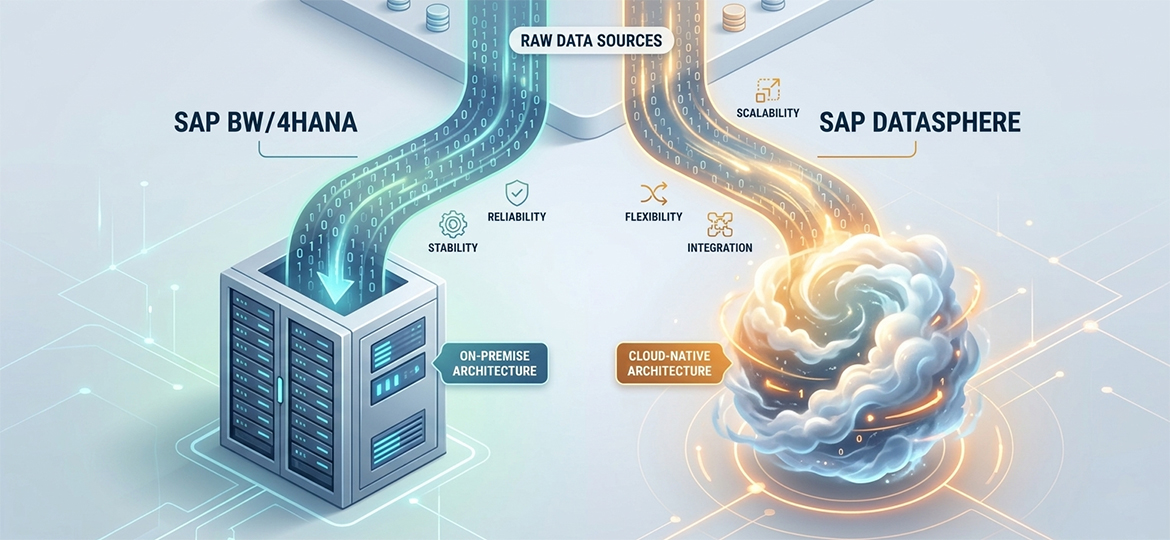
For stable, heavily regulated SAP on-premise landscapes, SAP BW/4HANA remains the safest choice, with guaranteed maintenance through 2040. However, for cloud-native strategies, non-SAP integration, and AI readiness, SAP Datasphere within SAP Business Data Cloud (BDC) is the future direction SAP has charted since February 2025.
Why This Decision Is Difficult in 2026
Thousands of global companies using SAP BW are now at a crossroads: SAP BW 7.5 maintenance will end in 2027, while SAP’s announcement of SAP Business Data Cloud (BDC) in February 2025 has fundamentally shifted the direction of SAP’s data strategy. Many organizations that were previously set on migrating to BW/4HANA are now questioning whether to jump straight to Datasphere/BDC.
TL;DR
|
Organization Profile |
Recommendation |
|
SAP-only, on-premise, highly regulated |
SAP BW/4HANA (or BW/4HANA PCE in BDC) |
|
Hybrid SAP + non-SAP, self-service required |
SAP Datasphere within BDC |
|
Complex hybrid, phased transition |
Coexistence (BW/4HANA + Datasphere via BW Bridge) |
|
Greenfield, AI-first |
BDC + SAP Databricks |
BW/4HANA = guaranteed stability through 2040. Datasphere = SAP’s strategic direction for the next decade. The best choice depends on your organization’s data profile, regulatory requirements, and readiness — not on vendor slogans.
Why SAP Ecosystem Migration Is Urgent in 2026
Three critical shifts in 2025–2026 are demanding that organizations make strategic data management decisions immediately:
- With primary support for SAP BW 7.5 ending December 31, 2027 (with a paid extension option through 2030), your organization has less than 24 months to plan a migration strategy. Available options include SAP BW/4HANA (supported through 2040), SAP Datasphere, or a hybrid architecture approach.
- With the launch of SAP Business Data Cloud (BDC) in February 2025, you can leverage this SaaS model to consolidate Datasphere, SAC, SAP BW, and SAP Databricks into one unified platform designed specifically to support AI and cross-enterprise analytics initiatives.
- License Update Notice (Effective January 1, 2026): Starting that date, Datasphere and SAC services are no longer available through BTPEA, CPEA, or PAYG cloud service options for new customers — they are offered exclusively through BDC licensing. Existing customers may not renew legacy contracts after December 31, 2025. We urge you to immediately update your RFP documents and project planning accordingly.
SAP BW/4HANA: What, For Whom, and When Is It Right?
Definition and Architecture
SAP BW/4HANA is SAP’s fourth-generation data warehouse, running exclusively on SAP HANA in-memory database, with a top-down modeling paradigm based on InfoObjects, ADSOs, and CompositeProviders. It can be deployed on-premise or in a private cloud (AWS, Azure, GCP), with a modern UI via BW/4HANA Web Cockpit and Fiori.
Core Strengths
- Rigorous governance by design — ideal for financial regulations, tax compliance, and auditing requirements.
- Mature semantic layer — the result of 25+ years of iteration since BW 1.0 in 1998.
- Deep talent pool — BW consultants in Indonesia far outnumber certified Datasphere consultants.
- Very long-term maintenance — through 2040, beyond the planning horizon of most current CIOs.
Limitations
- Slowing innovation: new SAP features are primarily being delivered to Datasphere/BDC, not BW/4HANA.
- Limited cloud-agnostic nature: though it can be hosted on hyperscalers, its monolithic architecture is not truly cloud-native.
- Integrating non-SAP systems (Salesforce, Snowflake, external data) requires significantly more effort compared to Datasphere.
When BW/4HANA Is the Right Fit
Based on patterns from manufacturing and FMCG projects across Southeast Asia, BW/4HANA remains the best choice when:
- 80%+ of data originates from SAP systems (S/4HANA, ECC, SuccessFactors).
- The organization has a strong, established internal BW team — and the retraining cost to Datasphere is significant.
- Auditors or regulators require data residency and full control over the storage layer.
- Planning and consolidation scenarios (BW-IP) are still used heavily and the organization is not ready to move to SAC Planning.
SAP Datasphere (within BDC): What, For Whom, and When Is It Right?
Definition and Architecture
SAP Datasphere is a cloud-native, SaaS-based data service built on SAP HANA Cloud, based on the business data fabric paradigm — federating SAP and non-SAP data without requiring mandatory extraction. Its workspace is divided into Spaces for team/domain isolation, and modeling can be performed both top-down and bottom-up.
Since February 2025, Datasphere has been officially positioned as a core component of SAP Business Data Cloud, alongside SAP Analytics Cloud and SAP Databricks.
Core Strengths
- Data federation & virtualization — query data without large-scale replication.
- Extensive non-SAP connectors — Salesforce, Snowflake, BigQuery, Azure, S3.
- Native integration with Databricks — the key enabler for modern AI/ML pipelines.
- Self-service for business users via Business Builder.
- Elastic scalability — Capacity Units can be scaled up or down without major migration.
Limitations
- Maturity for complex models still trails BW/4HANA — some BEx features (analysis authorizations, full OLAP engine) are not yet 100% equivalent.
- New learning curve — the Spaces & Business Builder paradigm differs significantly from the classic BW Workbench.
- Full cloud dependency — no on-premise option (except via BW/4HANA PCE).
- Costs can be surprising if workloads are not monitored (Capacity Units are consumption-based).
Datasphere’s Position within the BDC Umbrella in 2026
Important: after January 1, 2026, “buying standalone Datasphere” as a new customer is no longer relevant — you will subscribe to SAP BDC and then allocate BDC capacity to Datasphere, SAC, or Databricks services as needed. Existing customers can continue their BTPEA/CPEA/PAYG contracts until they expire.
5. Head-to-Head: 12 Comparison Dimensions
|
# |
Dimension |
SAP BW/4HANA |
SAP Datasphere (within BDC) |
|
1 |
Deployment |
On-premise / private cloud (PCE) |
SaaS multi-tenant (HANA Cloud) |
|
2 |
Database engine |
SAP HANA (in-memory) |
SAP HANA Cloud + Data Lake |
|
3 |
Modeling paradigm |
Top-down (ADSO, CompositeProvider) |
Top-down + bottom-up + federation |
|
4 |
SAP source connectivity |
Very mature (ABAP CDS, SLT, ODP) |
Mature via BW Bridge & ODP |
|
5 |
Non-SAP source connectivity |
Limited (requires Smart Data Access) |
Extensive (Snowflake, Salesforce, BigQuery, S3) |
|
6 |
Real-time vs. batch |
Batch + real-time via SLT |
Real-time + native federation |
|
7 |
Governance & ownership |
Full, in customer’s hands |
Shared responsibility (SaaS) |
|
8 |
Skill requirements |
ABAP, BW Modeler, BEx |
SQL, Spaces, Business Builder |
|
9 |
AI/ML readiness |
Limited, requires additional pipeline |
Native via SAP Databricks |
|
10 |
Planning capability |
BW-IP (mature) |
SAC Planning (cloud-native) |
|
11 |
Licensing |
CAPEX (license + maintenance) |
OpEx/consumption (Capacity Units) |
|
12 |
Maintenance horizon |
Through 2040 |
Continuous SaaS updates |
4 Concrete Migration Paths
SAP provides four official approaches for transitioning from legacy BW to a target architecture.
- Remote Conversion — Metadata + data are automatically transferred from BW 7.x or BW/4HANA to the target (BW/4HANA or Datasphere via BW Bridge). Best when you want to preserve your historical investment. Per SAP Note 3141688, supported from BW 7.3 SP10 and above.
- Shell Conversion — Only metadata is transferred; data is reloaded from the source. Best when the quality of legacy data is questionable and you want a clean reset.
- Greenfield — Build a new model in Datasphere from scratch. Suitable for Persona C, or when the legacy BW model is no longer business-relevant.
- Cloud Approach / Lift-and-Shift via PCE — Move BW 7.5 or BW/4HANA to the Private Cloud Edition within BDC. BW 7.5 maintenance in PCE is extended through 2030, providing time for a phased transition to Datasphere.
Final Recommendation & 90-Day Action Plan
BW/4HANA = proven stability. Datasphere/BDC = the future direction. Your choice depends on the velocity you want to adopt — not on which product is “better.”
90-Day Action Plan (Starting Today)
Days 1–30 — Assessment:
- Inventory all InfoProviders, queries, and custom ABAP objects in your legacy BW system.
- Map source systems (% SAP vs. non-SAP).
- Clarify your regulatory stance (data residency, audit requirements).
- Validate the skill readiness of your internal team.
Days 31–60 — Proof of Concept:
- Select 1–2 high-impact use cases (e.g., real-time sales reporting or predictive demand analytics).
- Run a POC in Datasphere or BW/4HANA sandbox, with concrete metrics (time-to-insight, monthly cost).
Days 61–90 — Roadmap & Business Case:
- Develop an 18–24-month roadmap with a target architecture decision.
- Build a 5-year TCO model for at least 2 scenarios.
- Present to the executive sponsor with transparent trade-offs.
FAQ Section (Schema-friendly)
Q: Is BW/4HANA being discontinued after the BDC release? A: No. SAP guarantees system support through 2040. BDC is simply a new ecosystem “umbrella” that also covers BW/4HANA.
Q: Is migration to BDC licensing mandatory? A: On-premise users can continue operating as normal. However, as of January 1, 2026, new Datasphere/SAC licenses must be purchased via BDC.
Q: How long does a migration to Datasphere typically take? A: Generally 6–18 months, highly dependent on the complexity of your custom objects (ABAP).
Q: Can Datasphere fully replace BW/4HANA? A: Not entirely yet (e.g., BEx Query). Use BW Bridge as a landing zone for phased migration, not as a full replication.
Q: What role does SAP Databricks play in this ecosystem? A: It acts as a first-party service dedicated to handling AI/ML workloads and advanced data engineering.
Q: Is a BDC free trial available? A: Yes. A 30-day self-service trial is available to explore core services including Datasphere, SAC, and Databricks.
Strategic Consultation with Soltius Indonesia
As the only SAP Platinum Partner in Indonesia and a United VARs member since 1998, Soltius Indonesia has guided data warehouse modernization projects across manufacturing, FMCG, and financial services sectors — including a Data Lakehouse implementation for PT Garudafood on Google Cloud. Our Data Architect team is ready to help you develop a 90-day assessment, decision matrix, and TCO business case tailored to your specific landscape.
Schedule an initial consultation: soltius.co.id
Other News