Blog

SAP Clean Core Strategy with SAP BTP: A Comprehensive Guide to Efficient Digital Transformation
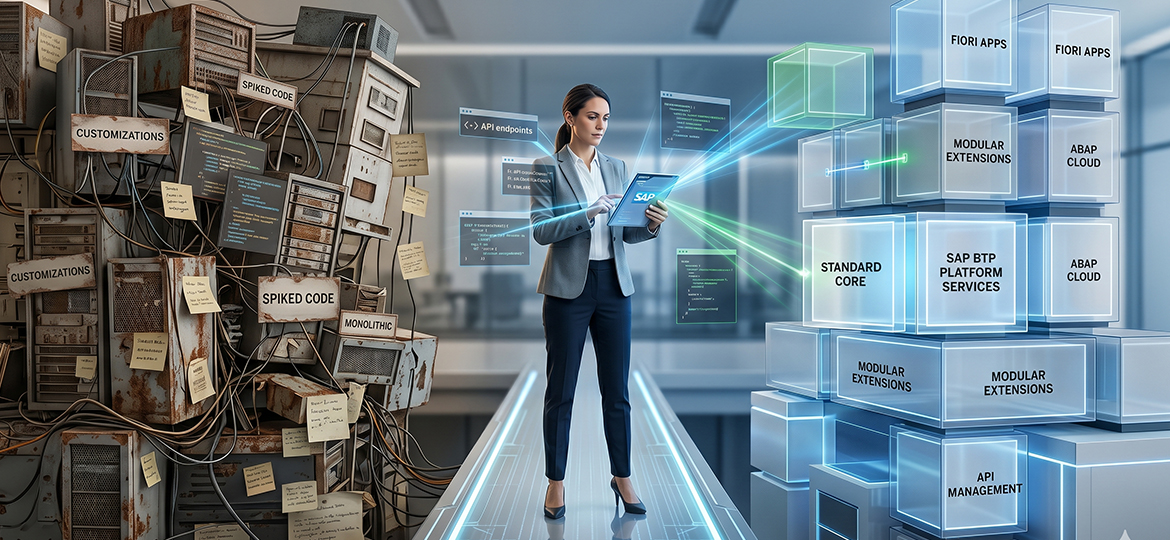
In large-scale enterprise technology ecosystems, a trapping paradox often emerges: systems originally designed to accelerate business slowly turn into a burden due to a pile of haphazard customizations. If you manage an SAP architecture, the term "spaghetti code" or excessive modification to standard objects is no stranger. This condition often makes the system upgrade process feel like climbing a mountain full of technical landmines.
Skyrocketing maintenance costs and the fear of downtime during version updates are real specters for many organizations. In the midst of this deadlock, the Clean Core philosophy emerges as a new compass. By leveraging the power of SAP Business Technology Platform (BTP), companies now have a golden opportunity to dissect and clean up their systems, building a much more agile and adaptive digital foundation.
Understanding the Essence of SAP Clean Core in Modern Standards
Technically speaking, Clean Core is not just a trend, but a principle where the main application (core) is kept pure according to manufacturer standards. Imagine your SAP system as the engine of a luxury vehicle. If you tinker too much with the internal valves and wiring using non-standard, self-assembled components, authorized mechanics will throw their hands up when service time arrives. The same goes for SAP; wild customizations will only close the door to future innovation.
Why Do Excessive Modifications Become a "Time Bomb"?
Over the past decade, many SAP users have been trapped in the habit of making direct modifications to the application layer (on-stack). This practice leaves a deep trail of problems:
-
Broken Upgrade Chains: Every time a security patch or new feature is released, thousands of lines of custom code must be dismantled and retested manually.
-
Innovation Paralysis: IT teams spend 80% of their energy just keeping the legacy systems running (keeping the lights on), instead of designing profit-generating solutions.
-
Silo Dependency: Poorly documented custom code creates a dangerous dependency on a handful of legacy personnel.
The Clean Core philosophy is here to sever that chain. By keeping the "core" clean, organizations can perform updates instantly with minimal risk.
SAP BTP: The Conductor in Clean Core Orchestration
The big question is: if we are forbidden from touching the core system, where should all the company's unique business logic be placed? The answer lies in SAP BTP (Business Technology Platform).
BTP serves as a vast canvas outside the main system. This is where the concept of Side-by-Side Extensibility plays its role. Instead of embedding code within S/4HANA, you build additional applications or functions on top of the BTP platform that communicate elegantly via official APIs.
Comparison: In-App vs. Side-by-Side Extensibility
-
In-App Extensibility: Remains within the SAP S/4HANA environment but is limited to using tools that have been "blessed" by SAP (such as adding custom fields or safe, simple logic).
-
Side-by-Side Extensibility: Builds entirely standalone applications outside of SAP using the BTP infrastructure. This gives developers the freedom of expression without threatening the stability of the core system.
Like a master chef, SAP BTP is a modern kitchen that provides all the spices and advanced equipment, while the core SAP system is the legendary recipe book kept pristine from destructive scribbles.
Strategic Implementation Roadmap (The Practitioner's Way)
Transitioning to a Clean Core is not a lightning-fast journey completed overnight. It is a transformation requiring precision and a proven methodology.
-
Code Audit and Cleanup (Custom Code Migration)
The first step is not building, but conducting technical introspection. Use instruments like the Custom Code Analyzer to map out your thousands of legacy codes.
-
Retire: Eliminate obsolete codes that have not been called for years.
-
Back-to-Standard: If the business requirement is now accommodated within standard S/4HANA features, immediately abandon your custom code.
-
Redesign: If the function is vital and unique, redesign its architecture to be migrated to BTP.
-
-
Adoption of SAP BTP ABAP Environment (Steampunk)
For senior ABAP developers, transitioning to the cloud often feels intimidating. However, Steampunk provides a comfortable bridge. You can still work with the ABAP language, but within a cloud-friendly corridor. You only interact with standardized APIs, ensuring your code will not "break" when the central system performs an update.
-
Harmonious Integration via SAP Integration Suite
To prevent the Clean Core strategy from creating new information silos, strong connectivity is required. The SAP Integration Suite ensures data flows seamlessly between the core system and BTP extensions, keeping data integrity intact without the hurdles of system bureaucracy.
Strategic Comparison: Traditional Model vs. Clean Core
| Evaluation Aspect | Traditional Customization (Legacy) | Clean Core Strategy (BTP) |
| Execution Location | Embedded within the SAP Core | Separated in the Cloud (Side-by-Side) |
| Upgrade Cost Burden | Very High & Resource-Draining | Efficient, Fast, & Scalable |
| System Stability | High Risk (Potential Code Conflicts) | Highly Stable & Isolated |
| Innovation Agility | Locked in Internal Ecosystems | Open (Can Adopt AI & IoT) |
| Governance | Messy (Spaghetti Code) | Centralized & Standardized |
Navigating Governance and Best Practices
Maintaining Core purity is a long-term commitment. Organizations are advised to form a Center of Excellence (CoE) that acts as a technology "curator". Every new feature request from the business line must pass through a strict filter:
-
Can this be resolved with built-in (standard) features?
-
If not, is a lightweight modification (In-App) sufficient?
-
If it must be built independently, is its architecture aligned with BTP standards?
Furthermore, the Data Decoupling strategy is highly crucial. Avoid external applications making direct queries to the main database. Always use official API pathways or OData services to maintain enterprise data performance and security.
Conclusion: A "Future-Proof" Business Future
Adopting a Clean Core strategy with SAP BTP is not just about following technological trends, but a defensive as well as offensive move to survive amidst digital disruption. By separating the innovation engine from the stability of the core system, you gain two advantages at once: robust operational reliability and the speed to maneuver in the market.
Do not let code from the past become an anchor holding back the momentum of your business ship. Clean your core now, and give your organization room to grow boundlessly.
Optimize Your Clean Core Transformation with Soltius
Realizing a pure Clean Core ecosystem requires more than just theoretical knowledge; it takes practical expertise to dissect technical complexities without sacrificing operational smoothness. Often, the biggest challenge arises when determining priorities on what to retain and what to migrate to BTP to achieve maximum ROI.
Do not let technical ambiguity slow your transformation pace. As a strategic partner in the digital journey, Soltius is here with a solid track record in SAP implementations to help you formulate an accurate and efficient Clean Core blueprint.
Why Choose Soltius?
-
In-Depth Code Audit: We help identify which digital assets are valuable and which are merely burdens.
-
Mastery of SAP BTP: Our experts ensure the migration to Side-by-Side Extensibility proceeds without significant friction.
-
Result-Oriented Strategy: Our focus is to ensure your system is not only technically clean but also delivers a tangible impact on cost efficiency.
Ready to liberate your SAP system from the shackles of hindering legacy code? Contact the Soltius Consulting Team Now for Your Strategic Transformation Discussion.
Other News