Blog

SAP Clean Core: The Complete Guide to Strategies, Dimensions, and S/4HANA Migration

Have you ever felt unexcited when the IT team mentions the word "system upgrade"? For many companies, upgrading an ERP is no longer just a regular IT project, but rather like trying to untangle a ball of yarn that has hardened over the years. This is what we often refer to as "Spaghetti Code."
Excessive system customization in the past might have succeeded in solving temporary problems. However, such wild customization has now turned into a technical debt monster holding your company's innovation hostage. As a result, system updates that should have been completed in a matter of weeks end up taking years and draining budgets up to billions of rupiah.
The good news is, you don't have to stay trapped in this exhausting cycle. The SAP Clean Core approach is here as an elegant way out. This concept redesigns how your system works, ensuring the company's ERP remains agile, is always ready to face cloud technology updates, and of course, frees the core system from suffocating modifications.
Understanding SAP Clean Core
Many business leaders frown and think, "Does this mean our ERP system cannot be customized at all to our company's unique needs?" Let's clear up this misconception.
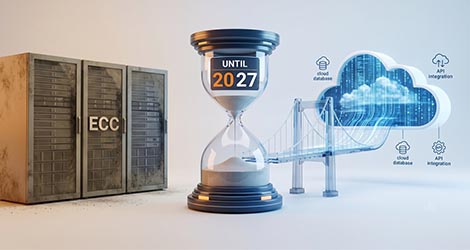
SAP Clean Core is an IT architecture methodology and approach where the core of the ERP system (S/4HANA) is kept pure from modifications to the standard code. This means the company can still customize freely, but all those modifications are built and placed outside the core system.
With this approach, customization is no longer a parasite slowly gnawing at the system's health, but becomes an extension that works harmoniously side-by-side. To understand this, let's look at these two customization approaches:
-
In-App Extensibility (The Trap of the Past): Dismantling and modifying SAP's standard code directly within the ERP core. This practice makes the system rigid and at high risk of breaking during the update process.
-
Side-by-Side Extensibility (The Modern Solution): Building custom features on an external platform (such as SAP BTP) that communicates with the core system via official and stable public API channels.
By applying this definition, your core system will always be in prime condition and ready to absorb cloud innovations or the latest security updates without the drama of delays.
5 Dimensions of the Clean Core Strategy
Achieving a clean ERP system is not an overnight magic trick. It is more like tending to a living garden ecosystem; you cannot just water one tree and ignore the soil. SAP has mapped out 5 fundamental dimensions that must run in parallel for this strategy to succeed.
1. Extensibility (System Extensibility)
This dimension regulates how you add new features without altering the ERP core. Get rid of the habit of changing standard source code.
-
On-Stack Extensibility: Use built-in SAP extension tools (Key User Extensibility or Developer Extensibility) that are guaranteed safe and upgrade-ready.
-
Side-by-Side Extensibility: For heavy and complex customizations, build the applications outside the core system using SAP BTP (Business Technology Platform).
2. Processes (Business Processes)
Bringing convoluted, outdated business processes into S/4HANA is like moving junk furniture into a luxurious new house.
-
Do not force the system to adapt to your company's old ways.
-
Instead, adopt SAP Best Practices (industry standards). Process standardization is the main key to minimizing the need for customization from the start.
3. Data (Data Management & Quality)
The Garbage In, Garbage Out principle strongly applies here. Any system, no matter how advanced, will choke if fed with messy data.
-
Ensure your master data governance is well organized.
-
Perform data cleansing, deduplication, and archive irrelevant historical data before you migrate or upgrade the system.
4. Integration (System-to-System Integration)
How does your ERP "talk" to third-party applications? In the past, many unselectively penetrated straight to the database level.
-
Stop the practice of direct database access (Direct DB access).
-
Use stable, SAP-approved Public APIs (whitelisted). These APIs act as an official communication bridge that will not collapse even if your ERP system is updated.
5. Operations (IT Operations)
Maintaining a Clean Core requires continuous monitoring, but that does not mean your IT team has to stare at monitor screens 24/7.
-
Transition from exhausting manual monitoring to fully automated operations (Automated Monitoring).
-
Use SAP's built-in analytical tools to identify anomalies, data movements, or customizations that begin to cross the boundaries of Clean Core rules.
Dissecting the Data Dimension: The Main Pillars of Clean Core Data
Why do we need to discuss data specifically? Because no matter how advanced the S/4HANA cloud architecture you build is, digitalization initiatives will only be as strong as the data supporting them. To ensure your data ecosystem is ready to face the future, SAP guidelines formulate 5 crucial pillars:
1. Data Governance
This is not just rigid rules on paper, but a strategic initiative providing a solid structure to maintain data trust, control, and consistency.
-
Appoint a clear "data owner" for each specific domain so there is a party responsible for its standardization.
-
Centralize your Master Data Management (MDM) to govern the data lifecycle and avoid duplication across disparate systems.
2. Data Strategy
A strong data strategy serves as both an anchor and a blueprint uniting business innovation ambitions with the company's technical IT reality.
-
This pillar focuses on harmonizing data models so SAP and non-SAP systems can integrate.
-
The goal is data democratization: granting data discovery access to more business users so they can gain insights and make decisions faster.
3. Data Quality
High-level data quality is a non-negotiable prerequisite in automation and AI adoption. Poor data quality will instantly poison your analytics dashboards.
-
Quality is measured by 6 indicators: accuracy, completeness, consistency, timeliness, validity, and uniqueness.
-
Conduct data profiling to find incompleteness issues or errors before these flaws end up damaging your business process chain.
4. Data Tiering (Data Volume Efficiency)
Paying a bloated monthly cloud bill just to store legacy data is like renting a luxurious downtown penthouse, but using half of its rooms to stack used cardboard boxes. Implement a volume management strategy through smart S/4HANA Data Tiering:
Comparison Table: SAP Data Tiering Efficiency Strategy
| Data Category | Access Characteristics | Storage Location | Impact on Cloud Costs |
| HOT | Accessed very frequently | In-memory Database | Most Expensive (Exclusive for high-value data) |
| WARM | Accessed less frequently | Native Storage Extension (NSE) | Medium (Reduces the load on main memory capacity) |
| COLD | Almost never accessed | Archiving | Very Cheap (Dramatically cuts memory and disk size) |
5. Data Protection
As the transition to increasingly connected and cloud-based SAP systems happens, protecting data from hacking or unauthorized access is highly crucial.
-
Implement a solid disaster recovery strategy and backup mechanism.
-
Control authorization using strictly curated role-based access principles. Ensure your system is also able to comply with regulations like GDPR for data tracking and auditing processes.
Business Benefits & Clean Core ROI
For the board of directors, every IT decision must be answerable by one fundamental question: "What is its impact on business efficiency and company profits?" Carrying a legacy ERP system with overlapping customizations is like running a marathon while carrying a backpack full of bricks. Companies waste too much energy and cost just to survive to keep the system from going down, instead of sprinting ahead of competitors.
SAP Clean Core is here to release that heavy burden. Here are compelling reasons why this initiative will deliver real Return on Investment (ROI) for your business:
-
Ultra-Fast S/4HANA Upgrades: Say goodbye to traumatic upgrade projects that take months. With a clean system core, the update cycle can be drastically cut to a matter of days. You save hundreds of IT team working hours and significantly reduce consultant costs.
-
Cutting Technical Debt: Every line of wild customization code is technical debt whose "interest" keeps piling up every year. By standardizing processes and moving extensions out of the core, bloated system maintenance costs will instantly shrink.
-
Towards AI & Cloud Innovation: SAP continuously releases cutting-edge features, including Generative AI and predictive analytics. A clean system core ensures your company is not left behind. You can readily absorb these latest innovations without being blocked by compatibility issue walls.
To make it easier to convince stakeholders, let's look at the stark comparison between your business's past and future systems:
Comparison Table: Traditional ERP vs. Clean Core ERP
| Business Criteria | Traditional ERP | Clean Core ERP (Modern S/4HANA) |
| Upgrade Cost & Time | Very high (Can take years) | Low & Efficient (Matter of days/weeks) |
| Speed of Innovation | Very Slow (Hindered by locking code) | Lightning Fast (Always ready to adopt Cloud & AI features) |
| Operational Risk | High (Prone to downtime when the system is altered) | Controlled (Stable untouched core system) |
Implementation Steps: Greenfield vs. Brownfield Approach
The transition to a Clean Core might sound intimidating. Especially if your legacy SAP system is already filled with thousands of lines of cluttered custom code. However, rest assured, you always have a roadmap to begin this journey.
Choosing this migration strategy is like deciding on residential matters. Do you want to tear everything down and build a new house on an empty lot, or gradually renovate your messy old house? Here are the two main routes you can choose according to your company's condition:
-
Greenfield Approach (Building from Scratch): This route is ideal for companies that want to completely discard the burdens of the past. You truly restart with a blank canvas, directly adopting pure SAP Best Practices standards from day one of operations.
-
Brownfield Approach (Phased Renovation): This path is chosen if your business is obligated to retain historical data from the legacy system. You migrate the existing system to S/4HANA first, then slowly and measurably begin "cleaning up" the customizations that soil the system core.
The Ultimate Weapons in Your Transition Journey
To execute the transition steps above, you are not left groping in the dark. You can utilize cutting-edge enabler tools from the SAP ecosystem:
SAP Signavio
Imagine this tool as an X-Ray machine for your business anatomy. Signavio will scan and map out which processes overlap, then provide appropriate standardization recommendations before the migration process is executed.
SAP BTP (Business Technology Platform)
This is your modern "external workshop." All complex customizations (which previously nested in and damaged the ERP core) are now moved, built, and run safely on this cloud platform.
Soltius: Your Trusted SAP Partner for the Clean Core Journey
Implementing SAP Clean Core requires more than just theoretical understanding. Tactical expertise is needed to dissect which customizations must be discarded, retained, or safely moved to SAP BTP.
Do not let your business innovation be held hostage by obsolete systems. As a leading SAP partner, Soltius is ready to be a reliable consultant and navigator for your company. Soltius's team of experts will fully assist you from the initial audit phase of dissecting spaghetti code with SAP Signavio, up to the seamless S/4HANA migration execution without disrupting your daily business operations.
Frequently Asked Questions (FAQ)
Here are some of the questions most frequently asked by IT executives regarding the implementation of this system architecture:
1. Does Clean Core only apply to S/4HANA Cloud users?
Absolutely not. This concept can and is highly recommended to be applied across all S/4HANA implementation editions, be it Public Cloud, Private Cloud, or On-Premise. It's just that the Cloud ecosystem usually enforces these Clean Core rules more strictly so the system can receive periodic automatic updates.
2. How long on average does it take to "clean" the ERP core?
There is no single absolute answer, as this heavily depends on the severity of the "tangled yarn" (spaghetti code) in your legacy system. For the Greenfield approach (new system), you can immediately enjoy a Clean Core from go-live. However, for an overhaul of a legacy system (Brownfield), the phased cleanup process generally takes between [NEEDS VALID DATA: Insert industry average estimate, e.g., 6 to 18 months] depending on business complexity.
3. What is the crucial role of SAP BTP in the Clean Core strategy?
SAP Business Technology Platform (BTP) is the heart of this strategy. BTP functions as the "main stage" where you build, test, and run all company customization applications. By moving customizations to BTP (Side-by-side extensibility), your ERP core remains sterile, safe, and ready to be updated at any time without fear of system errors.
Other News