Blog

SAP in the Cloud: Why IaaS (AWS, Azure, GCP) Is the Strategic Choice for Enterprise Indonesia?
Indonesia’s business world is standing at a crucial crossroads. Where rows of humming physical servers in the corporate data center room were once considered symbols of stability, that image is starting to look like a dusty artifact of the past. As digital transformation accelerates at a breakneck pace, many IT leaders at large enterprises — from manufacturing giants to major banks — are realizing that maintaining on-premise infrastructure often feels like keeping a white elephant: expensive to maintain, difficult to move, and far too slow for an era of instant competition.
We have to be honest: ever-ballooning hardware maintenance costs and the red tape of server procurement processes are frequently the primary stumbling blocks for AI innovation and big data processing. Yet, moving to the cloud is not merely a matter of following trends or shuffling workloads elsewhere. It is about building an elastic foundation.
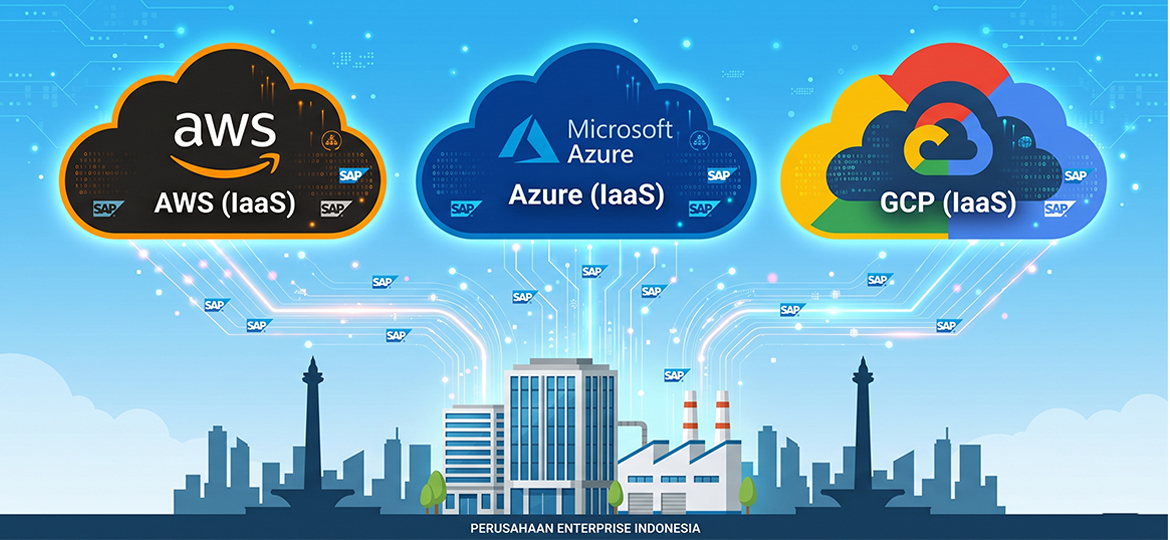
In this article, we will dissect in depth why the Infrastructure as a Service (IaaS) model — through hyperscale giants like AWS, Azure, and GCP — has become such a magnet for corporations in Indonesia. We will thoroughly examine the comparisons, explore how they answer the challenges of the strict UU PDP, and break down the cost-efficiency figures that could transform your company’s balance sheet.
The Paradigm Shift: From Rusty Iron to Elastic Infrastructure
Why are companies in major cities like Jakarta, Surabaya, and Medan increasingly abandoning traditional data centers? The answer boils down to one word: speed. In the past, if the finance team needed extra capacity for a grueling month-end closing process, the IT department might spend weeks just working through procurement, ordering, and configuring new hardware.
That paradigm has now shifted completely. Elastic infrastructure gives companies room to breathe. Imagine a system that can scale up when workloads peak and scale back down when activity subsides. This is the essence of the agility offered by the IaaS model.
The arrival of local Availability Zones in Indonesia — such as the AWS Jakarta Region (ap-southeast-3), Azure Indonesia Central, and GCP Jakarta (asia-southeast2) — has been an absolutely pivotal turning point. Before local regions existed, latency was a constant specter that made companies hesitant about migration. But now that infrastructure physically exists on Indonesian soil, that technical barrier has crumbled. Local companies can now run SAP S/4HANA at peak performance while ensuring their sensitive data never leaves Indonesian jurisdiction.
Beyond the technical dimension, there is also a psychological shift. Managing your own data center means worrying about cooling systems, backup power, and the physical security of the server room. By handing that burden to an IaaS provider, your IT team is no longer trapped in a firefighter’s role — forever chasing down faulty cables and failing hard drives — and can instead focus on higher-value business strategy.
Competitive Advantages of IaaS for SAP S/4HANA
Choosing IaaS is not simply a matter of renting someone else’s servers. For enterprise companies in Indonesia, it is a tactical move to unlock advanced capabilities that would be impossible to achieve in a conventional local data center.
1. Scalability Without the Drama
Nearly every IT department at a major retail company knows the agony of a sluggish system during a double-date flash sale or month-end closing rush. This is where IaaS proves its worth. With auto-scaling features, your SAP infrastructure can be configured to add capacity automatically when thousands of transactions flood in simultaneously. You pay only for what you consume — a remarkably precise form of efficiency.
2. Integrated AI & Analytics Innovation
If you run SAP on Google Cloud (GCP), you get direct access to Vertex AI. On Azure, integration with Microsoft Fabric becomes seamlessly smooth. Companies are no longer merely recording transactions (ERP) — they are beginning to predict the future. Data from SAP flows into AI engines to read consumer behavior patterns in the local market, enabling data-driven decision-making that is far more accurate.
3. Cost Efficiency: Breaking Free from CapEx
Let’s talk honestly about the numbers. In the traditional (CapEx) model, you must pour billions of Rupiah upfront to purchase servers that may only be utilized at 30% of their capacity. IaaS transforms this model into OpEx (operational expenditure).
Analogy: Managing SAP on-premise is like sinking a massive well in the middle of a raging storm — you expend too much effort and money on basic infrastructure, when all you actually need is water (data) flowing steadily to sustain your business.
Addressing Regulatory Challenges: UU PDP and Data Sovereignty
For the banking sector and state-owned enterprises, moving to the cloud often runs into one pressing question: Is our data safe and legally compliant?
The enactment of UU PDP No. 27/2022 and OJK regulations has clarified the rules of the game. The Indonesian government is now extremely strict about where personal data is stored. This is precisely where AWS, Azure, and GCP — each already possessing a local region in Jakarta — hold a distinct advantage.
- Data Localization: By storing data in the Jakarta region, companies are automatically compliant with data sovereignty rules. Data does not travel abroad without justification, making regulatory audits considerably simpler.
- Multi-Layered Security: These global providers invest billions of dollars annually in security systems. Encryption features for data at rest and in transit help companies meet high security standards without having to build their own digital fortress from scratch.
AWS vs Azure vs GCP: Which One Fits Best?
Choosing a cloud provider is like selecting a port for a large cruise ship: every port has different facilities, even though the destination is ultimately the same — docking safely.
|
Feature / Strength |
AWS (Amazon Web Services) |
Microsoft Azure |
Google Cloud (GCP) |
|---|---|---|---|
|
Maturity |
Extensive experience with the most comprehensive SAP documentation. |
Best integration for users of the Microsoft ecosystem (Office/Teams). |
The leader in Data Analytics and AI innovation (Vertex AI). |
|
Infrastructure |
Jakarta Region (3 AZs) since 2021. |
Highly capable Indonesia Central Region. |
Low latency with advanced infrastructure in Jakarta. |
|
Best Fit |
Retail, Manufacturing, and large Startups. |
Corporations already oriented toward Microsoft. |
Companies hungry for Data-Driven innovation. |
Migration Strategy: Pure IaaS vs RISE with SAP
This is a debate that frequently surfaces at the CIO’s table. Should you opt for pure infrastructure rental (IaaS) or enroll in the RISE with SAP program?
- Pure IaaS Model (Self-Managed): You rent compute from AWS/Azure/GCP, but retain full control over the operating system and database. This suits companies with a strong internal IT team that require highly specific module customization.
- RISE with SAP (Managed Service): This is a packaged Cloud ERP as a Service. SAP takes responsibility for the infrastructure and SLA, while the underlying physical machines still run on hyperscaler hardware. Best suited for companies that want simplicity and prefer to focus on business processes rather than server technicalities.
Conclusion: An Unavoidable Investment in the Future
Migrating SAP to IaaS in Indonesia is not merely a technical cost-cutting move. It is a bold step toward achieving agility, security, and legal compliance all at once. By choosing IaaS with an operational region in Jakarta, your company gains blazing-fast performance alongside a legal shield under UU PDP.
Indonesia’s business landscape going forward will belong only to those who can move with agility. And that agility starts with the infrastructure foundation you choose today. Is your system ready to face an increasingly competitive and unpredictable market?
Is your SAP infrastructure ready to meet the increasingly dynamic challenges of the market? Don’t let the limitations of legacy technology become an anchor that holds back your business growth. Consult your digital transformation roadmap and SAP migration strategy now with Indonesia’s leading technology partner.
Discover the best implementation and infrastructure management solutions designed specifically for your business ecosystem, only at Soltius Indonesia. Let’s build a stronger, smarter, and more agile enterprise future — together, starting today.
Other News