Blog

SAP S/4HANA Retail Implementation Guide for Retail Chains
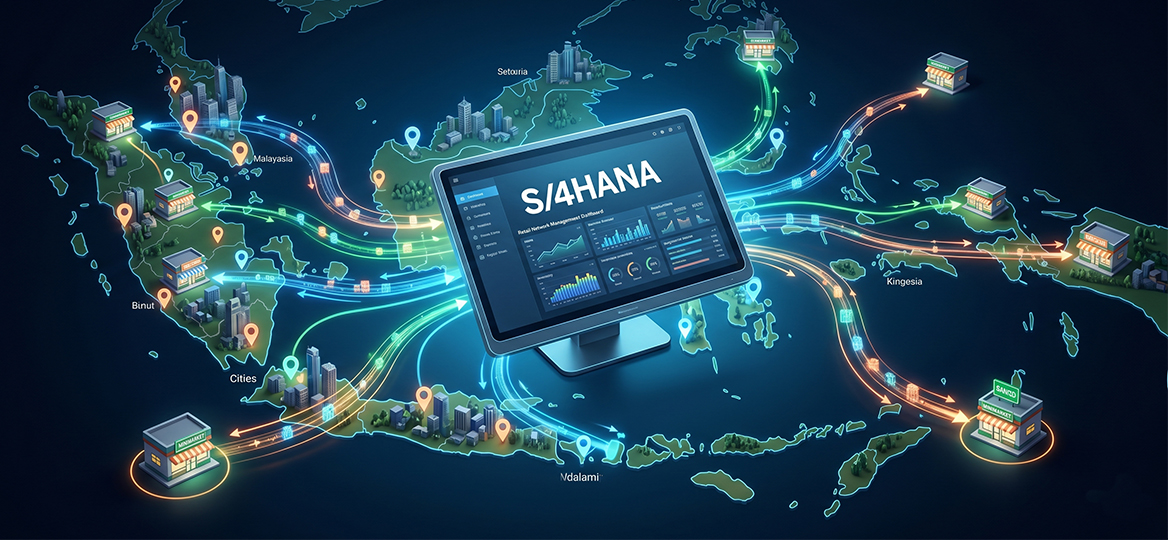
Summary: SAP S/4HANA Retail implementation unifies merchandise management, multi-store inventory, POS transactions, and e-commerce into a single real-time platform built on SAP HANA. Projects for mid-sized store networks typically span 9–18 months via SAP Activate Methodology, with three approaches: Greenfield, Brownfield, or Selective Data Transition.
SAP S/4HANA Retail implementation unifies merchandise management, multi-location inventory, POS transactions, and online channels into a single real-time platform. Projects typically run 6–20 months, depending on the number of stores and integration complexity. Success comes down to three things: master data readiness, the right deployment choice, and a realistic rollout strategy.
If you manage a store network, the challenges are probably familiar:
- Branch inventory shows stock on hand — but it’s actually sold out.
- Sales reports only become available the following day.
- Online promotions aren’t synced to physical stores.
- Head office teams spend their time reconciling data instead of making decisions.
The opportunity, however, is significant. According to BPS and APRINDO data, the retail sector’s contribution to Indonesia’s GDP stands at 5.12%, with wholesale and retail trade growing 5.49% in 2025.
This article is a practical guide based on hands-on experience implementing SAP in Indonesia’s retail sector. This is not a product brochure, not theory — it’s a framework to help you decide whether SAP S/4HANA Retail is the right fit, and how to execute it without a crisis midway through.
Why SAP S/4HANA Retail is the Go-To Choice for Store Networks
The short answer: three pressures are converging simultaneously — consumers demanding omnichannel experiences, legacy ERPs unable to support multi-store real-time operations, and SAP’s official end-of-support deadline for legacy systems.
SAP S/4HANA Retail vs. SAP IS-Retail Legacy: Key Differences
Mainstream maintenance for SAP Business Suite 7 (including SAP IS-Retail) ends on December 31, 2027, with optional extended maintenance until 2030. After that, systems enter a customer-specific maintenance phase with significant limitations.
|
Aspect |
SAP IS-Retail (Legacy) |
SAP S/4HANA Retail |
|
Database |
Multi-database (Oracle, DB2) |
SAP HANA in-memory native |
|
User Interface |
Classic SAP GUI |
SAP Fiori (web/mobile) |
|
Analytics |
Requires separate BW |
Embedded real-time |
|
Omnichannel |
Separate add-on |
Native via SAP CAR |
|
Maintenance |
Ends 2027 |
Through 2040 |
Understanding SAP S/4HANA Retail Architecture
SAP S/4HANA Retail architecture consists of three core layers: the digital core (S/4HANA), the customer activity repository (SAP CAR), and interaction channels (POS, e-commerce, loyalty). Not every store network needs all three.
Core Modules: Merchandise Management
The operational heart that manages the product lifecycle. Three foundations: Article Master (SKU master data), Assortment Management (which SKUs go to which stores), and Merchandise Hierarchy (layered category structure).
Important note: the majority of SAP Retail implementation failures stem from a poorly maintained Article Master — not module configuration or technical bugs.
SAP CAR & POSDTA: The Omnichannel Engine
SAP Customer Activity Repository (CAR) is a SAP HANA in-memory data platform that aggregates POS transaction data and other channel data in real time. POSDTA (Point-of-Sale Data Transfer & Audit) is the module within CAR that handles data flows from stores via PIPE (POS Inbound Processing Engine).
Operational benefits of CAR/POSDTA:
- Near real-time inventory updates after every transaction.
- Promotions synced across channels (POS, e-commerce, mobile).
- Hourly sales dashboards per store.
- Active on-shelf availability alerts.
POS, E-commerce & Loyalty Integration
You don’t have to replace your existing POS or e-commerce platform. SAP CAR supports third-party POS integration (NCR, Toshiba, local vendors) via IDoc/API. For e-commerce, SAP Commerce Cloud provides a single catalog, a single customer master, and a unified cross-channel promotion engine.
Five Things You Must Prepare Before Implementation
Failed implementations almost always share the same root cause: insufficient preparation during the pre-project phase. The following five critical areas must be solid before a contract is signed.
- Business Case & ROI Calculation — covers investment, operational savings, revenue uplift, risk cost, and opportunity cost.
- Master Data Readiness Assessment — assess Article Master, Vendor, Customer, Pricing, and Merchandise Hierarchy. A significant portion of SKUs typically require cleanup before migration.
- Organizational Structure Design — Site, Plant, and Storage Location design is irreversible. Involve the Head of Operations, Supply Chain, and Finance in a dedicated workshop.
- Deployment Model Selection — On-Premise, Private Cloud (RISE with SAP), or Public Cloud (GROW with SAP). Most mid-to-large store networks choose RISE.
- Internal Team & Steering Committee — free up key users to at least 50% of their regular workload. Without consistent executive sponsorship, large-scale projects will falter.
Greenfield, Brownfield, or Selective Data Transition?
SAP offers three transition approaches. The best choice depends on how much customization exists in the current system, and how much historical data must be preserved.
- Greenfield: A fresh implementation from scratch following SAP Best Practices. Suitable when the existing ERP is heavily customized, non-SAP, or when a business process redesign is desired. Duration: 9–18 months.
- Brownfield: A direct conversion from SAP ECC IS-Retail to S/4HANA. Data and configuration are carried over automatically. Suitable when you’re satisfied with your existing processes. Duration: 6–12 months.
- Selective Data Transition: A hybrid approach for multi-entity consolidation or partial data migration. Suitable for retail groups formed through M&A. Duration: 12–24 months.
Practical rule of thumb: retailers not yet on SAP → Greenfield + Cloud. Retailers on SAP ECC IS-Retail with manageable customization → Brownfield. Multi-entity retail groups or post-acquisition consolidations → Selective Data Transition.
The 6 Phases of SAP Activate Methodology
SAP Activate consists of six sequential phases, each with a quality gate at transition. For retail, each phase carries specific context that is often overlooked in the standard SAP manual.
|
Phase |
Duration |
Key Output |
Success Factor |
|
1. Discover |
4–8 weeks |
Business case, target operating model |
Realistic scope, right deployment model |
|
2. Prepare |
4–6 weeks |
Project charter, active sandbox, team ready |
Key users freed up 50%+ from routine work |
|
3. Explore |
6–12 weeks |
Solution design, gap analysis, RICEFW list |
Key users decide — not just observe |
|
4. Realize |
4–9 months |
Configuration, RICEFW, UAT signed-off |
Clean master data, end-to-end testing |
|
5. Deploy |
2–4 weeks |
Production system live |
Rollback plan, phased cutover |
|
6. Run |
Ongoing |
KPIs achieved, transition to AMS |
Consistent post-implementation review |
Typical total project duration: 9–18 months for mid-sized store networks. The Realize phase is the longest and highest-risk.
When SAP S/4HANA Retail Is the Right Fit — and When It Isn’t
SAP S/4HANA Retail is an enterprise-grade solution for retailers with complex, multi-channel operations and real-time data requirements. But it’s not for everyone.
Right fit for:
- Mid-to-large store networks (50+ outlets) with multi-format operations.
- Businesses where e-commerce represents a significant share of revenue (>20%).
- Multi-entity or retail holding groups.
- Retailers subject to strict regulatory and audit requirements (listed companies, foreign investors).
- Long-term digital transformation vision (5–10 years).
Consider alternatives for:
- Small networks (<20 stores) with simple operations — alternatives: Microsoft Dynamics 365 Business Central, Oracle NetSuite, or local retail ERP.
- Highly dynamic businesses that pivot frequently — alternatives: flexible cloud-native retail platforms.
- No budget for upfront investment and ongoing support.
- Go-live requirements under 3 months — alternatives: ready-to-use SaaS retail platforms.
There is no single “best” solution. There is only the most appropriate solution for your business context.
FAQ: Frequently Asked Questions
Do we need to replace our existing POS?
Not necessarily. SAP CAR is designed to integrate with third-party POS systems via IDoc or API, including NCR, Toshiba, or local vendors that can transmit TLOG data in compliance with POSDTA standards.
What if we’re still running SAP ECC IS-Retail?
Three options: Brownfield (direct conversion, 6–12 months), Greenfield (fresh implementation), or Selective Data Transition. Mainstream maintenance for SAP IS-Retail ends December 31, 2027.
How much does implementation cost?
SAP S/4HANA implementation services generally start from USD 75,000. For a mid-sized Indonesian store network (20–100 outlets), a realistic 5-year total investment ranges from USD 1.5 million to USD 5 million, including licensing, implementation, infrastructure, and support.
Can implementation be done module by module?
Yes — and it’s recommended. Phase 1: Core S/4HANA + Merchandise + CAR/POSDTA. Phase 2: SAP Commerce Cloud. Phase 3: Loyalty & AI/ML. This strategy spreads risk and investment over time.
What’s the difference between RISE and GROW with SAP?
RISE with SAP = S/4HANA Cloud Private Edition — flexible, supports limited customization. GROW with SAP = Public Edition — fit-to-standard, fastest to deploy. Most mid-to-large store networks choose RISE.
Conclusion & Next Steps
Implementing SAP S/4HANA Retail for a store network is not just an IT project — it is a business transformation that will define your competitiveness for the next 5–10 years. Its success is not determined by the sophistication of the technology, but by the quality of decisions made during the pre-implementation phase.
Start with a Soltius Consultation
As an experienced SAP Partner in Indonesia’s retail sector, Soltius is ready to help you navigate these decisions. Our team has handled SAP implementations for national-scale retailers, from minimarkets and supermarkets to department stores and specialty retail.
Other News