Blog

SAP S/4HANA vs. SAP ECC (Business Suite): The Fundamental Differences You Need to Know
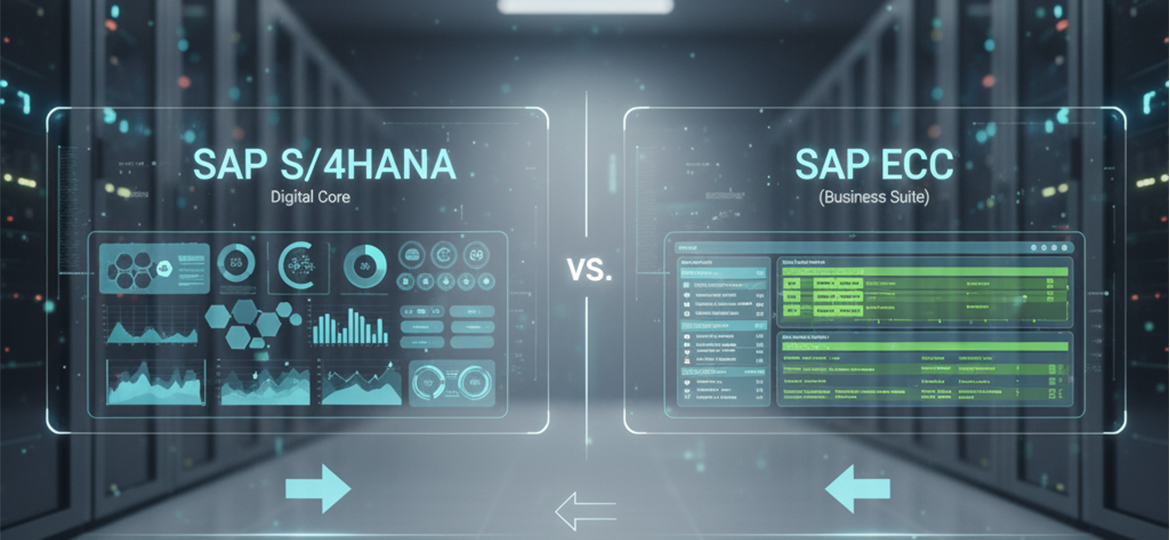
In the world of Enterprise Resource Planning (ERP), SAP has long been recognized as a market leader with various solutions that help companies manage their business processes in an integrated manner. The two most discussed SAP products in recent years are SAP S/4HANA and SAP ECC (SAP ERP Central Component), which is part of the SAP Business Suite.
Many companies still rely on SAP ECC for their daily operations, but SAP itself has announced that full support for ECC will be discontinued in the coming years. This makes the topic of migrating to SAP S/4HANA increasingly relevant.
This article will provide a comprehensive discussion of SAP S/4HANA vs. SAP ECC, including their fundamental differences, benefits, and the reasons why companies should start considering the transition now.
What Is SAP ECC (Business Suite)?
SAP ECC (ERP Central Component) is the core of the SAP Business Suite, which has been used by thousands of companies worldwide since the early 2000s. ECC is designed to integrate various business functions such as finance, logistics, HR, and procurement into a single unified system.
Some of the main modules in SAP ECC include:
-
FI (Financial Accounting)
-
CO (Controlling)
-
MM (Materials Management)
-
SD (Sales and Distribution)
-
PP (Production Planning)
-
HR (Human Resources)
SAP ECC runs on various databases (it is database-agnostic), such as Oracle, IBM DB2, and Microsoft SQL Server. This is what makes ECC flexible, although not as fast as modern in-memory-based systems.
What Is SAP S/4HANA?
SAP S/4HANA is the latest generation of ERP from SAP, launched in 2015. The "S" stands for Simple, "4" signifies the fourth generation, and "HANA" refers to High-Performance Analytic Appliance, SAP's proprietary in-memory database technology.
Unlike ECC, SAP S/4HANA runs exclusively on the SAP HANA database, which enables real-time data processing at much higher speeds. With this new architecture, companies can access business insights quickly, reduce complexity, and increase productivity.
SAP S/4HANA is available in two options:
-
On-Premise: The ERP system is installed and managed on the company's own IT infrastructure.
-
Cloud (Private/Public): A more flexible, subscription-based model managed by SAP.
Fundamental Differences: SAP S/4HANA vs. SAP ECC
To make it clearer, here are the main differences between the two:
Database
-
SAP ECC: Can run on various databases.
-
SAP S/4HANA: Runs exclusively on SAP HANA (an in-memory database).
Processing Speed
-
ECC: Performance is limited because it is based on traditional databases.
-
S/4HANA: Real-time processing with rapid analytics.
System Architecture
-
ECC: Older architecture with significant data redundancy.
-
S/4HANA: Simplified architecture with a leaner data model.
User Experience (UX)
-
ECC: Uses the SAP GUI interface, which tends to be complex.
-
S/4HANA: Uses SAP Fiori, which is more intuitive and mobile-friendly.
Analytics Features
-
ECC: Limited; requires additional systems for advanced analytics.
-
S/4HANA: Analytics are integrated directly into the ERP system.
Cloud Integration
-
ECC: Minimal integration with cloud services.
-
S/4HANA: Designed to support modern cloud ecosystems.
Benefits of Migrating to SAP S/4HANA
Why should companies switch to SAP S/4HANA? Here are several reasons:
-
Speed and Efficiency: Real-time transaction processing accelerates decision-making.
-
Process Simplification: A lean data model reduces redundancy and complexity.
-
Modern User Experience: SAP Fiori makes the system more user-friendly.
-
Future-Ready: Supports the integration of AI, machine learning, and IoT technologies.
-
Long-Term Support: SAP has already announced the end of full support for ECC, making migration no longer an option, but a necessity.
Challenges of Migrating from SAP ECC to SAP S/4HANA
Despite its many benefits, the transition to SAP S/4HANA also presents several challenges:
-
IT Infrastructure Readiness: Companies need to adapt both hardware and software.
-
Implementation Costs: The initial investment can be significant, though it will pay off with long-term benefits.
-
Organizational Culture Change: Adopting a new system requires proper training and change management.
With careful planning and the support of an experienced implementation partner, these challenges can be minimized.
When Should a Company Migrate?
SAP has announced that mainstream support for ECC will end in 2027, with a limited extension option until 2030. This means that companies still using ECC need to develop a migration roadmap immediately.
The sooner the migration is carried out, the greater the opportunity to maximize the benefits of modern SAP S/4HANA technology without being rushed.
Conclusion
The difference between SAP S/4HANA vs. SAP ECC is not just about technology, but also about long-term business strategy. The tried-and-tested ECC is now being phased out in favor of S/4HANA, which offers speed, flexibility, and the digital integration of the future.
For companies that want to remain competitive, migrating to SAP S/4HANA is a critical step. This decision will not only optimize operational processes but also open up opportunities for a broader digital transformation.
Migrating from SAP ECC to SAP S/4HANA is a complex journey that requires a mature strategy, technical expertise, and implementation experience. Soltius, as an official SAP partner in Indonesia, is ready to guide your company through every stage of the migration.
With a team of experienced consultants and a successful track record across various industries, Soltius delivers the best solutions to ensure your transition is smooth, efficient, and provides maximum value. Contact Soltius now and realize your company's digital transformation with SAP S/4HANA.
Other News