Blog

The Complete Guide to Digital Manufacturing Transformation 2026: Strategies, Implementation, & Choosing the Best Software
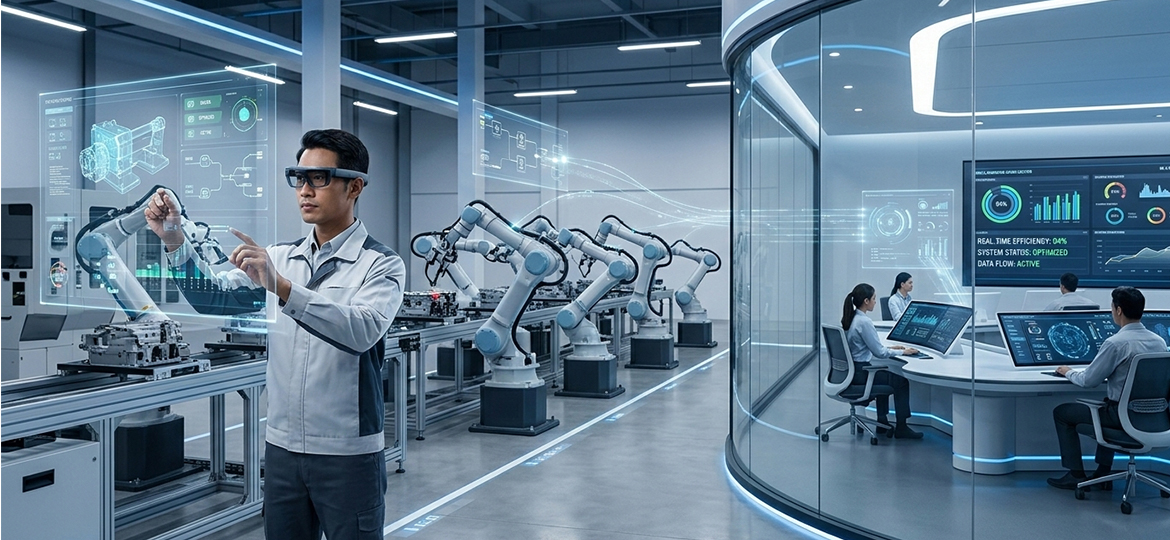
Frequent production machine downtime, continuously swelling operational costs, and supply chain pressures feel increasingly suffocating to your daily factory operations. We deeply understand how heavy the demands for efficiency are in this industry, which is why this article is specifically compiled as a practical end-to-end guide, starting from designing grounded initial strategies to real executions that will change the way work is done on the shop floor.
The need to move fast is now highly urgent. For context, in Q3 2025, the Ministry of Industry (Kemenperin) forged partnerships with the private sector to accelerate Artificial Intelligence (AI) adoption for 4.43 million Small and Medium Industry (IKM) players, considering its adoption rate is still lagging at the 1.45 level. Reflecting on the urgency of these data, we will dissect five structured implementation roadmap steps, up to uncovering the main criteria for choosing the truly right software to catch up and win the competition.
Why Digital Manufacturing Transformation is No Longer an Option, But a Necessity?
Many industry players still consider digitalization merely an expensive IT project. Yet, in reality, this is a survival strategy to keep your business relevant.
The competitive landscape has changed drastically. Factories that are slow to adapt will remain trapped in classic problems, such as raw material waste and detrimental machine downtime.
Latest Industry 4.0 Facts & Data in Indonesia (Citing the Ministry of Industry & McKinsey)
Let's look at the reality on the ground so our strategy is grounded in data. Reports from global institutions and the government show an urgency that cannot be ignored:
-
Ministry of Industry Acceleration: The government is aggressively targeting a minimum of 10 digital transformation pilot companies (National Lighthouses) per year. In 2024, Indonesia minted 15 companies, successfully exceeding the initial target.
-
Adoption is Still Limited: Based on a McKinsey Indonesia benchmark survey, it turns out only 21% of companies in the country have fully implemented digital technologies on their shop floors.
-
The Pilot Purgatory Trap: Reports from the World Economic Forum (WEF) and McKinsey reveal a bitter fact. Over 70% (even touching 74%) of industrial companies are still stuck in the initial trial phase, without ever successfully scaling up massively.
The data above sends one very clear message. The opportunity to lead the market is still wide open if you can execute it correctly and do not stop at the trial phase.
Real Impact on OEE (Overall Equipment Effectiveness) and ROI
On the shop floor, the most honest metric to measure performance is Overall Equipment Effectiveness (OEE). Unfortunately, many factory managers still calculate this crucial metric manually.
Calculating OEE using manual methods is like measuring the body temperature of an emergency patient using only the back of your hand; the estimate is very rough, biased, and often too late to prevent fatal machine breakdowns.
Digital transformation turns blind guesses into data-driven certainties. It is this real-time visibility that directly accelerates your Return on Investment (ROI). Observe the comparison of its impacts below:
| Operational Aspect | Traditional Factory (Manual) | Smart Factory (Digitalized) |
| Downtime Tracking | Only known from paper reports at the end of the shift. | IoT sensors provide alerts that exact second (real-time). |
| Quality Control | Relies on random sampling by human eyes. | 100% accurate visual inspection using sensors and AI. |
| Asset Maintenance | Machines are repaired only after completely breaking down. | Predictive. The system knows the machine needs service before it breaks down. |
4 Main Pillars of Technology on the Shop Floor
To achieve surges in OEE efficiency and accelerate ROI as we discussed earlier, you need a robust technological infrastructure. This is where digital innovation takes a central role in the heart of your operations.
Integrating technology on the shop floor is like creating superhumans out of a collection of steel machines. So that your factory can "feel," "think," and "act" with precision, you must master the following four fundamental elements:
-
Industrial IoT (IIoT) as the Nervous System: These smart sensors are integrated into various assets, from legacy machines to modern facilities. Their function is to absorb real-time data such as temperature, vibration, and downtime status, and then transmit it so all machines can "communicate" with each other.
-
Big Data Analytics as the Memory Space: Millions of data points from IIoT will mean nothing if they are merely piled up. Big Data technology is tasked with processing this complex ocean of numbers, filtering it into actionable operational insights ready for you to make quick decisions.
-
AI & Machine Vision for Quality Control: These are both the "eagle eyes" and the "smart brain" of your factory. Artificial Intelligence-based smart cameras can detect microscopic product defects on fast-moving assembly lines, far exceeding the capabilities of human eyes that tire easily.
-
Digital Twin as a Virtual Simulation Arena: Imagine having a virtual twin that is highly identical to your physical factory. Digital Twins allow you to test new layouts or predict machine breakdowns digitally, without the risk of halting actual production lines.
Implementation Roadmap: 5 Steps to Digital Manufacturing Transformation Success
Buying expensive software and installing smart sensors does not automatically transform your factory. Without a mature strategy, you will merely waste your budget and risk getting trapped in Pilot Purgatory like the majority of other companies.
To avoid such failures, follow this practical five-step roadmap:
-
Digital Readiness Assessment & Infrastructure Audit: The first step is to be honest about your factory's current condition. Conduct a thorough audit of your existing infrastructure. Are your machines still entirely analog? Has your internet network (Wi-Fi/LAN) covered the shop floor area? Mapping this starting point is highly crucial before you design a digital architecture.
-
Determine a Pilot Project with the Fastest ROI: Don't try to change the entire factory overnight. Choose one specific production area or machine that is most problematic (e.g., the machine with the highest downtime). If you can quickly prove cost savings (Return on Investment) in this small area, support from the management ranks will flow much easier.
-
IT (Information Technology) and OT (Operational Technology) Integration: This is the most technical yet most decisive phase. Combining IT and OT is like being a reliable translator for two residents from different planets. The OT world (factory machines) speaks the language of voltage and motor RPM, while the IT world (office systems) uses the language of databases and the cloud. Both must be connected so production data can be accessed directly from the board of directors' meeting room.
-
HR Upskilling (Facing Operator Resistance): Even the most advanced technology will collapse if rejected by its users. It is natural for field operators to feel afraid that their positions will be replaced by AI. A humanistic approach is deeply needed here; provide continuous training and convince them that technology is here to turn them into "super operators," not to get rid of them.
-
Evaluation and Scaling: Once the pilot project runs successfully and HR starts getting used to it, it is time to conduct a comprehensive evaluation. Note what works and what needs improvement. Next, carry out scaling (expanding the scale) by implementing the proven system across all other production lines gradually.
Guide to Choosing the Best Manufacturing Software in 2026
The success of digital transformation relies heavily on the system architecture you implement. You need software with high integration capabilities able to bridge the managerial level (IT) and the operational level (OT). Two crucial components in this topology are ERP and MES.
ERP (Enterprise Resource Planning): The Core System of Business Management
ERP functions as a centralized database that manages macro business processes. This system integrates Supply Chain Management (SCM), Finance, and Procurement modules, up to global inventory.
ERP implementation ensures standardizing information flow across departments, prevents data silos from occurring, and facilitates production capacity planning (Capacity Requirements Planning) based on actual market demand data.
MES (Manufacturing Execution System): Real-Time Execution Control
MES operates directly on the shop floor, bridging instructions from the ERP down to the control level such as Programmable Logic Controllers (PLC) and Supervisory Control and Data Acquisition (SCADA).
This system is tasked with tracking the movement of Work-in-Progress (WIP), controlling production routing, digitizing work instructions (electronic batch records), and acquiring machine data in real-time for automatic OEE calculation.
| Technical Capability | ERP System | MES System |
| Operational Scope | Strategic planning, macro inventory, and financial operations. | Production execution, quality control (in-line), and machine tracking. |
| Time Resolution | Transactional cycles (hours, days, months). | Real-time data processing (milliseconds to seconds). |
| Integration Focus | Enterprise IT Systems (CRM, HRIS). | Operational OT Systems (PLC, SCADA, IIoT sensors). |
3 Fundamental Criteria for Choosing a Software Vendor
Selecting the right technology ecosystem requires strict vendor evaluation. Ensure your manufacturing solution provider meets the following technical specifications:
-
Scalable & Cloud-Ready Architecture: The system must support flexible deployment (on-premise or cloud) and possess high scalability to accommodate the addition of new machine nodes without system latency.
-
Interoperability (Open API): The software is obligated to support standard industrial communication protocols (such as OPC UA, MQTT) and feature RESTful APIs to facilitate seamless two-way IT/OT integration.
-
SLA & Local-Based Support: Vendors must offer a strict Service Level Agreement (SLA) with a technical support team (engineers) based in Indonesia to minimize the Mean Time to Repair (MTTR) when system issues occur.
Conclusion
Digital manufacturing transformation in 2026 demands measurable technology adoption and a data-driven architecture. Getting past the Pilot Purgatory phase requires a precise infrastructure audit, seamless IT and OT integration, as well as the selection of a comprehensive ERP and MES ecosystem.
Soltius Indonesia is ready to be your system integration partner in designing a smart manufacturing architecture. With deep technical capabilities and an enterprise-scale implementation track record, we will ensure your technological transition runs efficiently with a measurable ROI. Consult your shop floor infrastructure needs with the Soltius team of experts today!
Other News