Blog

The Difference Between Decommissioning, Archiving, and Deleting: Understanding the Role of SNP Outboard
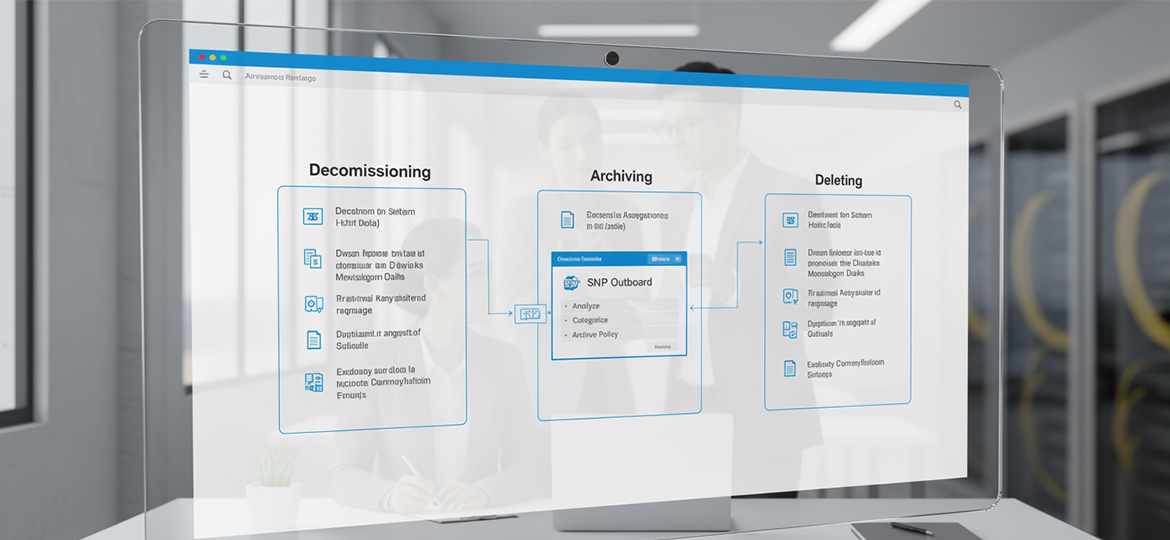
In the digital era, data management has become one of the primary challenges for companies. As transactional, operational, and historical data accumulates, companies must be able to manage it in a way that is efficient, secure, and compliant with regulations. Three commonly used approaches are decommissioning, archiving, and deleting. Although they may sound similar, all three have different roles and impacts within the SAP ecosystem.
Amidst this complexity, the SNP Outboard solution emerges, offering flexibility and certainty in managing legacy data without disrupting core system operations. This article will discuss in-depth the differences between decommissioning, archiving, and deleting, and how SNP Outboard plays a vital role in a company's data management strategy.
Decommissioning: Retiring Legacy Systems
Decommissioning is the process of deactivating legacy systems or applications that are no longer in use, yet their data still holds business or regulatory value. In the context of SAP, decommissioning is often performed when a company migrates to a new system, for instance, from SAP ECC to SAP S/4HANA.
Instead of maintaining the legacy system with its high infrastructure costs, companies can shut it down and move critical data to a specialized platform. With decommissioning, the data remains accessible for audit, compliance, or analytical purposes, but without the cost burden of maintaining the old system.
Benefits of Decommissioning:
-
Reduces infrastructure and license costs for legacy systems.
-
Ensures data availability for regulatory and business needs.
-
Minimizes security risks on obsolete systems.
Archiving: Storing Old Data Safely
Archiving is the process of moving old, infrequently accessed data from the production system to a separate storage location. This data is not deleted but is stored for future reference or auditing.
In SAP, archiving is typically performed on transactional or master data that is no longer relevant for daily operations. For example, sales transaction data that is more than 10 years old.
Benefits of Archiving:
-
Improves production system performance as data volume is reduced.
-
Provides access to historical data without burdening the primary database.
-
Helps ensure compliance with long-term data retention regulations.
Deleting: Permanently Erasing Data
Unlike decommissioning and archiving, deleting means permanently erasing data from the system. This approach is usually taken for data that is no longer relevant, has no business value, and is not legally required to be retained.
However, deleting must be done with extreme caution. A deletion error can have fatal consequences, both from an operational and a legal compliance perspective.
Benefits of Deleting:
-
Frees up significant storage space.
-
Reduces data management complexity.
-
Lowers the risk of sensitive data misuse.
SNP Outboard: A Smart Solution for Data Management
When choosing between decommissioning, archiving, and deleting, companies often face a dilemma: how to maintain a balance between cost efficiency, data availability, and regulatory compliance?
This is where SNP Outboard comes in as a solution. SNP Outboard is a platform that enables companies to archive, decommission systems, or delete data in a controlled and secure manner.
The Role of SNP Outboard in Decommissioning
-
Moves data from legacy systems to a lighter platform.
-
Provides easy and fast access to historical data without needing to maintain the old system.
-
Supports a smooth migration to SAP S/4HANA.
The Role of SNP Outboard in Archiving
-
Archives data according to business and regulatory needs.
-
Ensures accessibility of historical data without disrupting the production system.
-
Provides full transparency into the data lifecycle.
The Role of SNP Outboard in Deleting
-
Permanently deletes data using a mechanism that complies with regulations.
-
Provides logs and proof of compliance for audit processes.
-
Reduces the risk of human error in data deletion.
Strategic Benefits of SNP Outboard
By integrating SNP Outboard into their data management strategy, companies gain various strategic benefits:
-
IT Cost Efficiency: Reduces server, license, and maintenance costs for legacy systems.
-
Regulatory Compliance: Supports international standards like GDPR as well as local data retention regulations.
-
System Performance Improvement: Optimizes production system performance by moving old data out of the main database.
-
Data Access Flexibility: Provides access to historical data whenever needed without disrupting daily operations.
-
Risk Mitigation: Reduces the likelihood of sensitive data leaks from unmaintained legacy systems.
Conclusion
The difference between decommissioning, archiving, and deleting lies in how a company treats its old data. Decommissioning focuses on retiring legacy systems, archiving preserves historical data, while deleting completely erases data.
In practice, however, companies often need a combination of all three. With SNP Outboard, companies can perform decommissioning, archiving, or deleting in a structured, secure, and regulatory-compliant manner.
As an official partner of SNP and SAP in Indonesia, Soltius has extensive experience in helping companies manage their SAP data efficiently. Our consultant team is ready to support the implementation of SNP Outboard to meet your decommissioning, archiving, or deleting needs, while also ensuring regulatory compliance and IT cost efficiency.
Contact Soltius today for a smarter, more secure data management solution tailored to your business needs.
Other News