Blog

The SAP Datasphere Concept: What Is a Business Data Fabric and How Does It Work?
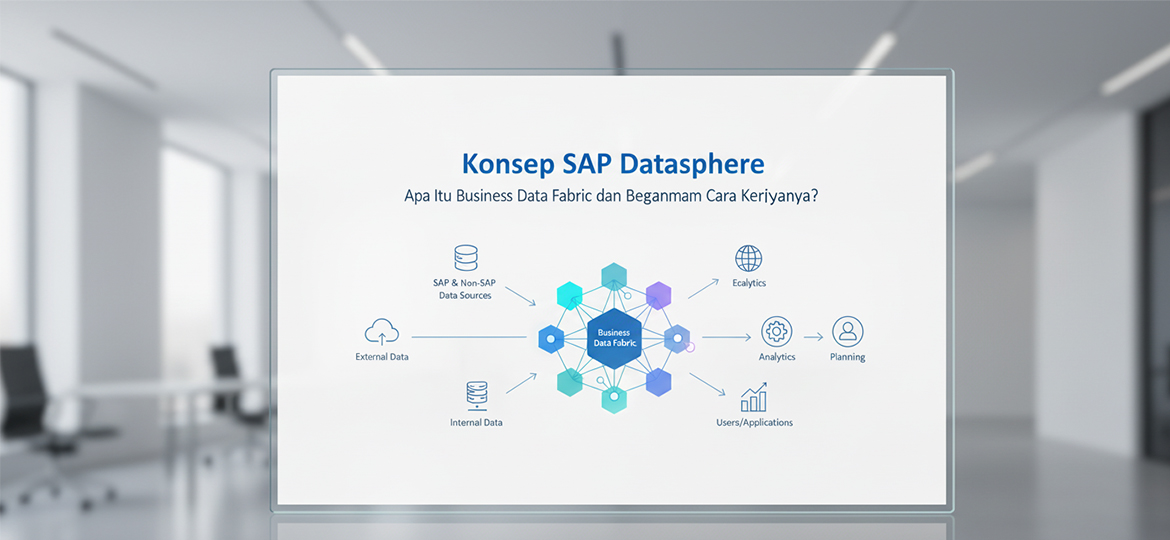
We are currently in a digital era where data is dispersed across various systems and platforms, both in the cloud and on-premise. For companies especially, data that is scattered without clear context becomes difficult to fully utilize.
Thus, the primary challenge is how to manage this dispersed data so that it remains relevant and easily accessible to the various stakeholders who need it.
This is where SAP Datasphere emerges as a solution to build a Business Data Fabric—a data management architecture that connects, manages, and governs data from various sources in an integrated manner, without losing its business context. Let's explore this intelligent platform further!
What Is a Business Data Fabric?
Before delving into SAP Datasphere, let's first understand what a Business Data Fabric is. In essence, a Business Data Fabric is a data management architecture that unifies various information sources into a single, integrated layer, ready for direct use in a business context. This way, data from various systems can be accessed in real-time, consistently, and can be immediately utilized for analytical purposes.
SAP Datasphere provides the foundation for building a Business Data Fabric by connecting SAP and non-SAP data, enabling seamless integration between systems, and ensuring data is easily accessible to business users.
Key Features of SAP Datasphere in Building a Business Data Fabric
To build a robust and credible Business Data Fabric, SAP Datasphere offers several key features, such as:
1. Data Integration from Various Sources SAP Datasphere enables data integration from multiple sources, both SAP and non-SAP, through data federation and replication. This ensures that dispersed data can be accessed centrally without needing to physically move the data.
2. Business Semantic Model By using a semantic model, SAP Datasphere ensures that accessed data has clear business context. This makes it easier for users to understand and utilize data for analytics and decision-making.
3. Centralized Data Catalog SAP Datasphere provides a data catalog that allows users to easily discover, understand, and manage data. This catalog also supports data governance, ensuring compliance with regulations and internal policies.
4. Collaboration and Data Sharing With SAP Datasphere, organizations can securely share data with partners and third parties. This supports better collaboration and enables joint innovation within the data ecosystem.
Challenges in Implementing a Business Data Fabric and Their Solutions
In its application, the Business Data Fabric is not without its challenges. However, every challenge has its solution. Here are some challenges that typically arise when building a Business Data Fabric, along with their solutions:
1. Integration Complexity Integrating various heterogeneous data sources can be a technical challenge, especially if the systems used are incompatible. However, SAP Datasphere provides tools and a framework to simplify this integration process.
2. Metadata Management Maintaining metadata consistency across all systems is a significant challenge. SAP Datasphere assists in managing metadata centrally, ensuring that data-related information remains accurate and up-to-date.
3. Scalability and Performance As data volumes grow, ensuring the system remains scalable and maintains optimal performance becomes critical. SAP Datasphere is designed to handle large scales and support efficient data processing.
Why SAP Datasphere is the Right Choice
SAP Datasphere is currently the best cloud-based platform for building a Business Data Fabric. Why is this? Here are the reasons:
1. Comprehensive Data Integration SAP Datasphere can unify data from various sources—whether SAP or non-SAP, cloud or on-premise—without needing to physically move the data. This allows companies to have an accurate and reliable single source of truth.
2. Real-Time Access with Business Context The available data is not only complete but is also provided with business context, allowing users to perform analytics and make decisions quickly and accurately.
3. Supports Intelligent Analytics and AI The platform facilitates the use of AI and predictive analytics in real-time. For example, companies can predict market demand, optimize the supply chain, or analyze product performance without waiting for manual reports.
4. Operational Efficiency and Scalability With workflow automation and centralized data management, companies can reduce manual errors, increase efficiency, and scale usage according to business growth needs.
5. Collaboration Across Teams and Business Partners Datasphere facilitates secure data sharing with internal teams and external partners, fostering joint innovation and ensuring all parties work with the same up-to-date information.
6. Supports Digital Transformation Strategy and Competitive Advantage By building a Business Data Fabric through Datasphere, companies are not just managing data but transforming it into a strategic asset. This increases the speed of decision-making, strengthens innovation, and provides a sustainable competitive advantage.
Build Your Business Data Fabric with SAP Datasphere from Soltius
To assist you in building a Business Data Fabric using SAP Datasphere, Soltius is here as an experienced strategic partner. With a deep understanding of SAP Datasphere and its implementation, Soltius can help you design, implement, and optimize a data solution tailored to your company's needs. Consult your business needs with us today and get the best solution.
Other News