Blog

Understanding What SuccessFactors Is: An All-in-One Solution for HR Management Transformation
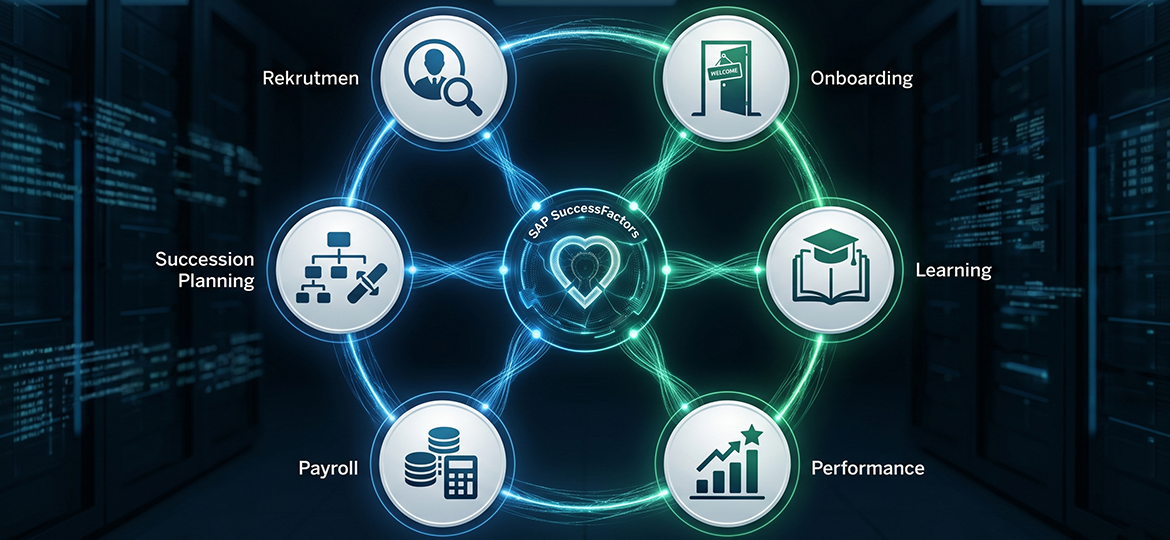
Managing Human Resources operations often triggers high inefficiency when employee data is trapped in siloed systems. The recruitment process is prone to bottlenecks due to manual candidate tracking, while performance appraisal documentation runs without a standardized matrix structure. This infrastructure fragmentation not only creates redundant administrative tasks that burden HR staff, but also prevents management from gaining comprehensive data visibility regarding talent capabilities and retention within the company.
To resolve these operational hurdles and data centralization issues, SuccessFactors emerges as an all-in-one, cloud-based Human Capital Management (HCM) solution. This platform functions as a single architecture that automates the entire employee lifecycle, from the talent acquisition phase and compensation management to real-time performance analytics. With full integration in a single ecosystem, the HR team can leave behind reactive administrative management and focus entirely on executing HR development strategies driven by data precision.
What is SAP SuccessFactors? (Complete Definition)
SAP SuccessFactors is a cloud-based software suite (SaaS) specifically designed for enterprise-level Human Capital Management (HCM) needs. This platform consolidates all HR operational functions into a single centralized database, eliminating redundancies and maintaining data validity.
As a crucial pillar of the SAP ecosystem (the world's largest Enterprise Resource Planning / ERP provider), this platform offers the advantage of native integration. Data from SuccessFactors can flow seamlessly into financial systems (FICO) or other company operational systems without requiring complex third-party middleware.
One thing that sets this system apart is the paradigm shift from HCM to Human Experience Management (HXM). While traditional HCM systems only look at administrative operations, the HXM approach collects experience metrics (experience data/X-data). This system measures employee sentiment, motivation, and engagement to ensure they remain productive.
Core Modules of SAP SuccessFactors
To facilitate an understanding of this platform's capabilities, here is a concise table of the offered module architecture:
| Module Name | Core Function |
| Employee Central | Core HR database, administration, & organizational structure management. |
| Talent Management | Recruitment workflow, onboarding, & performance management. |
| LMS | Training center, certification, & skill development. |
| Compensation | Salary budget planning, bonus allocation, & reward management. |
| Succession | Career path mapping & leadership succession preparation. |
| HR Analytics | Reporting dashboard, turnover prediction, & workforce strategy. |
Here are the technical details regarding how each module works within the corporate ecosystem:
-
Employee Central (Core HR & HRIS)
This module acts as the main foundation or single source of truth for all company data. Employee Central stores employee master data, global time/attendance tracking, and structured approval workflow mapping.
-
Talent Management (Recruitment, Onboarding, Performance)
Automates candidate tracking (Applicant Tracking System) to cut down recruitment time. Once a candidate is hired, the system immediately triggers a digital onboarding workflow. This module also standardizes performance appraisal matrices using Key Performance Indicators (KPIs) that are directly linked to business targets.
-
Learning Management System (AI-Based LMS)
The LMS in SuccessFactors functions like a proactive corporate "smart library". Using artificial intelligence algorithms, this module can recommend courses or certification paths that are most relevant to the skill gaps and career targets of each employee.
-
Compensation Management
Ensures the payroll and bonus distribution processes run objectively and comply with financial regulations. The HR team can automatically design salary structures across departments or countries, while simultaneously monitoring budget availability to prevent over-budgeting.
-
Succession & Development
Designed to ensure operational continuity when key positions suddenly become vacant. This module visually maps the talent pool (usually using a 9-box grid), helping management identify high-potential (HIPO) employees who are ready for promotion.
-
HR Analytics & Workforce Planning
Transforms raw data into predictive insights. Monitor real-time dashboards for diversity metrics (D&I), predict turnover ratios, and plan recruitment needs for the next 3-5 years according to business growth.
Benefits of SAP SuccessFactors for Companies
Transitioning to a new HR infrastructure certainly requires commitment and adaptation. For mid-scale to enterprise companies, adopting this HXM platform provides measurable strategic advantages, including:
-
Limitless Scalability (Cloud-Based): You no longer need to purchase and maintain costly physical servers. This system will expand alongside your business growth.
-
Massive HR Process Automation: This platform takes over repetitive tasks. Complex processes like payroll calculation, attendance recapitulation, and CV sorting are executed automatically by the system.
-
Data-Driven Decision Making: HR managers can shift from gut feelings to fact-based strategies. You can evaluate performance or detect turnover risks through real-time analytical dashboards.
-
Regulatory Compliance (Local & Global): This system automatically supports multi-language, multi-currency, and labor regulation updates, such as tax and insurance rules.
-
Enhanced Employee Engagement: Through the Self-Service portal feature (ESS/MSS), employees have the autonomy to access payslips, request leave, and view training progress from their mobile phones.
SAP HCM vs. SAP SuccessFactors — What's the Difference?
Many HR professionals and IT Managers are still confused about the difference between SAP HCM (a highly popular predecessor system) and SuccessFactors. Simply put, if SAP HCM is a powerful "steam train" that requires specialized and expensive rail infrastructure, then SuccessFactors is a high-speed "maglev train" moving smoothly over a cloud network.
Here is a comparison of the technical and operational architecture between the two:
| Comparison Indicator | SAP HCM (Legacy System) | SAP SuccessFactors (Modern System) |
| Infrastructure | On-Premise (Physical servers in the office) | Cloud / SaaS (Servers managed by SAP) |
| Funding Model | Capital Expenditure / High initial capital outlay | Operational Expenditure / Monthly or annual subscription |
| System Updates | Manual, complex, and requires downtime (annual) | Automatic and transparent (usually quarterly updates) |
| Functionality Focus | Traditional HR transactions & administrative compliance | Human Experience Management (HXM), engagement, & talent |
| Access Flexibility | Limited to the office intranet network or VPN | Access anytime & anywhere via browser and mobile apps |
When Should Your Company Move to SuccessFactors?
If your company is starting to get overwhelmed by local server maintenance costs, needs more agile data analytics, and wants to improve the digital employee experience, then migration is the right step.
Furthermore, this transition has already entered an urgent phase. SAP has officially announced that the End of Mainstream Maintenance deadline for core SAP Business Suite 7 applications, which includes the SAP ERP HCM On-Premise system, will conclude on December 31, 2027.
With the cessation of this support, the old system will no longer receive system updates (Support Packages) or legal regulation adjustments (Legal Change Patches). Therefore, migrating to SuccessFactors is now a strategic operational imperative to avoid future data security risks and HR legal non-compliance.
CONCLUSION
Digital transformation in Human Resources management is no longer limited to automating administrative records, but rather a transition towards data centralization and employee performance optimization. SAP SuccessFactors provides the cloud-based architecture needed to execute these strategies measurably.
With a system modularity that covers the entire HR operational cycle—from digital recruitment to succession planning this platform offers high scalability, legal compliance automation, and real-time predictive analytic capabilities. Considering the discontinuation of technical support for the SAP HCM On-Premise system in 2027, migration to a cloud infrastructure is now an operational urgency.
To ensure a smooth system transition, the first strategic step to take is to conduct an HR infrastructure audit. It is highly recommended to discuss directly with a certified SAP official implementation partner to obtain in-depth technical consultation, license cost estimations, and the design of a migration roadmap with the lowest possible risk for your business.
Other News