Blog

What Is a Sustainability Report and What POJK 51 Requires of Companies
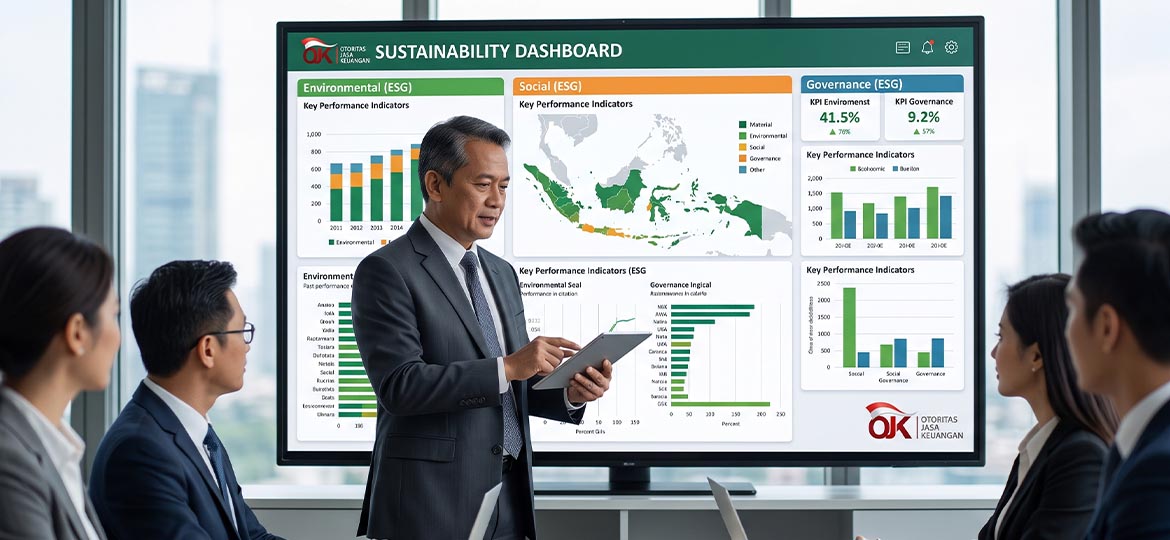
At the start of every year, corporate secretary teams gather energy consumption, employment, and social performance data from across divisions ahead of the reporting deadline to the OJK. The administrative questions that surface are usually the same: is the company among those required to prepare a sustainability report, what has to be in the document, and when is it due. POJK 51 answers all three in detail.
In short: a sustainability report (sustainability report) is a publicly disclosed report covering a company's economic, financial, social, and environmental performance in running its business sustainably. Indonesia's Financial Services Authority (OJK) mandates it through POJK No. 51/POJK.03/2017 for financial services institutions, issuers, and public companies, with nine minimum content components.
Who is required to prepare a sustainability report?
POJK 51 Article 10 paragraph (1) covers three groups: financial services institutions (LJK), issuers, and public companies. What often goes unread is that the obligation did not take effect for everyone at once. Article 10 paragraph (6) sets out when each category of entity becomes subject to it, running from financial year 2019 through to financial year 2025.
|
Commercial banks in BUKU 3 and BUKU 4, and foreign banks |
2019 |
30 April 2020 |
|
Issuers other than those with small and medium-scale assets; public companies; BUKU 1 and BUKU 2 commercial banks; financing companies; insurers; other financial services institutions |
2020 |
30 April 2021 |
|
Issuers with medium-scale assets; BPRKU 3; securities firms administering client securities accounts |
2022 |
30 April 2023 |
|
Issuers with small-scale assets; BPRKU 1 and BPRKU 2; other securities firms; pawnbroking; guarantee companies |
2024 |
30 April 2025 |
|
Pension funds with assets of at least Rp1 trillion |
2025 |
30 April 2026 |
* Applies where the report is prepared separately from the annual report (Article 10 paragraph 4). Where the two are combined, the deadline follows each entity's annual report deadline (Article 10 paragraph 3). The BUKU terminology comes from POJK 51; commercial bank classification now uses KBMI.
Financial year 2020 is frequently cited incorrectly. Issuers in general and public companies have been subject to the requirement since that financial year, not 2022, which applies only to issuers with medium-scale assets. The definition of a public company appears in Article 1 point 7: at least 300 shareholders and paid-up capital of at least Rp3 billion.
Companies outside those three groups are not required by POJK 51 to prepare a sustainability report, even though data requests from lending banks and corporate customers keep increasing.
What must a sustainability report contain under POJK 51?
Appendix II of POJK 51 sets out nine minimum content components that must be included. A common misunderstanding is that these apply to only one of the formats, when in fact all nine apply whether the report is prepared separately or forms part of the annual report (Article 10 paragraph 2). Appendix II point 3 demands the same information either way; only the reporting deadline differs.
- An explanation of the sustainability strategy
- An overview of sustainability aspects (economic, social, and environmental)
- A brief profile of the financial services institution, issuer, or public company
- A statement from the Board of Directors
- Sustainability governance
- Sustainability performance
- Written verification from an independent party, where applicable
- A feedback form (feedback) for readers, where applicable
- A response to feedback on the previous year's report
The phrase “where applicable” in component 7 signals that independent verification is conditional. Component 6 is the most time-consuming part, because Appendix II requires data to be presented comparatively across the last three years, from energy consumption through to profit and loss. Data history of that length is rarely documented centrally, which is why companies may consider using an ESG data dashboard such as SAP Sustainability Control Tower to collect and consolidate it. Mapping that data into the POJK 51 format, however, remains the reporting team's responsibility.
When Is the Deadline and What Happens If You Miss It?
Where a sustainability report is prepared separately from the annual report, it must be submitted to the OJK no later than 30 April of the following year (Article 10 paragraph 4). The sanctions imposed are administrative and consist only of a reprimand or written warning (Article 13). The word “fine” does not appear anywhere in POJK 51.
Claims of “fines of up to Rp1 billion” circulating in some articles have no legal basis. Beyond reporting to the regulator, Article 12 also requires the report to be published on the company's website, subject to the same 30 April deadline.
Even though the administrative sanctions are light, the risk to a company remains significant. A sustainability report is open to the public, so pressure from investors and lenders often carries more weight than any administrative penalty.
RAKB Is Not the Same Thing, and Where POJK 51 Is Heading
The Sustainable Finance Action Plan (RAKB) is a different document from a sustainability report. The RAKB sets out a one-year short-term and five-year long-term business activity plan, is mandatory only for financial services institutions, and falls due on 31 January where the institution is not required to submit a business plan (Article 4). A sustainability report, by contrast, reports performance that has already occurred and falls due on 30 April.
The RAKB looks forward at planning; the sustainability report looks back at performance.
POJK 51 remains in force at present. The OJK is preparing a revision through a draft POJK that would align report preparation with sustainability disclosure standards. It is still at draft stage, and the public consultation period closed on 13 March 2026.
The requirement to present three years of comparative data calls for a data history traceable directly back to operational systems, not a spreadsheet compiled as the deadline approaches. Rising reporting standards raise that bar further, which is why some companies are adopting SAP-based sustainability solutions earlier than they otherwise would.
FAQ (Frequently Asked Questions)
When is the deadline for submitting a sustainability report to the OJK?
Where it is prepared separately from the annual report, it must reach the OJK no later than 30 April of the following year (POJK 51 Article 10 paragraph 4). Where the two are combined, the deadline follows each entity's annual report deadline. Publication on the website is also due by 30 April.
What is the difference between a sustainability report and an annual report?
An annual report focuses on financial performance and business strategy; a sustainability report covers economic, financial, social, and environmental performance. POJK 51 allows the two to be separated or combined. The nine minimum components apply to both formats; only the deadline differs.
What is the RAKB and how does it differ from a sustainability report?
The RAKB is a document setting out a one-year short-term and five-year long-term business activity plan. It is mandatory for financial services institutions and falls due on 31 January where the institution is not required to submit a business plan. A sustainability report covers performance that has already taken place.
Conclusion
POJK 51 turned sustainability reporting from a voluntary initiative into an obligation with defined categories, content, and deadlines. The main obstacle is rarely philosophical; it is data traceability. As an SAP Platinum Partner through United VARs, Soltius implements and supports SAP Sustainability solutions so that the data in a report can be traced straight back to the system rather than assembled by hand.
For more on your company's sustainability data readiness, visit soltius.co.id.
Other News