Blog

What Is ETL (Extract, Transform, Load) in Data Processing
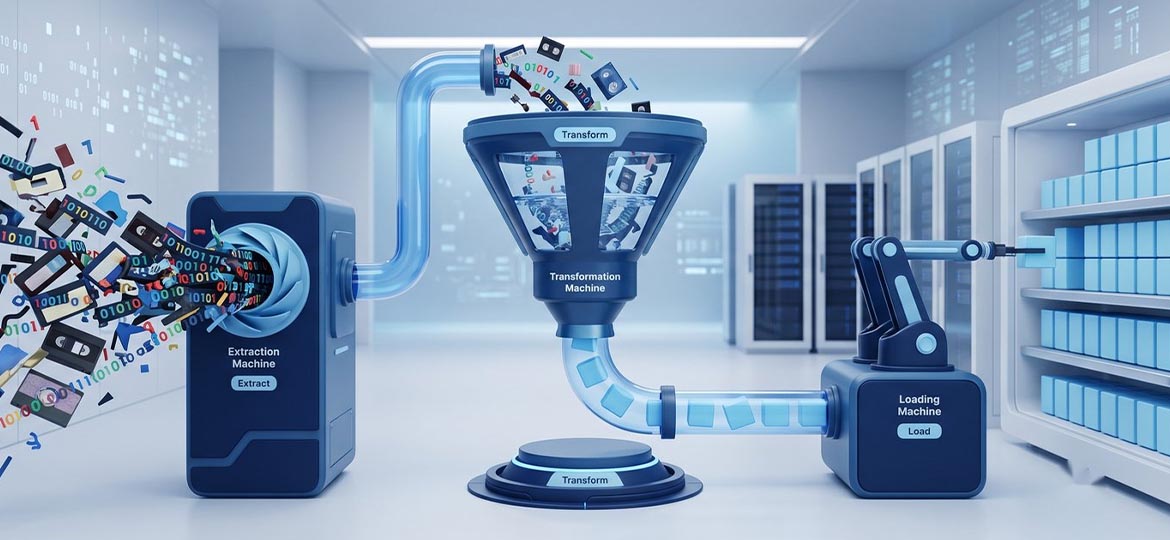
Sales data in the ERP (Enterprise Resource Planning) system, branch POS (point of sale) summaries, and the finance team's spreadsheets often show different numbers. The problem usually lies not in the dashboard but in the data path leading to the company's data warehouse. ETL is the standard mechanism for resolving these discrepancies. This article covers the three stages of ETL, how it differs from ELT (Extract, Load, Transform), and why pipeline quality is essential to the accuracy of management data.
ETL (Extract, Transform, Load) is a three-stage data integration process: pulling data from various source systems (extract), cleansing and standardising formats in a staging area (transform), then loading it into a target such as a data warehouse (load). The process produces a single, consistent source of data that is ready for analysis.
How Do the Stages of the ETL Process Work?
The three ETL stages run in sequence through a staging area, a temporary holding area between the source and target systems. AWS notes three common extraction methods: update notification, incremental, and full extraction. Pipelines are typically run in batch mode, for example overnight, so the data warehouse is ready when the working day begins.
This approach is nothing new. According to IBM, ETL was introduced in the 1970s alongside the shift to larger centralised databases, and later grew into the primary data processing method for data warehousing projects.
|
1. Extract |
Raw data is copied from source systems such as ERP databases, POS, CRM (customer relationship management), Excel files, and APIs into a staging area, through either a full or an incremental pull (only new and changed data). |
Daily sales transactions are pulled from the ERP, customer data from the CRM, and branch reports from Excel files. |
|
2. Transform |
Data is cleansed (duplicates removed, errors mapped to the target format), formats are standardised (dates, currencies, product codes), then it is merged and aggregated to suit the analysis required. |
“PT ABC” and “ABC, PT” are recognised as one and the same customer entity. |
|
3. Load |
The transformed data is loaded into the data warehouse: a full load the first time, then scheduled incremental loads for subsequent changes. |
Analysis-ready sales tables are refreshed each night and read by dashboards the following morning. |
In practice, most of the time on a data project is spent on the transform stage rather than on extract or load. Standardising product codes across several different systems usually takes far more time than simply copying data.
What Is the Difference Between ETL and ELT?
The difference lies in the order of transformation. ETL cleanses and standardises data before it is loaded into the target system; ELT loads raw data first, then processes it inside the data warehouse using cloud computing power. The stages are the same; what moves is where and when the transformation happens.
The rule for choosing is fairly practical. ETL suits situations where data must be clean and standardised before it touches the target system; because transformation happens before the load, sensitive data such as financial records can be cleansed first. ELT is common on modern cloud data warehouses with large storage and compute capacity, particularly for high volumes of raw data in varied formats.
The two are not mutually exclusive. AWS notes that ETL and ELT can be used together within a single complex analytics architecture that processes many data formats from diverse sources.
The Role of ETL in Data Warehousing and Business Intelligence
A company's analytics chain runs in one direction: source systems, the ETL pipeline, the data warehouse, then the Business Intelligence (BI) dashboard. A mapping or cleansing error at the transform stage does not stop at the pipeline; it shows up directly as a wrong number on the dashboard that management reads. It is ETL quality, not dashboard design, that determines whether reports can be trusted.
The principle is known as garbage in, garbage out: a data warehouse does not fix data that arrives dirty; it merely stores it.
Today, ETL processes are largely run by managed data platforms. SAP Datasphere, announced on 8 March 2023 as the successor to SAP Data Warehouse Cloud, provides three types of flow for data pipelines: the data flow for classic ETL, the replication flow for bulk data replication, and the transformation flow for SQL-based transformation within the platform.
Two points are worth noting. First, ETL is not a one-and-done project; pipelines must be monitored and adjusted every time a source system changes, such as when a column is added or an application is replaced. Second, if your data comes from only one or two applications, a direct connection to a BI tool is often more efficient than building a full pipeline.
FAQ (Frequently Asked Questions)
What is an example of an ETL process in a company?
Retail sales consolidation is the most common example. Transactions from hundreds of branch POS terminals and ERP data are extracted in batch each night, standardised for format and product codes in a staging area, then loaded into the data warehouse. Management can then see a single consolidated sales figure without manual per-branch summaries.
Is ELT replacing ETL?
No. ETL has been in use since the 1970s and remains the standard whenever data must be clean and standardised before entering the target system, financial data being one example. ELT has grown alongside cloud data warehouses for large volumes. AWS notes that the two can even be used together within a single analytics architecture.
What tools are used for the ETL process?
There are three main categories: open source tools, ETL services from cloud providers, and integrated data platforms. In the last category, SAP Datasphere provides three types of flow (data flow, replication flow, transformation flow), so both ETL and ELT patterns can run on a single platform.
Conclusion
The three stages of ETL look simple in theory, but it is the discipline of carrying them out that separates a report you can trust from a summary that keeps getting questioned. Companies looking to fix their data should start with the pipeline, not the dashboard. Through its Data and AI Consulting services, Soltius helps companies design and implement data pipelines and modern data warehouses such as SAP Datasphere, turning scattered data into a single source of figures that can be trusted.
To discuss ETL pipeline design and your company's readiness for SAP Datasphere, please visit soltius.co.id.
Other News