Blog

What Is Human Capital Management (HCM)? A Complete Guide
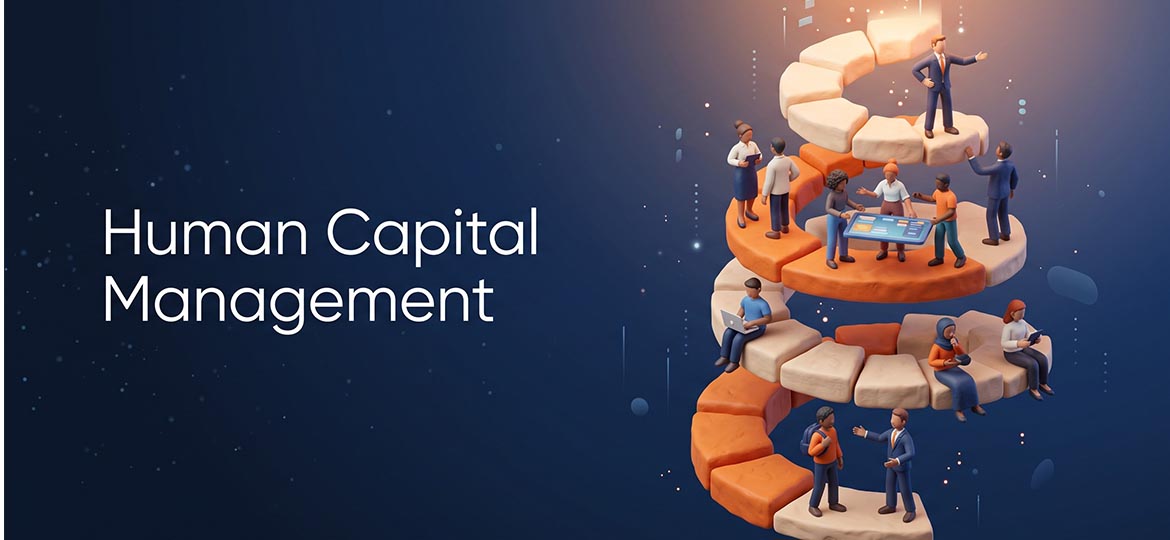
In many companies, employee matters still stop at attendance, payroll, and personnel records. Yet management needs more strategic answers. Who are the key talents that must be retained? What skills will still be lacking next year? Questions like these are what make human capital management relevant. This article explains how it differs from traditional HR, its functions across the employee lifecycle, and how digital systems put it into practice through Human Capital Management solutions in companies.
Human capital refers to the knowledge and skills of employees, whose value can keep growing. Building on that, human capital management is a way of managing employees as strategic assets rather than just a workforce. Its scope covers the entire employee journey, from recruitment, development, and performance to retention. In practice, HCM is usually run with the help of a digital system called a Human Capital Management System (HCMS).
What Is the Difference Between Human Capital Management and Traditional HR?
The main difference lies in perspective. Traditional HR, or human resource management (HRM), sees employee costs as an expense (cost) and focuses on administration and compliance. HCM sees them as an investment and is oriented toward strategy and business growth. So what sets the two apart is their point of view, not just the name of the department.
The following table summarizes the HRM vs. HCM comparison:
| Dimension | Traditional HR (administrative HRM) | Human Capital Management (HCM) |
|---|---|---|
| View of employees | Resources or labor | Capital and assets to be developed |
| Cost treatment | Cost (expense) | Investment |
| Orientation | Efficiency and compliance | Strategy and business growth |
| Scope | Administration: attendance, leave, payroll, data | End-to-end: talent, performance, learning, analytics |
| Employee value over time | Tends to be seen as depreciating | Seen as increasing with development |
In reality, both deal with the same people, and their day-to-day tasks are not very different. What differs is the perspective and the ultimate goal. The term human capital underlines this: employees are seen as capital whose value can grow through development. In the past, HR systems focused largely on attendance, payroll, and record-keeping. Today, HR teams are expected to be strategic business partners, not just an administrative unit.
This perspective comes from human capital theory, formulated by the economists Theodore Schultz (1961) and Gary Becker (1964). According to this theory, human skills and knowledge are a form of capital that grows through investment, such as education and training. Note that this is an economic theory, not an official SAP definition. Still, it explains where the idea of “employees as assets” comes from.
Key Functions and Components of Human Capital Management
HCM is not a single activity. It is a series of functions that follow the employee journey, from attracting and recruiting to developing, measuring performance, compensating, and retaining employees. Data from one function helps inform decisions in the next. It is because of these interconnections that HCM deserves to be called capital management rather than mere administration.
- Recruitment and selection: attracting and selecting the right talent.
- Onboarding: helping new employees become productive quickly.
- Performance management: setting and monitoring measurable work goals, such as KPIs and OKRs.
- Compensation and benefits: designing a fair and competitive rewards structure.
- Learning and development: training, upskilling, and succession planning as part of talent management.
- Workforce planning: mapping talent needs for the next period.
- Compliance and payroll: managing personnel data, reporting, and regulatory compliance.
In many companies, these seven functions are still spread across various spreadsheets and separate applications. As a result, employee data is often inconsistent and difficult to use for decision-making.
How Does an HCM System (HCMS) Support a Human Capital Strategy?
An HCM system brings these functions together on a single platform. The result is a single source of employee data, automated processes, and people analytics that help turn data into talent decisions. Without a system, a human capital strategy is hard to run at scale, because the data is fragmented and decisions are made without reliable numbers.
One example of a cloud-based HCM suite is SAP SuccessFactors. SAP notes that the product was named a Leader for the 10th consecutive time in the Gartner Magic Quadrant for Cloud HCM Suites for 1,000+ Employee Enterprises, published on September 16, 2025. It also serves more than 10,000 customers worldwide, from startups and midsize companies to large enterprises (SAP News Center, September 2025). The “1,000+ employees” in the report's name refers to the scope of Gartner's category, not a minimum number of users.
Even so, an HCMS is only an enabler, not a substitute for strategy. Buying software doesn't automatically mean a company is “doing HCM.” The benefits only show once HR processes have been agreed upon and employee data is well organized. In the field, new HR system implementations most often stall not because of their features, but because employee data hasn't been cleaned. That is why implementations usually start with the most urgent function instead of activating all modules at once.
When it works well, this approach delivers three things: more measurable productivity, better talent retention, and data-driven HR decisions.
FAQ (Frequently Asked Questions)
What is the difference between human capital (HCM) and human resources (HRM)?
HRM views employees as resources and operational costs, with a focus on administration. HCM, on the other hand, views employees as assets or investments, with a strategic focus. The term human capital comes from the human capital theory put forward by Theodore Schultz (1961) and Gary Becker (1964), which holds that skills are capital whose value can be increased through education and training.
What are the components of human capital management?
There are generally six to seven functions across the employee lifecycle: recruitment and selection, onboarding, performance management, compensation and benefits, learning and development, workforce planning, and compliance and payroll. The exact list may differ from one organization to another, but they are all interconnected as a single series rather than standalone activities.
What is an HCMS (human capital management system)?
An HCMS is software that makes HCM truly workable on a day-to-day basis. It unifies employee data, automates HR processes, and provides people analytics for reading HR data. One example is SAP SuccessFactors, a cloud-based suite that, according to SAP, is used by more than 10,000 customers worldwide (SAP News Center, September 2025).
Is human capital management the same as an HRIS?
Not quite. HCM is a discipline or strategy for managing human capital, while an HRIS (human resource information system) is a category of software for HR administration. HCM has a broader scope because it covers talent management and analytics, not just personnel record-keeping.
Who runs human capital management in a company?
HCM is run by the HR or people team together with line leaders, not by HR alone. Because it is strategic, connecting talent with business goals, its key decisions also involve management above the HR function. Examples include decisions on skill priorities, succession plans, and development budgets.
Conclusion
Ultimately, human capital management is about perspective: treating employees as capital whose value needs to be nurtured, and then supporting that with the right processes and systems. Technology follows strategy, not the other way around. As an SAP Platinum Partner through United VARs and part of Metrodata Group since 1998, Soltius implements and supports SAP HCM solutions, including SAP SuccessFactors, so that they connect with your core business systems.
To assess your readiness for human capital management and explore implementing SAP SuccessFactors in your company, visit soltius.co.id.
Other News