Blog

What is Inventory Management? Definition, Functions, and Examples
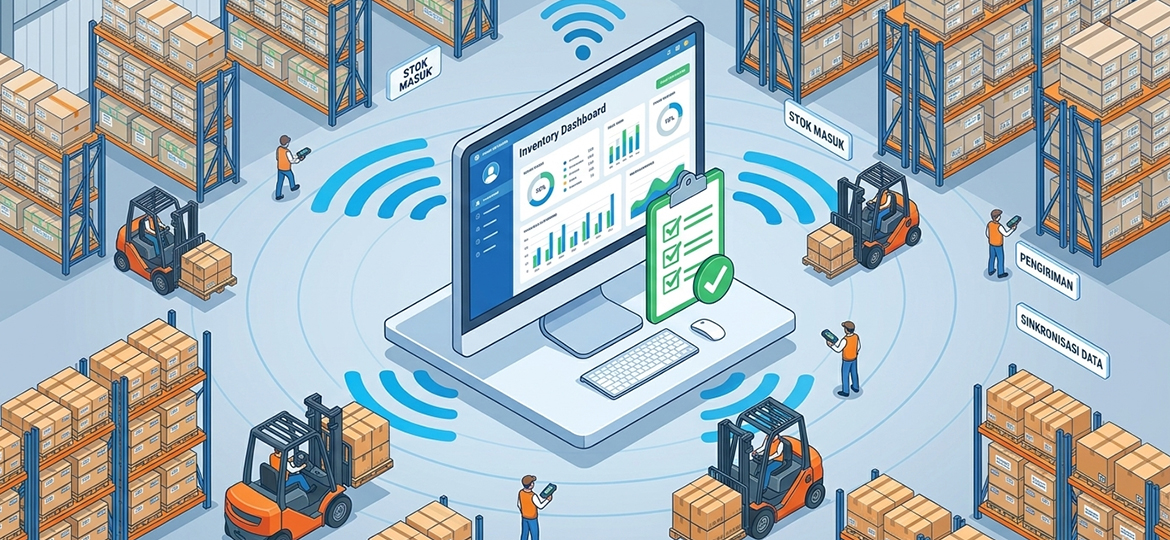
Many business practitioners face discrepancies between recorded data and physical goods because they still rely on basic spreadsheet applications that lack real-time synchronization capabilities. Using software not specifically designed for large-scale goods turnover often triggers fatal operational bottlenecks, ranging from the risk of overselling (selling out-of-stock items), the accumulation of dead stock, to inefficiencies in tracking unit movements between warehouses.
To resolve these operational constraints, the understanding and application of standardized Inventory Management are highly essential. This article will present a comprehensive A-Z guide on inventory management, covering its technical definition, its primary functions within the supply chain, various popular stock control methods, up to the technical indicators of when your company must immediately escalate by switching to an integrated Inventory Management System (IMS).
What is Inventory Management? (Complete Definition)
Conceptually, Inventory Management is a series of operational and strategic processes that regulate the entire lifecycle of goods within a company. This process includes the stages of planning, ordering, storing, and releasing goods for production purposes as well as direct sales.
In operational practice, this system functions to track the inflow and outflow of three main categories of inventory: raw materials, work-in-progress, and finished goods. Its main objective is to ensure the availability of goods in precise quantities, at the right locations, and at the required time to avoid cost inefficiencies.
The Difference Between Inventory Management vs. Inventory Control
In the supply chain industry, inventory management is often equated with inventory control. In fact, both have different technical scopes. For clarity, here is a comparison table:
| Aspect | Inventory Management | Inventory Control |
| Main Focus | Strategic (High-level planning) | Tactical (Daily operational supervision) |
| Scope | Manages the entire supply chain flow, from suppliers to the hands of consumers. | Limited to the movement and physical status of goods already within the warehouse. |
| Ultimate Goal | Optimizing cash flow, maintaining profitability, and preventing overstock or stockouts. | Preventing shrinkage, theft, and damage to goods on storage racks. |
| Examples of Activities | Demand forecasting, determining reorder points, supplier negotiation. | Physical audits (stock opname), barcode label scanning, warehouse layout management. |
Why is Inventory Management Crucial for Business?
Inventory management is not merely an administrative warehouse task, but a vital operational instrument that determines the company's financial health. Inaccuracies in managing the circulation of goods will have a systemic impact on the entire business ecosystem.
Here are three technical reasons why an inventory management system is highly crucial:
-
Cash Flow Optimization: The company's working capital is strongly tied to the inventory turnover metric. Procurement of goods that exceeds demand projections will freeze liquid assets into physical stock, thereby hindering the company's financial liquidity for other operational needs.
-
Dead Stock Prevention: Data history-based inventory control helps map the product lifecycle. This prevents the accumulation of obsolete, damaged, or expired goods that ultimately must be written off as an absolute loss.
-
Improved Fulfillment Capabilities: Accurate stock availability minimizes the risk of backorders or transaction cancellations due to stockouts. This supply stability directly correlates with increased customer satisfaction and retention.
Academically, this efficiency has been proven in various supply chain management studies. Based on research published in industrial management-related journals, the implementation of a measurable inventory system is proven to significantly reduce warehouse operational costs.
Read Also: Managing Eco-Friendly Restaurants with the Help of Energy & Waste Management Systems
6 Main Functions of Inventory Management
Functionally, inventory management acts as a regulator between the supply and demand sides. Here are its six main technical functions in business operations:
-
Preventing Stockouts: Ensuring inventory levels are always above the safety stock limit to respond to unexpected market demand fluctuations.
-
Ensuring Smooth Production Cycles: Providing real-time visibility of raw material availability to prevent the halting of production lines due to material delays from suppliers.
-
Minimizing Shrinkage and Depreciation: Facilitating systematic tracking of product shelf-life, thereby minimizing potential losses due to damaged goods or those past their expiration date.
-
Holding Cost Efficiency: Managing the volume of goods in the warehouse so that it does not exceed optimal capacity, which directly impacts the reduction of utility, insurance, and facility maintenance costs.
-
Demand Forecasting Accuracy: Providing valid historical data on the movement of goods for projecting sales trends and planning purchase volumes in subsequent periods.
-
Data Centralization Across Locations: Integrating stock visibility information across various facilities (such as distribution centers, branch warehouses, and retail stores) into a single centralized database.
Popular Inventory Management Methods & Strategies
The application of Inventory Management requires a specific framework tailored to the type of product, warehouse capacity, and business model. Selecting a precise method will optimize the goods turnover cycle in a measurable way.
Here are some of the most widely implemented technical approaches on an industrial scale:
Economic Order Quantity (EOQ) & Safety Stock
Economic Order Quantity (EOQ) is a mathematical calculation used to find the equilibrium point between ordering costs and holding costs. This formula helps companies determine the most economical order volume for every material or goods purchasing transaction.
As a complement to EOQ, companies also set Safety Stock. This is the quantity of reserve inventory allocated specifically to mitigate risks. Its goal is to secure operations from sudden demand spikes or delivery delays from suppliers (lead time delay).
Just-in-Time (JIT)
The JIT method focuses on maximum efficiency by reducing inventory volumes in the warehouse to the lowest essential level. Within this system's framework, materials or goods are only ordered and received precisely when the production schedule or order delivery requires them.
The main advantage of JIT is its ability to drastically cut holding costs. However, this method demands a very high level of data synchronization with suppliers and is highly vulnerable to external logistics disruptions.
FIFO, LIFO, and FEFO
These three strategies are standard protocols governing the physical flow of goods leaving storage facilities. The selection highly depends on the physical characteristics of the products sold:
-
FIFO (First In, First Out): The first units of goods recorded as entering the warehouse are the first units taken out to be sold. This protocol is ideal for maintaining the quality of products with fast trend cycles.
-
LIFO (Last In, First Out): The last units to enter the warehouse are prioritized to be taken out earlier. This method is generally used for piles of homogeneous materials (such as building materials), although its use is now restricted by several international accounting standards.
-
FEFO (First Expired, First Out): Outflow priority is strictly based on the nearest expiration date, regardless of the chronology of the goods entering the warehouse. This protocol is absolutely mandatory for strictly regulated industries such as Food & Beverage (F&B) and pharmaceuticals.
Read Also: The Importance of Implementing a Warehouse Management System in a Company
Examples of Inventory Management Implementation in Various Industries
The application of an inventory system is always tailored to the operational characteristics of each industrial sector. Here are its core implementations:
-
Retail & F&B: Heavily reliant on the FEFO (First Expired, First Out) method. The system is used to track batch numbers and expiration dates in real-time to prevent losses from food waste and maintain food safety standards.
-
Manufacturing: Manages three layers of stock (raw materials, work-in-progress, and finished goods) using Economic Order Quantity (EOQ) calculations. The goal is to align the schedule of material arrivals from suppliers so that the factory's production process is not halted.
-
E-Commerce & Omnichannel: Focuses on synchronizing a centralized stock database connected to multiple sales platforms simultaneously. This is crucial for preventing overselling when orders spike massively and accelerating the fulfillment of consumer orders.
When Should Your Business Switch to an Inventory Management System (IMS)?
Operationally, relying on manual spreadsheets has a maximum limit of scalability. As transaction volumes increase, manual recording will instead become the main bottleneck. Based on the experience of supply chain practitioners, here are the technical indicators that your business must immediately adopt an Inventory Management System (IMS):
-
Data Reconciliation Cycles Are Too Long: Your team spends days just conducting stock opname and matching the numbers in the system with the physical goods in the warehouse.
-
Recurring Overselling Incidents: Real-time data desynchronization occurs between sales storefronts and warehouse availability, leading to the unilateral cancellation of consumer orders.
-
Multi-Location Complexity: You start having difficulty tracking unit movements (stock transfers) between facilities, such as from the central warehouse to various retail branch stores or regional distribution centers.
-
Poor Financial Visibility: You cannot instantly pull inventory turnover ratio reports or inventory valuations for financial audit purposes.
Conclusion
Inventory Management is not just an administrative recording activity, but a strategic pillar that secures cash flow, minimizes the risk of asset depreciation, and maintains customer satisfaction levels. The implementation of precise methods—whether it is EOQ, JIT, or FEFO—as well as the transition to automated systems, will determine your business's capability in facing market escalations.
Do not wait until your profit margins are eroded by the accumulation of dead stock or the loss of customer trust due to stockouts. Conduct an inventory efficiency audit today.
To ensure the success of digital transformation in your company's supply chain ecosystem, schedule an IT system architecture consultation session with the experts at Soltius. We are ready to help design an IMS solution that is most relevant to the scale and complexity of your business.
Read Also: Improve Efficiency and Predictive Maintenance by Leveraging SAP Datasphere for Asset Analytics
Other News