Blog

What Is Omnichannel Retail and How to Implement It
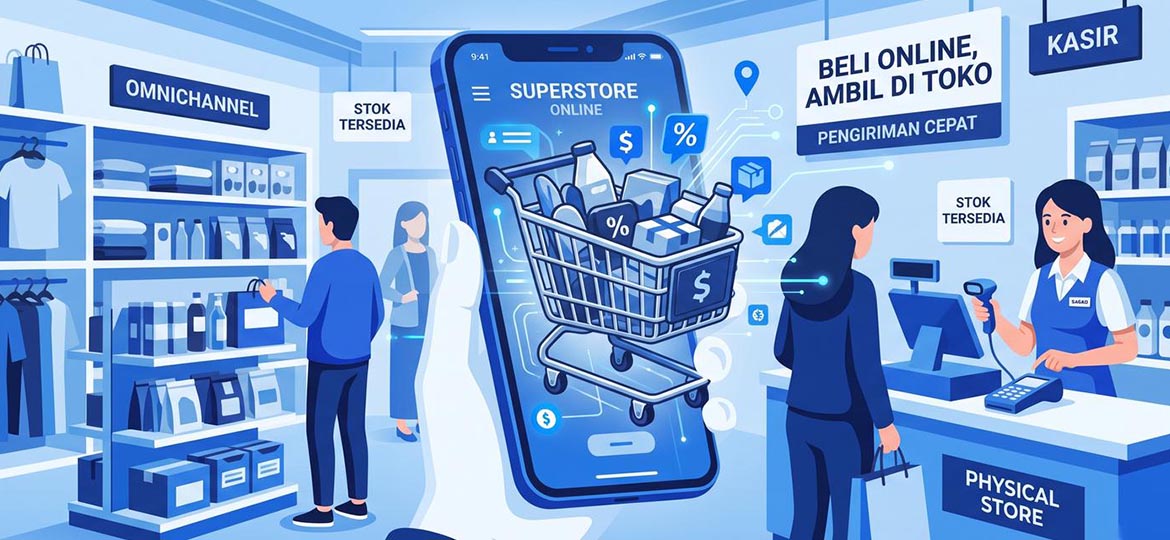
A customer sees a product on TikTok Shop, asks about stock via WhatsApp, pays on your website, then comes to the store to pick it up. On the surface, that journey looks seamless. The problem almost always appears behind the scenes: the stock recorded as available on the marketplace turns out to have already sold at the store counter, and then that online sale piles up into a manual recap that is only reconciled into accounting a week later. This is the heart of omnichannel retail that is rarely discussed in full. This article explains what omnichannel retail is, how it differs from multichannel, how to implement it gradually, and why a seamless front-end is only as strong as an integrated back-office.
In short: Omnichannel retail is a retail strategy that unites all sales and communication channels (physical store, website, app, marketplace, social media) into one seamless experience for the customer. Unlike multichannel, all channels in omnichannel share the same data: stock, prices, and purchase history flow in one integrated system.
Through this article, we will trace its basic concept, a comparison table with multichannel, five implementation steps, the integration layer that is often underestimated, and an honest section on when your business in fact does not yet need full omnichannel retail.
What Is Omnichannel Retail?
Omnichannel retail is an approach that places the customer, not the channel, at the center of the strategy. All touchpoints, from physical store, web, and app to marketplace, share the same single data, so customers can move between channels without losing continuity. The keyword is not “being present in many places” but “one consistent experience.”
What distinguishes omnichannel from merely “having many channels” is its data flow. When a customer adds a product to the cart in the app, sees the same item available at the nearest store, then completes the transaction at the counter, the system behind it treats those three interactions as one journey, not three separate transactions.
What's the Difference Between Omnichannel and Multichannel?
The key difference lies in data integration. Multichannel means the business is present across many channels, but each channel stands on its own with separate strategy, stock, and customer history. Omnichannel connects all those channels so that data flows between them. Multichannel focuses on the product in each channel; omnichannel focuses on the customer journey.
There is one principle practitioners often phrase: every omnichannel is multichannel, but not every multichannel is omnichannel. A shop can have a website, a physical outlet, and accounts on three marketplaces at once, but if the stock in each is managed with different numbers and the purchase histories don't know one another, that is still multichannel. The emphasis is the same across many academic and industry references: what matters is integration, not the number of channels.
The following table summarizes the differences across the five dimensions that most often become points of confusion:
|
|
|
|
|
|
|
|
|
|
|
|
|
|
|
|
|
|
|
|
The difference is felt clearly in a simple moment. In the multichannel model, a customer who buys online and then wants to exchange an item at the store is often refused because “the system is different.” In the omnichannel model, that transaction should be completable in any channel, because the data is one.
How to Implement an Omnichannel Strategy: 5 Steps
Implementing an omnichannel strategy is not something that can be done overnight. You need to follow five gradual steps, from strengthening the data foundation to execution in the field: map the customer journey, unify the data, ensure stock data is accurate, enable cross-channel fulfillment, and monitor and evaluate the results. The third step is the most critical point that is often neglected.
-
Map the customer journey. Recheck every interaction point (such as social media, the marketplace, the website, and the store counter) and find out where customer data breaks. Focus on fixing the existing gaps, not merely adding new channels.
-
Unify customer and product data. Create one master database covering product details, prices, and customer profiles. This is indeed a detailed stage, but it is very crucial; untidy data will only make problems spread faster to all channels.
-
Integrate stock data (a single source of truth). Make sure stock from the warehouse, the store, and online channels is connected into one accurate system. Without this, the risk of overselling (selling goods that are already out of stock) will be very high.
-
Enable cross-channel fulfillment. Once stock data is in sync, you can start running schemes such as buy online, pick-up in store (BOPIS) or ship-from-store, where a store can act as a pickup point or a shipping hub for online orders.
-
Evaluate and improve. Monitor real metrics, such as BOPIS conversion, stock accuracy, and operational speed. Without clear KPIs, problems behind the scenes often go unseen until it's too late.
This sequence is crucial. Many retailers want to jump straight to the fourth step, such as a “pick up in store” feature, without first making sure their stock data is accurate. The impact is disappointed customers, because the item they bought online turns out to be unavailable when they pick it up at the store.
Why Omnichannel Depends on the Integration of POS, Warehouse, and Accounting
A seamless front-end is only as strong as an integrated back-office. When a sale happens at the store counter, the shared stock seen by all channels must decrease immediately; prices and promotions must be managed centrally so they are consistent in-store and online; and online transactions must be reconciled automatically into accounting. This is where a retail ERP serves as the foundation.
This is the gap that most often leaks in the field: the connection point between the point-of-sale (POS) in the store and the central system. If counter sales don't immediately draw down shared stock, your marketplace and website will sell goods that are actually no longer there. Inaccurate inventory data is indeed widely acknowledged as the main root of omnichannel failure: not because the front-end is poor, but because the stock numbers in the back can't be trusted.
As an example of a foundation, SAP S/4HANA Retail is designed to handle this layer. The product is available in two variants: on-premise (SAP S/4HANA Retail for Merchandise Management) and cloud (SAP S/4HANA Cloud for retail, fashion, and vertical business). A few relevant capabilities, confirmed via official SAP materials:
-
POS integration. Prices and article data are sent from the central system to store POS, while sales data and stock movements are sent back to the center through outbound and inbound processes (SAP Learning, 2026).
-
Centralized pricing and promotions. Through SAP Omnichannel Promotion Pricing (OPP), which consists of a Price and Promotion Repository and a Promotion Pricing Service, selling prices and promotions are calculated from one source so they are consistent across channels (SAP Help Portal, 2026).
-
Cross-store stock visibility. The Nearby Stores tab shows all locations (stores and distribution centers) in the same country that have stock of an article, as a foundation for cross-location fulfillment.
-
BOPIS / click-and-collect. In SAP S/4HANA Cloud, this scenario is recorded as the Omnichannel Order Fulfillment for Retail (5FZ) solution process: when an order is saved, the system automatically generates a pickup request at the store (SAP Learning, 2026).
An honest note on the mechanics: BOPIS and ship-from-store only work if per-location stock is accurate in real time. The e-commerce system must be synchronized with a system that knows the nearest store location and its actual stock. This is where the ERP's role as a single source of truth becomes a prerequisite, not an add-on. Ship-from-store itself is better understood as a general operational concept (the store functions as a shipping warehouse) than as a named feature in one particular product.
The warehouse component must not be forgotten either. Stock accuracy in the warehouse and stores is usually supported by a warehouse management system; a deeper discussion of this is in our article on the warehouse management system. Because the entire integration of POS, warehouse, and accounting rests on the core system, many retailers treat this step as part of a modern ERP foundation project, rather than merely installing an omnichannel application on the surface. In retail implementations, this is the point usually handled by an SAP implementation partner.
The following table maps the system layers generally needed:
|
|
|
|
|
|
|
|
|
|
|
|
|
|
|
|
When Your Business Does NOT Yet Need Full Omnichannel (and Why Many Fail)
This part is rarely written by competitors, because every article tends to sell. In fact, full omnichannel adds complexity, and if forced on an organization that is not ready, it actually adds cost without results. You likely don't need to rush if your channel volume is still small, your master data is still messy, or your core processes are not yet stable.
The causes of omnichannel retail project failure usually recur in the same pattern:
-
Dirty master data. Article codes, prices, and locations that are inconsistent across systems make integration spread errors faster, rather than bringing them to order.
-
Stock that is not real-time. If the store POS and the e-commerce system are not synchronized instantly, overselling and stock discrepancies become routine complaints.
-
Channels “bolted on” without basic processes. Adding a new marketplace without connecting it to the core inventory system only moves the manual work somewhere else.
-
Lack of change management. Store operations teams who are not yet trained will go back to “working around” the system via manual notes.
When does it finally make sense to switch? When cross-channel stock discrepancies have become a routine complaint, online sales volume is already significant, and manual recaps are starting to slow the book close. At that point, holding off on integration is actually more expensive than doing it.
It is also important to stress: omnichannel is not the exclusive domain of giants. A mid-sized business with 5–10 stores and two or three digital channels can start gradually, beginning by unifying the stock master data before switching on BOPIS. What matters is not company size, but readiness of process and data.
FAQ (Frequently Asked Questions)
What is omnichannel retail?
A retail strategy that unites all sales channels—such as physical store, website, social media, and marketplace—into one connected system. With omnichannel, stock, price, and customer-history data are synchronized. Customers can start a transaction in one channel and complete it in another seamlessly, without friction.
What is the difference between omnichannel and multichannel?
The fundamental difference is in data integration. In a multichannel system, each channel operates separately (silos) with its own data. By contrast, omnichannel connects all channels to one central system so that customer and inventory data are always accurate wherever they shop.
What are examples of omnichannel retail in Indonesia?
It is already widely applied. For example, Sociolla integrates the online experience with its hundreds of physical stores, Blibli connects its online platform with its network of electronics outlets, and MAP Group has succeeded in boosting sales through an interconnected ecosystem of physical and online stores.
What is BOPIS or click-and-collect?
A service model in which customers order products online then pick them up directly at a physical store. It is a practical solution for saving on shipping costs. Its main requirement is real-time stock synchronization between the online system and the physical store location so that product availability is accurate.
What are the main benefits for a business?
The benefits include increased sales because customers can shop more freely, far more efficient operations thanks to data synchronization (reducing the risk of manual errors and overselling), and higher customer loyalty thanks to a consistent shopping experience.
What systems are needed?
You need an integrated ecosystem: an ERP as the data center, a point-of-sale (POS) system connected in real time, a warehouse management system (WMS) for stock accuracy, and a digital platform connected directly to the main data source.
Why do omnichannel projects often fail?
The main causes are usually “dirty data” that is out of sync, stock that is not real-time across systems, and attempts to connect channels without fixing the central inventory system. In addition, a lack of operational (HR) preparation is often a major obstacle too.
Conclusion
Omnichannel retail is not about being present in as many channels as possible, but about making all those channels speak with one set of data. A seamless customer experience up front, such as buy anywhere, pick up anywhere, and exchange anywhere, can only stand on top of a neat integration of POS, warehouse, and accounting in the back. That is the work that is often underestimated and, precisely for that reason, often becomes the cause of an omnichannel retail project stalling. As an SAP Platinum Partner through United VARs membership and part of the Metrodata Group since 1998, Soltius accompanies retailers in connecting store and online channels on top of an ERP foundation, including through implementing solutions such as iVend Retail and SAP S/4HANA Retail.
To discuss omnichannel readiness in your retail business, explore Soltius's omnichannel retail solutions at soltius.co.id.
Other News