Blog

Why Do Indonesian Retailers Fail to Scale? Here’s the Role of ERP Behind It (and How to Implement It Without Losing Money)
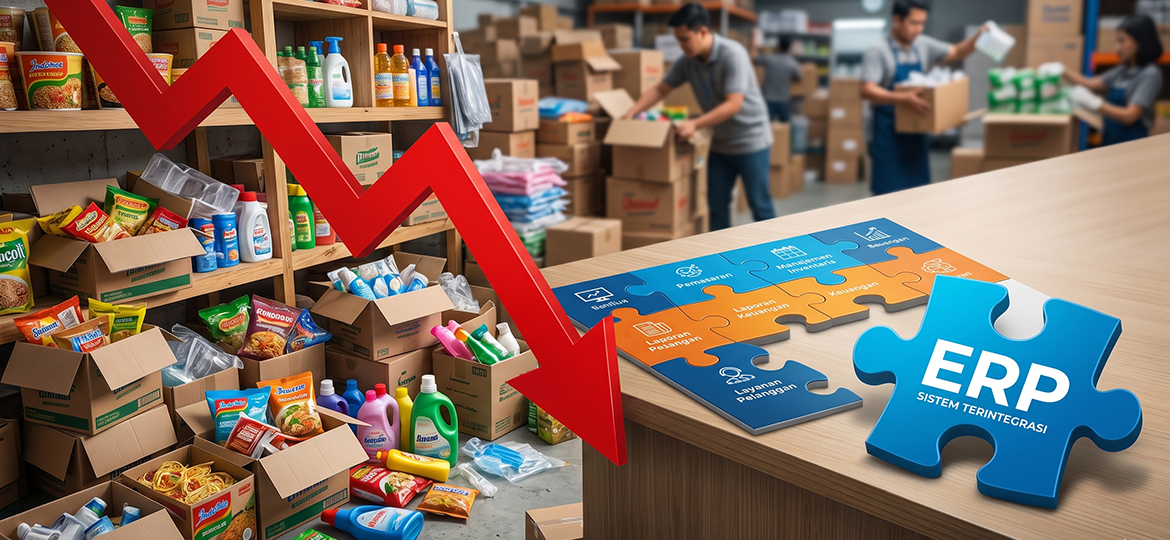
Most Indonesian retailers don’t fail because the market dries up—they fail because they can’t scale operations: inventory is a mess across branches, cash flow is opaque, and online and offline channels are out of sync. ERP for Indonesian retail serves as the “central nervous system” that integrates inventory, finance, and multi-channel operations into a single source of data. Yet 55–75% of ERP implementations end in failure when undertaken without proper preparation.
Throughout 2024–2025, news of major store closures kept coming. In 2024 alone, Matahari Department Store (LPPF) shuttered 13 underperforming outlets (Infobanknews, Dec 2024), and in May 2025 Aprindo confirmed plans to close around 8 more (CNBC Indonesia, May 2025). The problem isn’t just weak purchasing power—many retailers still have customers but simply cannot manage growth in a healthy way.
The Real State of Indonesian Retail 2024–2025: More Than Just a “Slump”
The popular narrative says Indonesian retail is “slumping.” The data tells a more nuanced story. According to BPS (Statistics Indonesia), the economy grew 5.11% in 2025, up from 5.03% in 2024 meaning the market is still expanding. But that growth is uneven.
Bank Indonesia’s Retail Sales Survey (Survei Penjualan Eceran) for July 2024 recorded the Real Sales Index (IPR) rising 4.5% year-on-year to 212.4, driven by the Food, Beverages, and Tobacco segment. Essential categories are still growing. What has slowed is the discretionary segment—fashion, footwear, and consumer electronics.
Weakening purchasing power is a real signal. BPS Acting Head Amalia Adininggar Widyasanti reported that Indonesia experienced deflation of 0.12% in September 2024, the fifth consecutive month of deflation since May 2024. The last time the country saw a streak like this was in 1999 following the Asian financial crisis, when Indonesia recorded seven straight months of deflation.
Yet there is another, more compelling story. NielsenIQ data from HARBOLNAS 2024 showed the transaction value of local products reaching Rp16 trillion, up from Rp12 trillion in 2023. The market hasn’t disappeared—it has simply shifted channels and changed its patterns.
Retailers that collapsed didn’t fail because the market ran out—they failed because they couldn’t scale operations when demand patterns shifted quickly. Matahari is the most visible example. Through Q3 2024, total sales reached Rp9.48 trillion, down 1.4% from the prior period, with the number of stores shrinking from 154 to 147 and employees from 9,092 to 8,335 (LPPF Q3 2024 financial report). The store closures aren’t the end of the story—they are a symptom of the inability to adapt.
5 Root Causes of Why Indonesian Retailers Fail to Scale
In several ERP implementation projects I was involved in between 2023 and 2025, the following five patterns appeared almost every time.
1. Ghost Inventory Across Branches (Physical vs. System Mismatch)
The POS records say there are 12 medium-sized shirts in stock at the Surabaya branch. In reality, only 3 remain—the rest are sitting in the Bandung branch due to an unrecorded manual transfer. The result: online orders are rejected, customers walk away, or worse—the order ships, then triggers a refund.
This problem emerges once a company has more than two branches and lacks centralized inventory management. Stock becomes a black box.
2. Cash Flow Is Not Visible in Real Time
The finance team only learns the cash position on the 10th of the month for transactions from the previous month. Decisions about buying merchandise, paying suppliers, or drawing operating funds are made on the owner’s “gut feeling.” In retail, however, margins are thin—a 1–3% error in cash flow timing can wipe out a month’s profit.
3. Multi-Channel Chaos
Today, the average retailer sells across at least four channels: physical stores, Tokopedia, Shopee, and TikTok Shop. Without integration, each channel carries its own separate inventory. The result: overselling, disputes, and ratings dropping. The marketing team also has no idea which channel is actually the most profitable.
4. Decisions Based on “Feeling,” Not Data
Which SKUs sell best per branch per week? What is the margin on Product A vs. Product B after discounts and returns? Without business intelligence connected to a single data source, the answers are based on the owner’s intuition. That works with one store—not with ten.
5. Operations Team Consumed by Manual Reconciliation
This is the quietest but most lethal symptom. Finance staff spend 60–70% of their time matching cashier deposits against marketplace receipts and bank statements. Warehouse staff are consumed by weekly stock counts. There is no time left for strategy. As the business grows, the workload multiplies, headcount rises linearly, and margins shrink further.
The pattern is clear: all five problems are rooted in data fragmentation. ERP for Indonesian retail—when chosen and implemented correctly—resolves this fragmentation.
What Is ERP and Why Does the Difference from POS or Accounting Software Matter?
ERP (Enterprise Resource Planning) is an integrated system that unifies operational modules—inventory, sales, procurement, finance, HR, and business intelligence—into a single database. POS systems and accounting software only address individual pieces of the puzzle.
Many retailers mistakenly believe they “already have a system” because they use a sophisticated POS or software like Accurate or Jurnal. That is a foundation—not an integrated system.
The Role of ERP in Addressing 5 Retail Scaling Problems
Real-Time Multi-Branch Inventory Management
ERP consolidates stock across all outlets and warehouses into a single view. Every transaction—sales, transfers, returns, breakage—updates automatically. Physical stock counts are still necessary, but their frequency can drop from weekly to monthly, with accuracy rising to 95%+ rather than the typical 70%.
Finance Automation & Tax Integration
Since Coretax (DJP’s integrated tax system) officially went live in Indonesia, retail tax compliance has become more technical—e-Faktur, e-Bupot, and SPT reporting that must reconcile with actual transactions. A well-built ERP for Indonesian retail is already Coretax-ready and integrates directly with e-Faktur, reducing the risk of penalties and manual errors.
Omnichannel Integration
Modern ERP connects via API to Tokopedia, Shopee, TikTok Shop, and B2B marketplaces. Stock, pricing, and orders synchronize automatically. The team only needs one dashboard for all channels.
Business Intelligence for Faster Decisions
Real-time dashboards answer questions like: “Which branch had the best profit margin this week?” “Which SKUs are dead stock?” “What category do our highest-repeat customers buy?” Daily decisions are based on data, not guesswork.
Operational Scalability Without a Linear Headcount Increase
According to Panorama Consulting, 97% of organizations report improvement following a successful ERP implementation. The most consistent gain I see in the field: the revenue-to-headcount ratio improves. A business can grow 2x without doubling its back-office staff.
Why Do 55–75% of ERP Implementations FAIL?
This is the part vendors won’t tell you. According to Gartner, roughly 55–75% of ERP projects fail to achieve their stated objectives. McKinsey estimates that more than 70% of digital transformations in general also fail.
“Fail” here does not mean the software never turns on. Fail = not achieving the original business case: ROI not realized, low adoption, budget overruns, or a go-live date pushed back repeatedly.
5 primary causes of ERP retail implementation failure:
- Weak planning. Gartner stresses that inadequate upfront planning is the leading cause of failure—without a clear understanding of scope, objectives, and challenges, projects are prone to delays, budget overruns, and ultimately collapse.
- Poor change management. Operations teams are not involved from the start. The system is forced from the top down. By go-live, resistance surges.
- Chaotic data migration. Legacy data (product master records, suppliers, customers) is imported without cleansing. The new system is run on old garbage.
- Minimal training. Users receive two days of training, then are left on their own. They revert to manual processes because those feel more familiar.
- Vendor mismatch. Choosing a vendor because it is “cheapest” or “most popular,” rather than because it fits Indonesian retail workflows.
An extreme example frequently cited: Marin County, California, sued SAP for USD 30 million over a failed ERP implementation. The county spent USD 18.6 million on a project meant to streamline HR and finance, yet ended up unable to perform basic financial functions for two years. This happened in a U.S. government body with an enormous budget. Imagine the same scenario at an Indonesian SMB retailer without adequate preparation.
7 Realistic ERP Implementation Steps for Indonesian Retailers
Based on the successful implementation patterns that appear most consistently:
Step 1 — Operational Assessment (2–4 weeks). Map all business processes as-is: inventory flow, procurement flow, cash flow, reporting flow. Identify specific pain points with numbers, not opinions.
Step 2 — Business Case & ROI Target (2 weeks). Define measurable targets—for example: reduce reconciliation time by 60%, raise stock accuracy to 95%, shorten monthly closing from 15 days to 5 days.
Step 3 — Vendor Selection (4–6 weeks). Long-list 5–6 vendors, short-list 3, then run demos using real scenarios from your business (not generic demos). Soltius is one option worth consulting.
Step 4 — Data Cleansing & Master Setup (4–8 weeks). Clean up product, supplier, and customer master data. Standardize SKU naming conventions, categorization, and unit conversions.
Step 5 — Pilot at 1 Branch (4–6 weeks). Don’t go big-bang. More than 50% of companies choose a phased approach over big-bang (Panorama Consulting 2024). Start with the branch whose team is the most adaptable.
Step 6 — Intensive Training & Hypercare (4–8 weeks). Training in at least 3 rounds: conceptual, hands-on, and refresher. Provide a support team for the first 30 days post-go-live.
Step 7 — Phased Rollout & Continuous Improvement (3–6 months). Once the pilot branch is stable for 30 days, roll out to other branches gradually.
FAQ — The Most Frequently Asked Questions from Retailers About ERP
Q1: How much does ERP retail implementation cost for an SMB in Indonesia?
The total cost of ERP retail implementation in Indonesia for SMBs generally ranges from Rp120 million to Rp1.2 billion for the first year, covering software licensing (Rp60–600 million/year) plus implementation costs (1–2x the license fee). The main variables are the number of users, number of branches, and marketplace integration complexity. Avoid vendors who are not transparent about the 3-year total cost of ownership.
Q2: How long does ERP retail implementation typically take?
For an Indonesian SMB retailer with 3–10 branches, a realistic implementation runs 3–9 months from kickoff to go-live at the first branch. Full rollout across all branches can take an additional 3–6 months. A vendor that promises a “1-month go-live” for a multi-branch operation is a major red flag.
Q3: When is ROI on ERP typically achieved?
ERP retail ROI is generally visible 12–24 months after go-live. The fastest indicators to appear: reduced reconciliation time (often 40–60% faster), improved stock accuracy to 95%+, and faster monthly closing. Full financial ROI takes longer because it depends on how deeply the team changes its operating habits.
Q4: Will my business face downtime during migration to ERP?
With a phased implementation (piloting one branch first), operational downtime can be minimized to zero. What typically does happen is a temporary productivity dip of 2–4 weeks at the pilot branch as the team adapts. A multi-branch big-bang go-live, by contrast, carries high risk—avoid it unless there is a specific compelling reason.
Q5: What is the difference between ERP and POS or accounting software like Accurate or Jurnal?
POS focuses on cashier transactions; accounting software focuses on financial recording. Retail ERP combines both, plus real-time multi-branch inventory, native marketplace integration, procurement modules, and business intelligence—all in a single database. POS and accounting software are suitable for businesses with 1–2 outlets; ERP becomes relevant at 3+ branches or when selling across multiple channels.
Q6: What are the most common risks of a failed ERP implementation?
Five primary causes: weak planning (unclear scope), poor change management (team not involved), chaotic data migration (old garbage fed into the new system), minimal training (users revert to manual methods), and selecting the wrong vendor. Gartner notes that 55–75% of ERP implementations fail to achieve their original business case—the majority for non-technical reasons.
Q7: Does a small retail business (1 outlet) already need ERP?
Generally, no. If monthly revenue is below Rp500 million, with one outlet and fewer than 500 SKUs, a modern POS combined with accounting software is sufficient. Forcing ERP onto a business that isn’t ready turns it into a cost burden, not an investment. Readiness indicators: 3+ branches, monthly revenue above Rp2 billion, and sales across 2+ marketplaces.
Conclusion
ERP is not a silver bullet. But without ERP, scaling retail in Indonesia hits the same ceiling every time: ghost inventory, opaque cash flow, scattered channels, and a team exhausted from reconciliation.
Five key points to remember:
- Indonesian retailers in 2024–2025 failed to scale not because the market dried up, but because of operational data fragmentation.
- ERP is fundamentally different from POS and accounting software—don’t confuse them.
- 55–75% of ERP implementations fail; the majority due to weak planning, not technology.
- SMBs realistically need 3–9 months to implement and achieve ROI within 12–24 months.
- The right vendor is one that fits the complexity of Indonesian tax rules and marketplaces—not necessarily the most globally popular one.
The concrete first step: After deciding to consult with Soltius about your business needs, conduct an operational self-assessment on your business. Calculate how many hours per week your team spends on manual reconciliation, the percentage of stock discrepancy across branches, and how long monthly closing takes. Those numbers are your business case. Start there—not with a vendor brochure.
Other News