Blog

Zero Downtime 2026: How Artificial Intelligence (AI) is Transforming Factory Maintenance into Predictive Maintenance
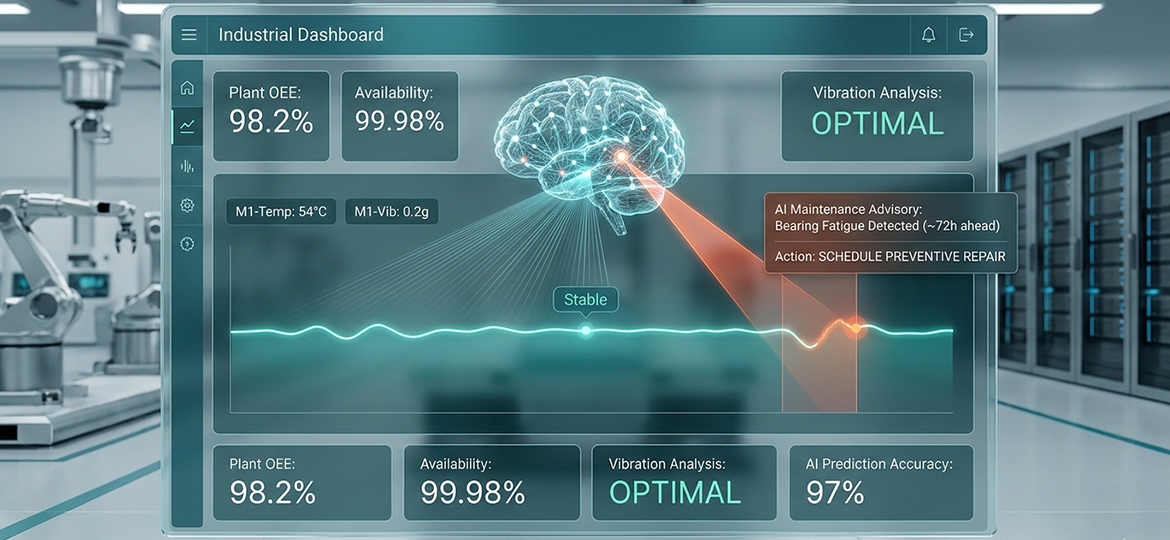
Imagine you are chasing a very tight production deadline, and suddenly the main machine completely shuts down—targets instantly fall apart and financial losses swell by the second. We all agree that sudden machine failure is a real nightmare that not only drains your pockets for emergency repair costs but also robs you of valuable operational time that is impossible to buy back.
However, you can now breathe a sigh of relief because Artificial Intelligence (AI) is here like a specialist doctor capable of predicting the future health of your machines, ensuring the factory is no longer haunted by "sudden machine shutdown" situations. Forget the outdated tradition of helplessly waiting for equipment to break down; let's thoroughly examine the differences between the old system and smart AI predictions, how it works, and its strategic advantages in realizing the Zero Downtime target in 2026.
Why is the "Fix it When it Breaks" Tradition Outdated?
In the past, many factories operated on a run-to-failure principle—using equipment continuously until its core components broke down. This approach is like keeping a time bomb in the middle of your main production line.
The moment unplanned downtime occurs, the entire operational chain is instantly paralyzed. A machine that stops abruptly not only halts production output but also risks triggering a chain reaction of damage to other interconnected mechanical components.
In the modern industrial era that demands high efficiency and tight margins, passive methods like this are no longer an operational option, but rather the fastest way to burn through company profits.
Reactive, Preventive, and Predictive Maintenance: The Evolution of Maintenance Strategies
To understand why this system transition is so crucial, let's dissect the three evolutionary phases in industrial facility maintenance management:
-
Reactive Maintenance (Post-Breakdown Repair): This is a responsive method where repairs are only made after a machine has completely died (for example, the bearings on a drive motor are destroyed). As a result, repair duration is unpredictable, the troubleshooting process takes a long time, and emergency repair costs skyrocket.
-
Preventive Maintenance (Time-Based Maintenance): Spare parts are replaced or serviced based on a fixed schedule (e.g., every 3,000 operating hours), regardless of the actual condition of the component. Although safer than the reactive system, this method often triggers over-maintenance. Factories tend to waste budgets by replacing components whose remaining useful life is actually still very long.
-
Predictive Maintenance (Condition-Based Maintenance): This is where high-level technology comes in. The system monitors machine technical parameters such as vibration anomalies, temperature spikes, or electrical current fluctuations—in real-time. This data is analyzed to precisely predict when a component will fail, so repairs can be scheduled efficiently right before the damage occurs, without disrupting the production schedule.
With a predictive system, factories no longer work by guessing machine conditions, but act based on actual, measurable data.
The Core Role of Artificial Intelligence (AI) in Guarding Your Factory's Critical Assets
In the transition towards a predictive system, Artificial Intelligence (AI) is the main driving engine. Without this technology, piles of sensor data from industrial machines are just meaningless rows of numbers.
This is where Artificial Intelligence (AI) takes over by acting like a tireless "analytical brain" that continuously reads your machine's pulse 24/7. AI is specifically designed to catch the smallest anomalies, such as microscopic shifts in rotor vibrations or a fraction of a degree in temperature spikes, which would certainly escape human sensory observation.
Instead of guessing, the AI system mathematically calculates the maximum limits of material endurance. This advanced tool accurately predicts when a component will fail, well in advance before the machine actually breaks down in the middle of busy production hours.
Monitoring Comparison: Conventional Approach vs. AI
| Monitoring Aspect | Human Operator (Conventional) | Artificial Intelligence (AI) |
| Monitoring Frequency | Limited to periodic inspection schedules. | Continuous (real-time 24/7). |
| Analysis Capacity | Only able to process a small amount of technical data. | Processes millions of data points in seconds. |
| Accuracy Level | Prone to fatigue and human error. | High precision based on pure mathematical algorithms. |
By utilizing Artificial Intelligence (AI), factory managers now have a kind of "future radar." Maintenance transforms from a tedious routine full of uncertainty into a highly measurable exact science.
3 Ways Artificial Intelligence (AI) is Realizing the "Zero Downtime" Vision by 2026
Realizing a production floor that never dies (zero downtime) is no longer just a sci-fi script. The digital ecosystem now works hand in hand like a symphony orchestra, where every instrument complements each other to produce perfect operational harmony.
So, how exactly does this smart technology secure your production line from the threat of mechanical wear and tear? Here are its three crucial stages:
1. IoT Sensors as the "Eyes and Ears" of the Machine
Artificial Intelligence (AI) requires a supply of high-quality raw data to make decisions. This is where Internet of Things (IoT) devices are installed directly onto the physical components of the machine to monitor the following critical indicators:
-
Vibration Monitoring: Detects microscopic asymmetries on rotating machine shafts.
-
Temperature (Thermal) Sensors: Oversees potential overheating caused by excessive friction or lubrication malfunctions.
-
Acoustic (Sound) Analysis: Captures unnatural sound frequencies (such as metal squeaks) that serve as early symptoms of component wear.
2. Machine Learning to Read Threat Patterns
Once a sea of data is collected in real-time, it is time for Machine Learning to show off its capabilities. These algorithms are tasked with processing millions of data points per second—a computational capacity that is impossible to match even by thousands of human technicians.
Based on historical machine failure data from the past, Machine Learning will dissect recurring technical patterns or anomalies. This system is capable of identifying the common thread of damage hidden far below the threshold of normal parameters.
3. Accurate Prescriptive Recommendations
The true greatness of modern Artificial Intelligence (AI) does not stop at the ability to guess when a machine will break. This technology steps far ahead by providing highly specific solution guidance (prescriptive analytics).
Instead of merely sounding a red danger alarm on a monitor screen, AI provides precise instructions such as: "Replace the left gear bearing on conveyor B before the shift change schedule on Thursday." Your technicians can immediately execute repairs with the right spare parts, without needing to waste time diagnosing the root cause of the problem.
The Real Challenges Towards 2026: Why Isn't Artificial Intelligence (AI) Implementation Instantaneous?
Although it sounds like a magical shortcut, we must honestly look at the reality on the ground. Shifting from traditional repair systems to Artificial Intelligence (AI)-based maintenance management is not an overnight process like flipping a light switch.
Building this predictive digital ecosystem is like planting a teak tree; it requires initial capital and extra care at the beginning, before you can finally harvest high-value efficiency results. There are several real roadblocks that industry leaders must face today:
-
Initial Investment that Requires Strategy: Procuring precision sensors and cloud server capacity certainly requires fresh funds. However, according to Forrester’s 2024 SME Tech Index, mid-sized factories implementing Micro-innovation (phased AI & IoT integration) spend an average of only $30,000–$70,000 in Capex. This smart strategy is proven to generate a Return on Investment (ROI) 2.3x faster compared to a complete system overhaul that can cost upwards of $250,000–$500,000!
-
Extra Stable Network Infrastructure: Predictive analytics systems breathe through the flow of data. If internet connectivity on the factory floor frequently disconnects or is very slow, automated sensors will fail to send real-time machine status updates.
-
HR Readiness and Adaptation: The greatest algorithm in the world will be paralyzed if the humans behind it are reluctant to adapt. There is a massive cultural challenge in upskilling field technicians so they become proficient at reading analytical dashboards and begin to trust digital recommendations.
These operational challenges do demand extra effort, but they are by no means a reason to back down. Overcoming these hurdles is the "price of admission" that must be paid for the survival and competitiveness of your manufacturing business.
Conclusion: Artificial Intelligence (AI) is Not Just a Trend, But an Absolute Prerequisite for Survival
Hanging the fate of production targets on manual guesswork is like walking on very thin ice. In this modern era, Artificial Intelligence (AI) is no longer just a seasonal tech trend, but an absolute prerequisite for survival so your factory can continue to breathe deeply amidst brutal industrial competition. Rather than continuing to burn budgets on emergency repairs that drain both emotions and company cash, switching to a predictive maintenance system is the strongest shield to protect operations from the threat of sudden machine failure.
Don't let your production floor be left behind while competitors have already zoomed ahead with advanced facilities that never sleep. Now is the time to take control and make the Zero Downtime vision a reality with Soltius. As a trusted digital transformation partner, Soltius is ready to assist you in designing and integrating the most suitable precision AI solutions for your business scale. Contact the Soltius team of experts today, and let's turn machine maintenance nightmares into profitable efficiency!
Other News