News

SaaS vs PaaS vs IaaS: Differences and Examples of Their Use
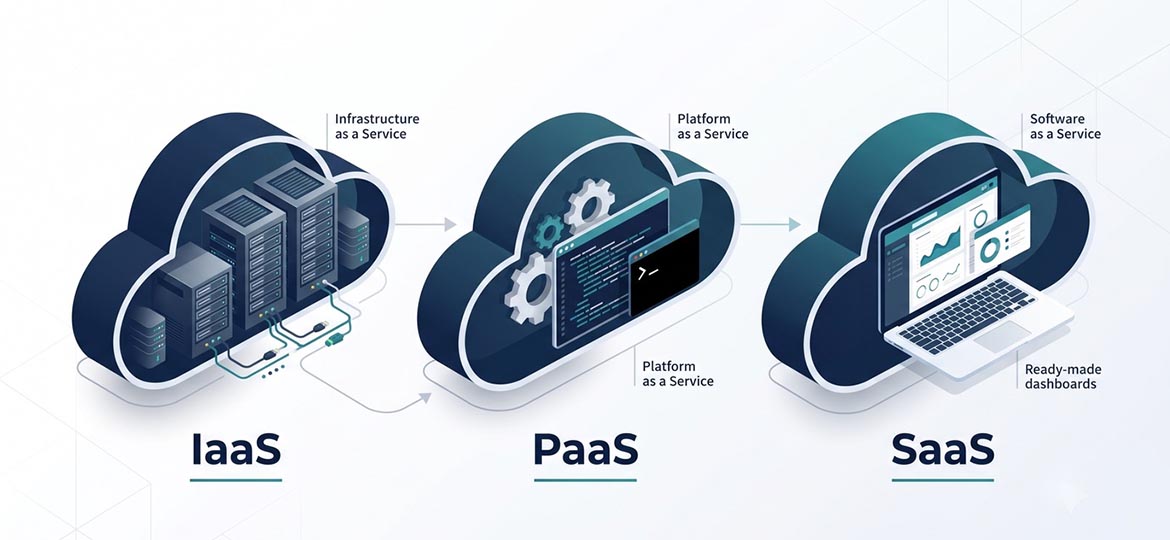
Cloud evaluation meetings often stall on three acronyms: SaaS, PaaS, and IaaS. Vendors throw the terms around, IT and finance teams read them differently, and plans to migrate ERP to the cloud end up delayed because there is no shared language. This article breaks down how the three differ from the angle that actually drives the decision: who manages what, how each is applied in companies, and when to choose which.
In short: SaaS, PaaS, and IaaS are the three cloud computing service models defined by the NIST standard, and they differ in where the line of management responsibility falls. SaaS delivers ready-to-use applications on a subscription, PaaS provides a platform for building and running applications, while IaaS rents out the basic infrastructure of virtual servers, storage, and networking. The closer you move to IaaS, the more control you gain and the more responsibility you carry.
Differences Between SaaS, PaaS, and IaaS: Who Manages What?
All three terms come from the standard definition of cloud computing published by the National Institute of Standards and Technology (NIST) in SP 800-145 in September 2011: SaaS stands for Software as a Service, PaaS for Platform as a Service, and IaaS for Infrastructure as a Service.
What separates them in the field is not the technology but the division of responsibilities. With SaaS, the provider manages almost the entire technology stack; with PaaS, you look after only your applications and data; with IaaS, you take over everything except the physical hardware. One thing stays constant: data and identity are always the user's responsibility in all three models.
|
Application |
Provider (user: limited configuration) |
User |
User |
|
User data & identity |
User |
User |
User |
|
OS, runtime, middleware |
Provider |
Provider |
User |
|
Servers, storage, physical network |
Provider |
Provider |
Provider |
|
Level of user control |
Lowest |
Medium |
Highest |
|
Speed to get started |
Fastest |
Fast for developer teams |
Requires an infrastructure team |
|
Example |
Microsoft 365, SAP S/4HANA Cloud Public Edition |
SAP Business Technology Platform, Azure App Service |
Azure Virtual Machines, AWS EC2 |
This table is consistent with the shared responsibility matrix from Microsoft, updated in May 2026: the operating system is managed by the user only in IaaS, and the physical layer always belongs to the provider.
The data and identity row is deliberately uniform. Moving to SaaS does not mean handing over responsibility, because securing your data and user accounts remains the company's obligation in every model.
How Are SaaS, PaaS, and IaaS Applied in Companies?
In enterprise environments, SaaS is generally used for ready-to-use business applications such as email, HR, and cloud ERP (Enterprise Resource Planning); PaaS for building extensions and integrations between systems; IaaS for workloads that demand full control over the server. All three commonly coexist within one architecture rather than replacing one another.
At the SaaS layer, companies use Microsoft 365 for collaboration, SAP SuccessFactors for HR, and SAP S/4HANA Cloud Public Edition for ERP; all on a subscription, with no infrastructure team of their own. For PaaS, the clearest enterprise example is SAP Business Technology Platform (SAP BTP), which SAP positions as a platform as a service. On top of it, your team builds extensions, integrations, and even low-code and no-code applications without touching servers or operating systems.
At the IaaS layer, companies rent virtual servers such as Azure Virtual Machines or EC2 from Amazon Web Services (AWS) on a pay-as-you-go basis, for workloads that need full control over the OS and its configuration. Within a single SAP landscape, the three often sit side by side; RISE with SAP bundles SaaS, PaaS (SAP BTP), and IaaS from hyperscalers (global cloud providers) in one contract.
When Should You Choose SaaS, PaaS, or IaaS?
The cloud service model is best decided workload by workload, not as a single decision for the whole company. In implementation practice, the first question is not “which model is best”, but “how much control does this workload need, and who is able to manage it”. Three practical rules as a starting point:
- Choose SaaS if you need standard applications that can be used quickly without an infrastructure team, for example email, HR, or standard ERP.
- Choose PaaS if your developer team wants to build applications or integrations without the burden of managing servers, operating systems, and runtimes.
- Choose IaaS if the workload demands full control over the operating system and configuration, and your team is ready to take on the management.
In practice, companies rarely have to pick just one; Microsoft itself notes that many cloud solutions combine several service models at once. The more control you take, the more operational responsibility your own team carries.
FAQ (Frequently Asked Questions)
Which is better: SaaS, PaaS, or IaaS?
None is universally superior. SaaS wins on speed of adoption, IaaS on control, and PaaS sits in between. All three keep growing: Gartner projects global public cloud spending of around USD 850 billion in 2026, up 21.3% from 2025. Choose per workload: how much control does your team really need.
Is SAP SaaS, PaaS, or IaaS?
It depends on the product. SAP S/4HANA Cloud Public Edition and SuccessFactors are consumed like SaaS, SAP Business Technology Platform is PaaS, and the infrastructure runs on hyperscaler IaaS such as Azure or AWS. RISE with SAP bundles all three layers in one contract.
Conclusion
The difference between SaaS, PaaS, and IaaS ultimately comes down to where management responsibility ends; the healthiest decision is made per workload, not one model for everything. This map becomes the foundation before the next step: moving core systems such as ERP to the cloud. As an SAP Platinum Partner through United VARs, Soltius implements and supports SAP solutions across all three layers, from applications to the SAP BTP platform to SAP running on cloud infrastructure.
To discuss the cloud service model that best fits your company's SAP landscape, visit soltius.co.id.
Other News