Blog

2027 Is Near: Why Your SAP Migration Should Start in 2026
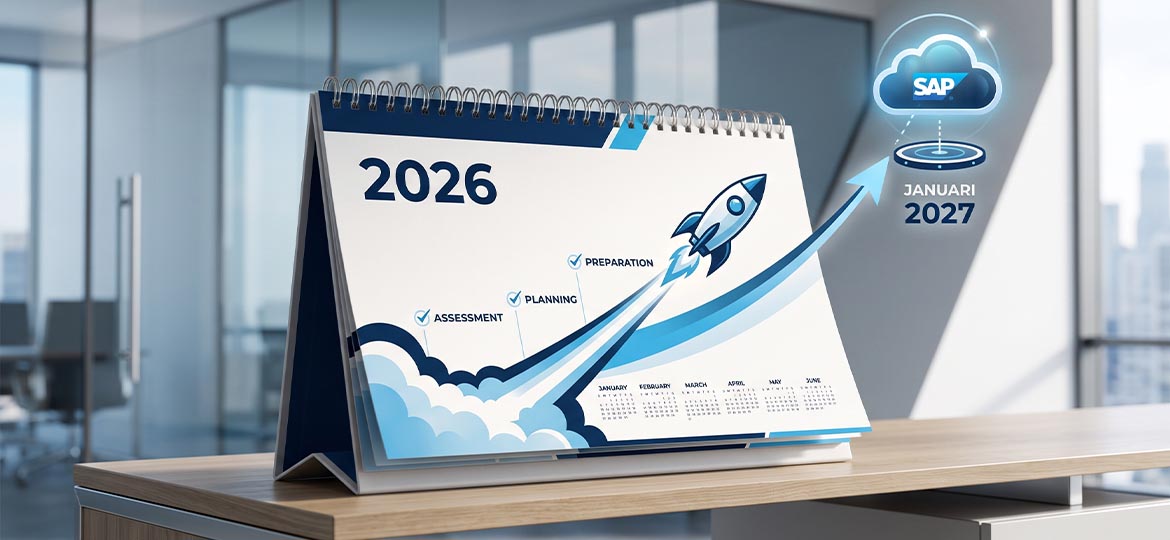
A CIO running SAP ECC (SAP ERP Central Component) already knows the 2027 deadline is there. What is still unresolved is the very thing that decides the budget: why start this year, not next. This article breaks down the arithmetic of time behind the 2026 SAP migration and how it connects to migrating ERP to the cloud, a decision that can no longer be put off.
In brief: The 2026 SAP migration is the decision to move the legacy SAP ECC system to SAP S/4HANA starting this year, rather than waiting. The reason is the arithmetic of time: an 18–36 month runway (estimated) collides with the end of ECC mainstream maintenance on December 31, 2027, so delaying raises the cost and the risk to a smooth go-live.
Why Should Your SAP Migration Start in 2026, Not 2027?
Because a large enterprise migration is not a one-year project. From decision to a stable system, the planning window commonly used runs 18–36 months (estimated). Counting back from the end of ECC mainstream maintenance on December 31, 2027, the realistic cutoff to start falls around mid-2026. Starting in 2027 is nearly impossible to finish cleanly on time.
That 18–36 month range is a planning envelope, not the raw project duration. It covers three segments:
- Decision and procurement. About 3–6 months for assessment, building the business case, choosing the path, and contracting.
- Implementation project. About 12–24 months, depending on the complexity of the landscape and the approach chosen; the brownfield path (converting the legacy system) tends to sit at the lower end, greenfield (rebuilding) at the upper end.
- Hypercare and stabilization. About 2–4 months after go-live until operations truly settle.
That the 2026 window is real, not rhetoric, is already proven on the calendar. The entitlement deadline for SAP Compatibility Packs for S/4HANA on-premise ends at the end of May 2026 through a final transition period announced by SAP (SAP Note 2269324, December 2025). After that deadline, most of the functionality in those packs may no longer be used. One 2026 milestone that has already passed marks that the countdown is truly running.
How Do Cost and Partner Capacity Move as the Deadline Approaches?
Because almost every company is moving in the same window, the market for SAP system integrators (SIs) and consultants narrows exactly as demand peaks. According to Gartner (cited by CIO.com), as of the end of 2024 only 39%, or about 14,000 of ~35,000 ECC customers, had migrated, and about 17,000 are projected to still be on ECC in 2027.
The consequences show up in two places: price and team choice. Industry estimates put the day rate of experienced S/4HANA consultants rising 30–50% in 2026–27 versus 2024, with demand for talent several times supply as the deadline nears. Companies that delay tend to get leftover capacity, not the core team. For those on a subscription path such as RISE with SAP, locking in a slot early means far more breathing room for planning.
|
Dimension |
Start in 2026 |
Delay to 2027 |
|---|---|---|
|
Partner/SI availability |
Slots still open; you can choose the team |
Queue full as the deadline nears |
|
Consultant day rate (industry estimate) |
2024–25 baseline |
Estimated +30–50% (2026–27 vs 2024) |
|
Freedom to choose the team |
Core team available |
Leftover capacity, “a different team” |
|
Buffer for testing & schedule |
Ample, full cycle |
Compressed, risk of clashing with financial close |
|
Risk of go-live slipping |
Low |
High as December 31, 2027 approaches |
|
Position vs maintenance |
Finished before mainstream ends |
May fall into extended (+2 percentage points) or a compliance gap |
What Are the Risks of Delaying, and When Does Delaying Still Make Sense?
The biggest risk is not the deadline itself but schedule compression. Delaying squeezes the testing cycle, raises the chance of a go-live clashing with the financial close, and opens compliance and security gaps after 2027. Delaying does not remove the cost; it shifts it to the point when capacity is most expensive and scarcest.
Extended maintenance is indeed available for 2028–2030 at a premium of +2 percentage points above the base maintenance fee, with no entitlement to new innovation. It is a buffer, not a strategy. It makes sense only in narrow cases, for example an entity that is about to be divested, not a reason to delay the decision for the core business.
The first concrete step does not have to wait for a full budget. Run SAP Readiness Check to map the custom code and the system’s position, then lock in a partner slot and set a go-live target. From there, the calendar decides the rest.
FAQ (Frequently Asked Questions)
What is the latest you should start an SAP migration to finish before 2027?
Around mid-2026. With SAP ECC mainstream maintenance stopping on December 31, 2027 and the planning-to-stabilization range usually 18–36 months (estimated), the assessment and setting the go-live target should ideally be done before the second half of 2026. Pushing the start point to 2027 cuts almost all of the room for testing.
Can an SAP migration be delayed with extended maintenance until 2030?
Technically yes, but it is not a solution. Extended maintenance keeps support in place for 2028–2030 at an added cost of 2 percentage points above the base maintenance fee, but with no access to new innovation. This option is reasonable only for special cases, such as an entity that is about to be spun off, not a reason to hold off on the core migration decision.
Why does the cost of an SAP migration rise if you delay?
The cause is capacity scarcity. As 2027 nears, demand for experienced S/4HANA consultants outstrips supply, so industry estimates put the day rate rising 30–50% in 2026–27 versus 2024. Beyond higher rates, companies that delay also face a shrinking choice of teams and a tighter schedule.
Conclusion
The 2027 deadline is not about panic but about the calendar. An 18–36 month runway and mainstream maintenance ending on December 31, 2027 make the 2026 SAP migration the most controlled and least expensive decision. As an SAP Platinum Partner through United VARs, with experience since 1998, Soltius runs the assessment and supports the execution of migrations to SAP S/4HANA on the ground.
To assess your 2026 SAP migration readiness and RISE with SAP options at your company, visit soltius.co.id.
Other News