Blog

AI in the Supply Chain: Use Cases and Benefits
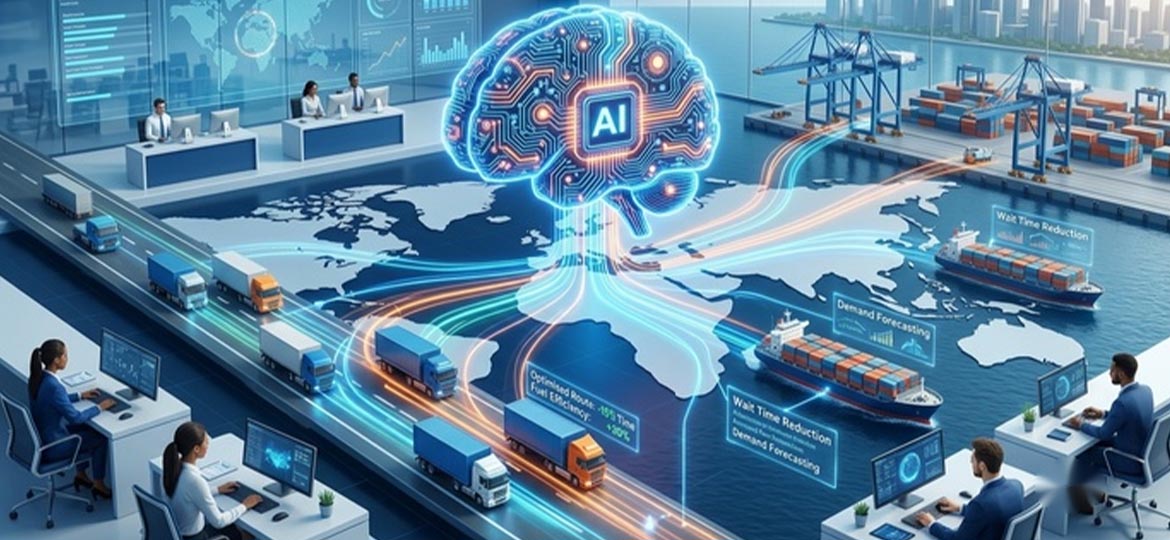
Sales forecasts miss the mark, shipping costs keep climbing, and supplier disruption only becomes visible once goods are already late. Meanwhile, AI offerings for supply chain management often stop at the jargon of being “smarter” without explaining what they actually do. This article unpacks four AI supply chain use cases relevant to manufacturing and distribution in Indonesia: how they work, their measurable benefits, and where to start.
In brief: AI supply chain is the application of artificial intelligence, particularly machine learning, to supply chain processes ranging from demand forecasting and inventory planning through to delivery. The system learns from historical data patterns and real-time signals to produce predictions and recommendations that are faster and more accurate than manual, spreadsheet-based planning.
4 Proven AI Use Cases in the Supply Chain
The four use cases with the strongest evidence for manufacturing and distribution are: demand sensing for demand forecasting, delivery route optimisation, inventory optimisation, and earlier detection of risk and disruption. These four were chosen not because they generate the most talk, but because their financial impact is clear and the figures are publicly documented.
- Demand sensing and demand forecasting. Statistical forecasts read medium-term patterns, weekly to monthly, from sales history. Demand sensing complements this: machine learning revises short-term forecasts at daily granularity using real-time signals such as incoming orders and point-of-sale (POS) data. Gartner predicts that 70% of large organisations will adopt AI-based demand forecasting by 2030 (Gartner, September 2025). In the SAP ecosystem, both run on a single cloud platform, SAP Integrated Business Planning (SAP IBP).
|
Aspect |
Demand forecasting |
Demand sensing |
|---|---|---|
|
Horizon |
Medium-term, weekly–monthly |
Short-term, daily granularity |
|
Primary input |
Sales history: trends, seasonal patterns |
Real-time signals: incoming orders, POS data |
|
Method |
Statistical models: time-series |
Machine learning: multiple linear regression, gradient boosting |
- Delivery route optimisation. AI weighs traffic, weather, fleet capacity, and delivery windows to build the most efficient routes and revises them as conditions change. Evidence at global scale: UPS's ORION system is estimated to save around 100 million miles of travel and 10 million gallons of fuel per year (INFORMS). The room for improvement domestically remains wide: national logistics costs stood at 14.29% of GDP in 2022 according to calculations by Bappenas and BPS.
- Inventory optimisation. AI recommends stock levels per product per location based on demand and supply variability, replacing uniform buffers set out of habit. A multi-echelon approach, as in SAP IBP for Inventory, calculates safety stock requirements across the entire distribution network at once rather than warehouse by warehouse.
- Earlier detection of risk and disruption. AI monitors external signals, from weather and port congestion through to supplier news, along with anomalies in internal data, then raises an alert before a delay ripples through to customers. The next direction: agentic AI, agents that do not stop at the alert but help execute routine responses; Gartner (April 2026) projects spending on supply chain management software with agentic AI reaching US$53 billion by 2030, with feature adoption rising from 5% (2025) to 60%.
What Are the Measurable Benefits of AI in the Supply Chain?
The benefits of AI in the supply chain read most clearly in three comparative figures. McKinsey (2021) recorded that early adopters of AI in the supply chain improved logistics costs by 15%, inventory levels by 35%, and service levels by 65% compared with competitors slower to adopt. These are company-to-company comparisons rather than absolute improvements, but the direction of the impact is consistent.
Decisions get faster. Planning cycles that were once weekly shift to daily because forecasts update automatically instead of waiting on spreadsheet reconciliation between divisions.
Working capital improves too: stock is set according to risk per product per location, so cash is not locked up in piles of safety stock held “just in case”.
The last benefit is felt by customers. Stockouts and delays fall because deviations are detected while there is still time to correct them.
How Should You Start Implementing AI in the Supply Chain?
Start with the single use case that has the readiest data and the most measurable financial impact, rather than chasing all four at once. For most companies, the most natural entry point is demand forecasting: the data already sits in the sales system, and the results are felt immediately in inventory and service levels.
- Audit data readiness. Make sure you have at least 2–3 years of sales and delivery history, clean product and location master data, and clarity on who owns the data.
- Choose one priority use case. Just two criteria: the financial impact is the easiest to measure, and there is a clear process owner in the organisation.
- Run it on a planning platform, not standalone tools. SAP IBP, for example, puts statistical forecasting, demand sensing, and inventory optimisation on top of the same data, so one success is easily extended to the next use case.
An honest note from the field: AI does not fix messy data; a model trained on chaotic history only accelerates the wrong decisions. Gartner also cites data completeness and accessibility as barriers to adoption. If your transaction volumes are small and demand is stable, a disciplined spreadsheet may well still be adequate today.
FAQ (Frequently Asked Questions)
What is the difference between demand forecasting and demand sensing?
Demand forecasting reads historical patterns over a weekly to monthly horizon. Demand sensing revises short-term forecasts at daily granularity using machine learning on real-time signals such as incoming orders and point-of-sale data. In SAP IBP, both run on a single planning platform.
Will AI replace supply chain planners?
What shifts is the content of the job. A Gartner survey (February 2026) of 509 supply chain leaders found that 55% expect agentic AI to reduce the need for entry-level hiring. Planners are not disappearing; their role shifts towards handling exceptions and validating AI recommendations, a human-in-the-loop pattern.
Where should a company start with AI in the supply chain?
With the use case that has the readiest data and the clearest financial impact, which is generally demand forecasting. Gartner projects that 70% of large organisations will adopt AI-based forecasting by 2030. Once one use case is proven, extend it to inventory or logistics on the same platform.
Conclusion
AI in the supply chain pays off when it is applied to a specific use case with data that is ready, rather than as technology for technology's sake. The four use cases above are entry points whose numbers have already been tested. As an SAP Platinum Partner through its United VARs membership, Soltius implements and supports supply chain planning solutions such as SAP IBP, including the SAP IBP go-live at PT Kino Indonesia in 2021, from readiness assessment through to post go-live support.
To explore implementing AI in your company's supply chain with SAP IBP, visit soltius.co.id.
Other News