SAP ECC End of Life 2027: The Impact and Your Migration Options

SAP ECC End of Life 2027: The Impact and Your Migration Options
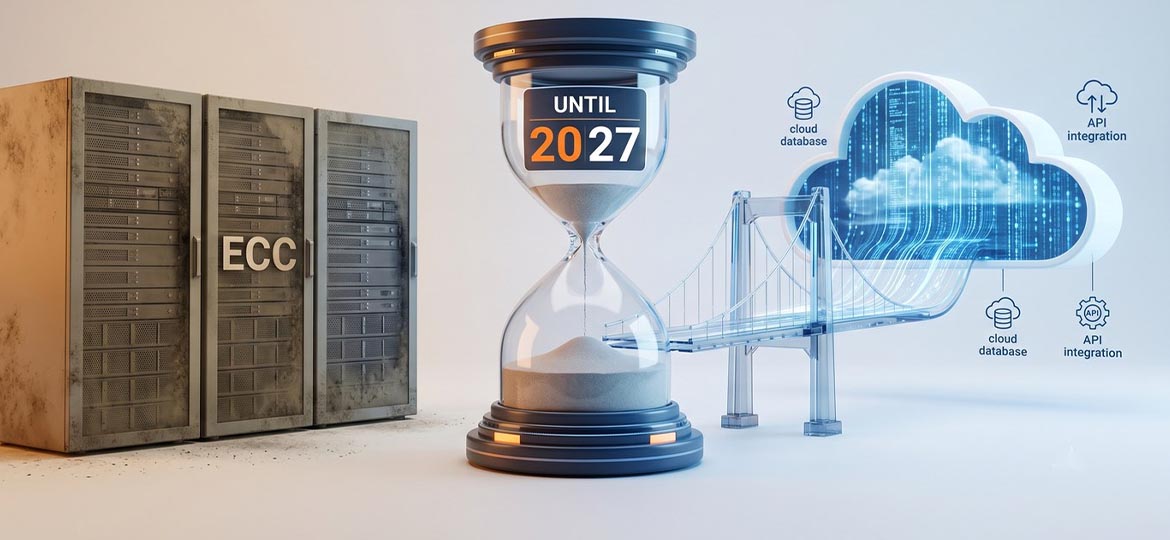
Although many companies still run their core systems on SAP ECC (SAP ERP Central Component), the SAP ECC 2027 deadline is now only 18 months away. Decisions about ERP migration to the cloud or holding on to the existing system can no longer be pushed to the next budget meeting. This article summarises the official dates from SAP, the real impact of staying put, and the four options along with their consequences.
In brief: SAP ECC 2027 is the deadline for the end of mainstream maintenance for SAP ECC 6.0 (SAP Business Suite 7) on 31 December 2027, applying to Enhancement Packages 6–8. SAP offers paid extended maintenance until the end of 2030; without it, the system keeps running but no longer receives security patches or new legal updates.
What Is the Impact of Staying on SAP ECC After 2027?
From the start of 2028, systems that remain on SAP ECC will move to customer-specific maintenance status, meaning a very limited service with no additional premium, where all security and compliance risk falls to the company internally. Version limits also matter: EHP 0–5 lost support at the end of 2025, so the extension option is available only for EHP 6–8 (SAP, support.sap.com, accessed July 2026).
The earliest consequences will appear on the compliance side. Every tax regulation change or reporting format update after the deadline has to be handled through in-house development, because SAP no longer releases legal updates for ECC. On the security side, new vulnerabilities found after 2027 will not be fixed, so the attack surface on your core system widens with each passing year.
The scale of the problem is not small. According to Gartner, as of the end of 2024 only 39% of roughly 35,000 ECC customers had migrated to S/4HANA (CIO.com, June 2025). The ecosystem is ageing too: ECC talent is becoming scarcer and add-on vendors are shifting focus, although there are no official statistics on the pace of this shift.
A misconception that often surfaces at management level is that the system will stop running on 1 January 2028. In reality, what ends is SAP's guarantee, not the operation of the system itself.
Four Options for Facing SAP ECC End of Support
Four paths are available, each with different consequences: staying put with no premium under customer-specific maintenance, buying time through extended maintenance from 2028–2030 at a 2 percentage point premium, migrating to SAP S/4HANA with a commitment of at least one release under maintenance until 2040, or RISE with SAP, which opens up a transition option of 2031–2033 for the most complex cases.
|
Stay put (customer-specific maintenance) |
The system keeps running; no security patches or new legal updates |
No premium; risk borne entirely by you |
No formal limit |
Systems due to be retired soon |
|
Extended maintenance |
Patches and legal updates continue |
2 percentage point premium above the maintenance base; EHP 6–8 only |
Early 2028 to the end of 2030 |
Those who need time to prepare for migration |
|
Migration to SAP S/4HANA (on-premise/private) |
A platform with a commitment of at least one release under maintenance until 2040 |
Migration project investment |
Ideally starting in 2026 |
Those who need full control over their infrastructure |
|
RISE with SAP (S/4HANA Cloud Private Edition) |
Migration, hyperscaler infrastructure, and managed services in a single subscription |
Subscription; the transition option requires a move to SAP ERP private edition before the end of 2030 |
Transition option: 2031–2033 |
Those who want out of running a data centre |
On the S/4HANA migration path, choosing a brownfield approach (converting the running system) or greenfield (reimplementation) is a follow-on decision once the main direction is set. The fourth path, RISE with SAP, runs S/4HANA Cloud Private Edition on hyperscaler infrastructure managed by SAP, so companies no longer need to run their own data centre. For customers with the most complex requirements, in February 2025 SAP announced the SAP ERP, Private Edition, Transition Option, which provides additional runway to 2031–2033, on condition of migrating to SAP ERP Private Edition before the end of 2030 and at a higher, undisclosed cost. This option should not become a reason to delay the decision.
There is one other path that is rarely discussed openly: third-party support from non-SAP providers. In theory the cost on offer is lower, but this path cuts off access to SAP's official patches, upgrades, and innovation roadmap. The savings claims come from the vendors themselves, so they warrant critical evaluation.
Why the Decision Has to Be Made in 2026 Rather Than Waiting for 2027
Because project duration and the queue run at the same time. Medco Energi, through a June 2026 stock exchange disclosure, allocated USD 1.75 million for S/4HANA migration at two of its subsidiaries, starting in 2026 with a target completion in 2027. Gartner projects that around 17,000 ECC customers, nearly half the installed base, will not have migrated by 2027.
That projection means thousands of companies will be competing for the same consultants and project slots as the deadline nears. On the ground, the main question is usually not “should we move” but “is it still feasible before 2027”. The closer the deadline gets, the less room there is to negotiate a schedule.
Extended maintenance can still be rational in certain situations, for example an entity due to be divested before 2030. Even so, a 2 percentage point premium with no new innovation makes it a stopgap, not a strategy.
The first step does not have to be a big one: map the EHP position of every ECC instance you run, calculate how much effective time is left, then schedule a migration assessment this half of the year.
FAQ (Frequently Asked Questions)
When does SAP ECC support actually end?
Mainstream maintenance for SAP ECC 6.0 (EHP 6–8) ends on 31 December 2027, while EHP 0–5 ended earlier, at the close of 2025. SAP offers paid extended maintenance until the end of 2030, and for complex customers under a RISE contract a transition option is available until 2033.
Can SAP ECC still be used after 2027?
Yes. The system keeps running under customer-specific maintenance status, but without the latest security patches and legal updates, so security and compliance risk is borne by the company itself. According to Gartner, only 39% of ECC customers had migrated to S/4HANA as of the end of 2024.
How much does SAP ECC extended maintenance cost?
SAP charges a 2 percentage point premium above the maintenance base for extended maintenance, running from early 2028 to the end of 2030, and only for EHP 6–8. This option buys a maximum of three years; it does not remove the need to migrate.
Conclusion
The 2027 deadline is not the day your system goes dark. It is the point at which the cost and risk of staying put start climbing every year. Of the four options available, the most expensive one is usually not deciding at all. As an SAP Platinum Partner recognised as Best RISE Partner and Best Cloud Partner for SAP SEA, Soltius helps companies map their route out of ECC, from initial assessment through to go-live. This quarter is the right time to start.
To discuss the RISE with SAP scenario that best fits your company's ECC landscape, visit soltius.co.id.
Other News